

Match the protein type to your goal, not to whatever’s on sale: whey isolate or a pea-rice blend for muscle gain, a high-protein-to-calorie isolate for weight loss, collagen only as an add-on for joints and skin. Target a moderate amount of protein per serving appropriate for muscle support, and never buy a tub without checking for third-party testing like NSF Certified for Sport or USP. Dairy tolerant and building muscle? Whey wins. Dairy-free or plant-based? A pea-plus-rice blend gets you the same amino acid coverage. That’s the whole framework many supplement selections build around.
TL;DR:
- Most effective protein powders are matched to specific goals, such as whey isolate for muscle gain or low-calorie plant blends for weight loss, not one-size-fits-all solutions.
- Third-party testing seals like NSF or USP verify label accuracy and help avoid products with contaminants or mislabeling, making quality and safety checklists essential.
- Consuming 20 to 30 grams of protein per dose optimizes muscle synthesis without unnecessary calories, and daily intake should align with body weight and activity level.
- Dairy tolerance influences protein choice: whey concentrate may cause digestion issues for some, while plant blends and isolate powders often digest more easily.
- Start with trial sizes, read ingredient labels carefully, and prioritize goal-matching protein types over marketing claims to make cost-effective and effective supplement purchases.
Table of Contents
- Which Protein Powder Should I Use for Muscle Gain, Weight Loss, or Recovery?
- What Are the Main Types of Protein Powder?
- How Do You Check Protein Powder Quality and Safety?
- How Much Protein Powder Should You Use Per Serving and Per Day?
- Will This Protein Powder Upset Your Stomach or Taste Terrible?
- How Do You Shop for Protein Powder Without Wasting Money?
- What Does the Research Actually Show About Protein Supplements?
- Who Wrote This Guide and How Does Nutribliss Handle Product Transparency?
- The Case Against One-Size-Fits-All Protein Advice
- Start With a Trial Size From the Nutribliss Store
- Sources
- FAQ
Which Protein Powder Should I Use for Muscle Gain, Weight Loss, or Recovery?
The honest answer is that “best protein powder” doesn’t exist in a vacuum. It exists relative to what you’re trying to do with your body, which is why the same tub of whey isolate can be perfect for one person and a bad fit for the next.
Building muscle is the most straightforward case. You want a complete protein high in leucine, the amino acid that flips the switch on muscle protein synthesis, at 20 to 30 grams per serving. Whey concentrate or isolate hits this reliably. A well-formulated plant blend, usually pea protein paired with rice or another grain protein, can match it, but check the label for a full essential amino acid profile rather than a single plant source. Harvard Health points out that whey, pea, soy, and hempseed all qualify as viable complete protein sources, and that total daily intake matters more than which one you pick.
Losing weight changes the math entirely. Here you’re optimizing for protein-to-calorie ratio, not just protein-to-scoop. An isolate or a lean plant isolate that delivers 25 grams of protein in 110 calories does more for satiety and fat loss than a mass-gainer style blend loaded with maltodextrin and added sugar. Look for less than 5 grams of added sugar per serving, a benchmark Johns Hopkins Medicine uses in its own suggested supplement guidance.
Endurance and recovery work is where people overthink things. A straight protein shake post-workout is fine, but if you just ran long or trained hard for two hours, adding a fast carbohydrate source (banana, honey, a scoop of maltodextrin) alongside your protein speeds glycogen replenishment. You don’t need a fancy recovery blend for this. Plain whey plus fruit does the job.
Meal replacement or appetite control calls for a different shopping list altogether. You want added fiber, a broader micronutrient profile, and more calories per serving, usually 200 or more, because you’re trying to replace an actual meal, not top off a snack.
Joint and skin goals are where collagen fits, and where it gets misused. Collagen lacks tryptophan and is low in several other essential amino acids, which makes it an incomplete protein on its own. It’s a legitimate addition for connective tissue support, but it shouldn’t be your only protein source if muscle maintenance is also a goal.
Here’s the goal-to-type cheat sheet:
- Muscle gain: whey concentrate or isolate, or a pea-rice blend, 20 to 30 g per serving
- Weight loss: high-protein, low-calorie isolate, under 5 g added sugar
- Endurance recovery: whey or plant protein plus a fast carb source post-session
- Meal replacement: higher-calorie blend with added fiber and micronutrients
- Joint/skin support: collagen peptides, paired with a complete protein elsewhere in your day
Pro Tip: Don’t buy a “recovery” or “performance” blend just because the label says so. Check the actual grams of protein per serving first. Plenty of overpriced tubs pack in 15 grams of protein and 40 grams of sugar dressed up as a recovery formula.
If you want more detail on matching a specific product to a specific goal, our practical fitness guide to protein powder types breaks down ingredient lists side by side.
What Are the Main Types of Protein Powder?
Every protein powder on the shelf falls into one of five camps, and the differences between them come down to processing, digestion speed, and amino acid completeness.
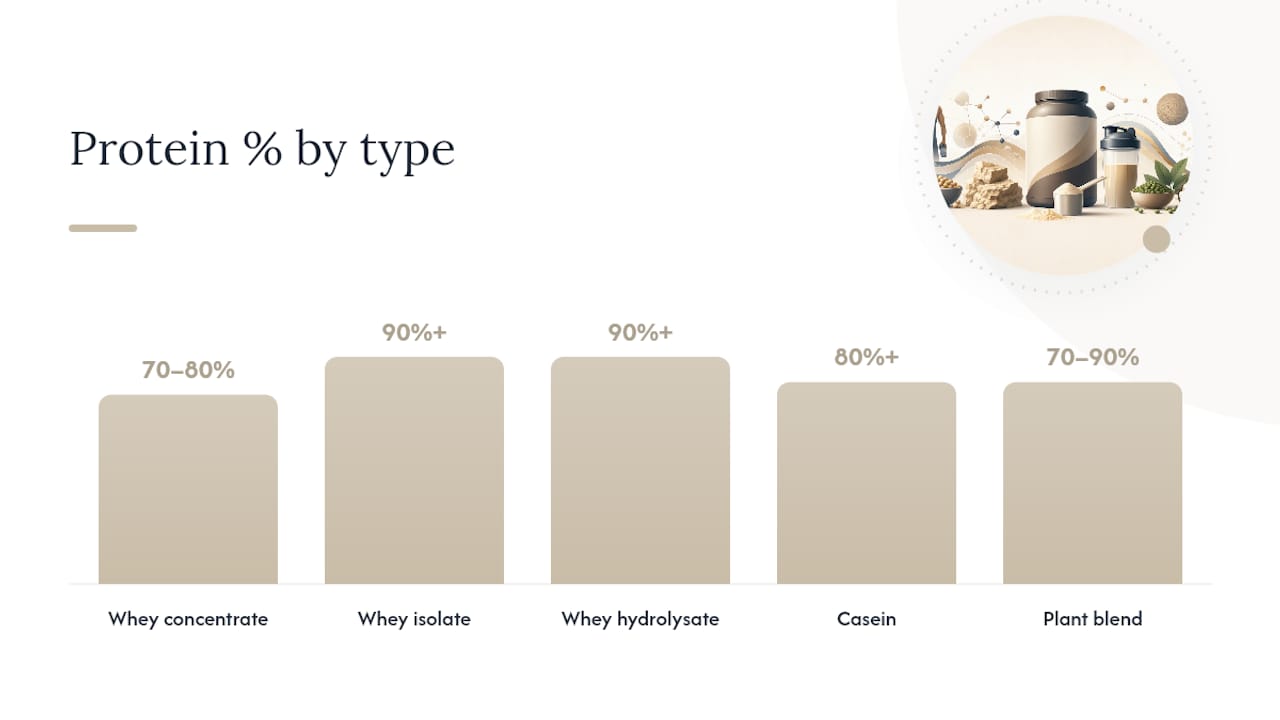
Whey concentrate is the least processed and cheapest form, usually 70 to 80 percent protein by weight, with some lactose and fat still intact. It digests fast, within 90 minutes to two hours, which makes it good for post-workout use. If lactose bothers you even a little, concentrate is often where the trouble starts.
Whey isolate goes through extra filtration to strip out most of the lactose and fat, pushing protein content to 90 percent or higher per scoop. It costs more, but it’s gentler on digestion and a better fit if you’re watching calories closely.
Whey hydrolysate is pre-digested through enzymatic processing, meaning your body absorbs it even faster than isolate. It’s the priciest whey option and mostly overkill unless you have a specific clinical reason (like being immediately post-surgery) to need ultra-fast absorption.
Casein digests slowly, over several hours, because it forms a gel in the stomach. That makes it a poor post-workout choice but a solid pick before bed, when a slow trickle of amino acids overnight supports muscle repair better than a fast-digesting protein that’s cleared your system in an hour.
Plant blends (pea, rice, soy, hemp combinations) vary widely in quality. A single plant source is rarely a complete protein, so the better products combine two or three sources to cover all nine essential amino acids. Precision Nutrition’s guide notes that blended plant proteins can match animal-based options in muscle-building effect when the amino acid profile is actually complete, not just the marketing.
Egg protein sits between whey and casein in digestion speed and offers a naturally complete amino acid profile, but it’s a niche option now, mostly bought by people with dairy allergies who still want an animal-based protein.
Collagen is almost entirely incomplete as a standalone protein but excels at what it’s formulated for, connective tissue and skin support, and mixes into coffee or smoothies without much flavor impact.
Quick reference on what you’re actually paying for:
- Concentrate: 70 to 80% protein, cheapest, some lactose, fastest digestion (mild speed)
- Isolate: 90%+ protein, moderate cost, low lactose, fast digestion
- Hydrolysate: 90%+ protein, highest cost, pre-digested, fastest absorption
- Casein: 80%+ protein, moderate cost, slow digestion (hours)
- Plant blend: 70 to 90% protein depending on formula, moderate cost, moderate digestion speed
- Collagen: near 90% protein by weight but incomplete amino profile, moderate cost
If dairy doesn’t sit well with you, or you’re vegan, a plant blend is the obvious starting point, and it’s worth reading the beginner’s guide to protein powders before you commit to a full-size tub.
How Do You Check Protein Powder Quality and Safety?
Third-party certification is the single most reliable signal you have as a shopper, because it’s the only check that comes from someone other than the company selling you the product. EatingWell’s guide to safe protein powder selection ranks NSF Certified for Sport, USP verification, and Informed Choice as the three marks worth actively seeking out. NSF Certified for Sport matters most for competitive athletes since it screens for banned substances; USP focuses on verifying that what’s on the label is actually in the tub.
Here’s a practical four-step check you can run in under a minute at the store or on a product page:
- Flip to the nutrition panel and find protein per 100 grams, not just per scoop. Scoop sizes vary wildly between brands, and a large scoop with low protein density can look impressive while delivering less actual protein than a smaller, better-formulated one.
- Scan the ingredient list length. A short list with recognizable ingredients beats a long one padded with fillers, gums, and artificial thickeners.
- Look for the words “proprietary blend.” That phrase means the company isn’t disclosing exact amounts of each ingredient, which makes it impossible to know if you’re getting a meaningful dose of anything beyond the primary protein source.
- Search the brand’s site for a Certificate of Analysis (COA) or third-party lab report. Brands confident in their sourcing usually publish these or make them available on request; brands that dodge the question usually have a reason to.
On heavy metals: independent testing has flagged elevated heavy metal levels in some protein powders, particularly plant-based ones that source ingredients from soil-heavy crops like rice and pea. The practical defense isn’t panic, it’s rotation and verification: buy from brands that test and publish results, and don’t rely on a single source or brand indefinitely.
Certification and label transparency aren’t a formality. They’re the difference between a supplement that does what it says and one you’re trusting on faith.
How Much Protein Powder Should You Use Per Serving and Per Day?
Twenty to 30 grams per serving is the number most clinical guidance converges on, and it’s not arbitrary. Research on protein doses per meal shows this range supports muscle protein synthesis effectively without loading on unnecessary calories. Going higher per sitting doesn’t scale linearly. Muscle synthesis per meal plateaus somewhere around 30 to 40 grams, so a 50-gram scoop mostly just adds calories you didn’t need.
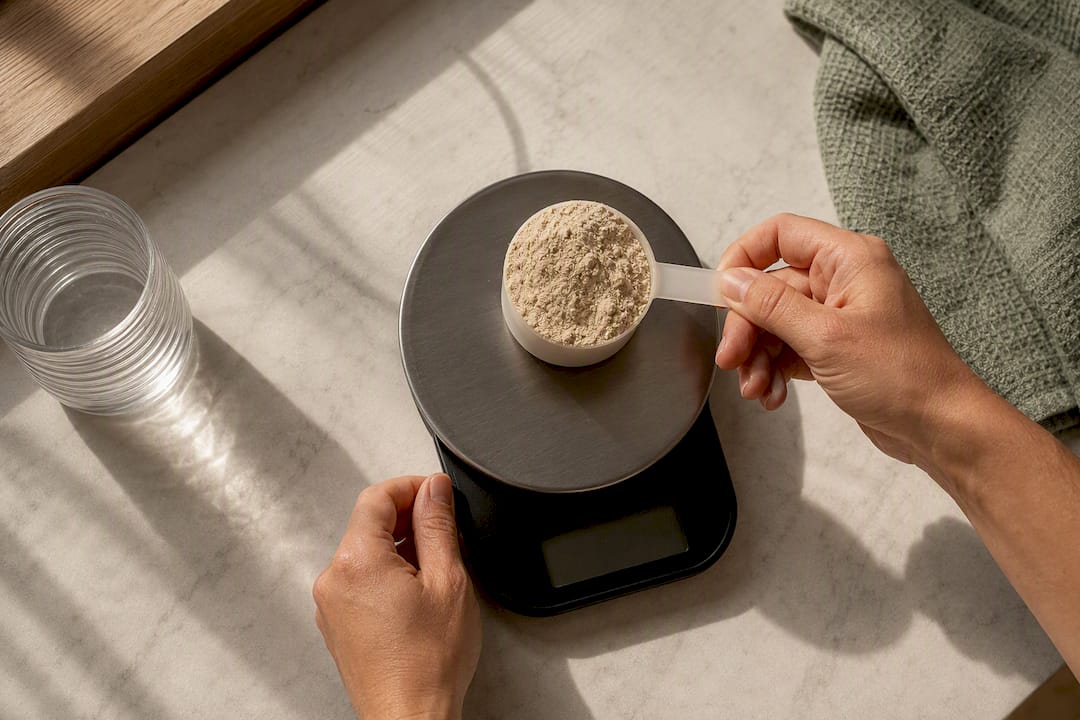
Your daily target depends on body weight and activity level. Active adults generally do well in the 1.2 to 2.0 grams per kilogram of body weight range, and supplements are meant to fill gaps in that total, not replace whole-food protein wholesale.
A couple of quick examples:
- 154 lb (70 kg) person, moderately active: roughly 84 to 140 g protein daily. One 25 g shake covers about a fifth of that; the rest comes from meals.
- 180 lb (82 kg) person training for muscle gain: roughly 98 to 164 g daily, likely needs two protein-rich meals plus one shake to comfortably hit the top of that range.
Timing matters less than total intake, but spreading protein across three or four meals (rather than stacking it all at dinner) tends to work better for muscle maintenance than a single huge dose.
Pro Tip: If you’re using protein powder as a convenience tool rather than a necessity, you don’t need to have a shake every single day. Save it for the days your food intake genuinely falls short, and let whole food carry the rest.
Will This Protein Powder Upset Your Stomach or Taste Terrible?
The powder that works perfectly on paper is useless if you can’t stand drinking it or it wrecks your digestion. This is the part most buying guides skip, and it’s the reason half the tubs in most people’s cabinets go unfinished.
Lactose intolerance is the most common culprit behind post-shake bloating and discomfort. Whey concentrate still contains meaningful lactose; whey isolate strips most of it out during filtration, which is why isolate often sits better even for people who react to regular dairy.
Plant-based allergens need their own label check. Soy and pea protein cross-contact risk is real in shared manufacturing facilities, so read the allergen statement, not just the ingredient list, if you have a diagnosed allergy rather than a general sensitivity.
Sugar alcohols and added fiber are frequent hidden triggers for gas and bloating, especially in “low sugar” or “high fiber” formulas that lean on sorbitol, erythritol, or inulin to hit their marketing numbers. If a new powder gives you GI trouble, check these ingredients before blaming the protein itself.
Practical tolerance testing beats guessing every time:
- Buy a single-serve packet or sample size before committing to a large tub.
- Track how you feel across three separate uses, not just one, since a single bad reaction can be unrelated.
- Try an unflavored version first if you suspect the flavor system (not the protein) is the problem.
- Mix at lower concentration initially (half a scoop) if you’re introducing a new protein type to your gut.
Flavor and mixability aren’t vanity concerns. A powder that clumps, tastes chalky, or leaves a bad aftertaste gets used once and abandoned, no matter how clean the ingredient list is. If digestion is a recurring issue, our breakdown on why protein powders sometimes cause discomfort covers the mechanisms in more depth.
How Do You Shop for Protein Powder Without Wasting Money?
Cost per usable gram of protein, not price per tub, is the number that actually tells you whether you’re getting a deal. A $30 tub with 24 servings at 25 grams of protein each costs about $0.05 per gram. A $20 tub with 15 servings at 18 grams each costs roughly $0.074 per gram, meaning it’s actually the more expensive option despite the lower sticker price.
Before committing to a full-size tub:
- Buy a trial size or single-serve packets first. Most brands sell sample packs specifically so you’re not stuck with 2 pounds of a powder you dislike.
- Test simple mixes before getting creative. Water for a leaner shake, milk for more calories and a creamier texture, and a handful of frozen fruit if you want flavor without added sugar packets.
- Add carbs and fats deliberately, not by accident. A post-workout shake benefits from some fast carbs; a meal-replacement shake benefits from healthy fat like nut butter or avocado to extend satiety.
- Check the return policy before you buy in bulk. Reputable sellers allow returns or exchanges on unopened trial sizes, and a company that stonewalls simple ingredient questions from customer service is a red flag worth noting before your next order.
Our guide on using protein powder for practical nutrition results has more recipe combinations if you’re bored of the standard water-and-scoop routine.
What Does the Research Actually Show About Protein Supplements?
Total daily protein intake matters more than which specific powder you buy, and that finding shows up consistently across the clinical literature. Where the source comes from matters less than most marketing suggests.
That said, some sources do show up favorably in head-to-head comparisons. A 2026 network meta-analysis covering 78 studies and 4,755 participants found that collagen and whey were the only supplement types showing statistically significant benefits for strength and fat-free mass compared to placebo, when paired with resistance training. Collagen actually showed the largest effect size in that particular analysis, with a standardized mean difference around 0.94 for fat-free mass, though researchers noted real heterogeneity across the individual trials, meaning results varied enough between studies that no single number tells the whole story.
A few things worth keeping in mind about that kind of evidence:
- Effect sizes from meta-analyses describe average trends across many trials, not a guarantee for any one person.
- Whey’s effect in that same analysis was smaller than collagen’s but still statistically meaningful, and whey remains the most extensively studied protein supplement overall.
- None of this evidence replaces resistance training. Protein supports the process; it doesn’t create the result on its own.
- Safety data reinforces why third-party testing matters: supplements aren’t regulated with the same premarket scrutiny as drugs, so quality control depends heavily on the manufacturer choosing to test.
The research supports a confident but modest claim: protein type affects outcomes at the margins, total intake and training consistency drive the majority of results.
Who Wrote This Guide and How Does Nutribliss Handle Product Transparency?
GAURAV has spent years covering supplement formulation and consumer nutrition for Nutribliss, focusing on how ingredient sourcing and label claims actually translate into real-world results. His prior breakdowns on protein powder types and what protein powder is actually good for dig deeper into individual use cases than this overview can.
Nutribliss product pages list ingredient sourcing and serving-size breakdowns directly on each listing, so you can check protein-per-scoop and calorie counts before adding anything to your cart, without digging through a separate spec sheet.
GAURAV’s three-point checklist for first-time buyers:
- Confirm the protein type matches your specific goal before checking anything else.
- Verify third-party testing or ask the brand directly for a Certificate of Analysis if it isn’t posted.
- Buy a trial size first, always, no matter how good the label reads.
The Case Against One-Size-Fits-All Protein Advice
Most protein powder content online is built to crown a single winner, and that framing does readers a disservice. The evidence doesn’t support one universal best option. It supports a decision tree: figure out your goal and your digestive tolerance first, then let those two factors narrow the field.
The biggest gap between conventional advice and reality is how little attention goes to adherence. A perfectly formulated powder that tastes bad or upsets your stomach gets used twice and shelved, and the research on protein and muscle only works if you actually consume it consistently. Buying decisions built purely around macros while ignoring flavor, mixability, and digestive comfort set people up to waste money.
If there’s one thing the evidence and the shopping economics agree on, it’s this: prioritize third-party testing and a goal-matched protein type first, then treat everything else, flavor, brand reputation, marketing claims, as secondary. Buy small before you buy big. The tub sitting half-used in a cabinet somewhere is proof of what happens when people skip that step.
— GAURAV
Start With a Trial Size From the Nutribliss Store
Nutribliss carries protein powders alongside electrolytes, recovery formulas, and everyday wellness supplements, all with ingredient sourcing and serving details listed directly on the product page, so you’re not guessing about what’s actually in the tub.

If you’re still deciding between a whey isolate and a plant blend, start small. Order a single-serve size or the smallest available tub rather than committing to a bulk purchase on your first try, and pair it with an electrolyte supplement if recovery and hydration are part of your goal, not just muscle repair. If a formula doesn’t agree with your stomach after a few uses, reach out to customer support about ingredients or a return before assuming every powder will cause the same reaction. Browse the full lineup at Nutribliss and pick the one that actually matches what you’re training for.
Sources
The clinical dosing guidance above draws on protein dosing research and Johns Hopkins Medicine’s suggested supplement benchmarks. Comparative effectiveness comes from a 2026 network meta-analysis, while Harvard Health and EatingWell inform the type-selection and safety guidance. Consult a doctor or dietitian for decisions specific to your health history.
This article is general information, not a substitute for advice from a qualified doctor. Consult a qualified healthcare professional about your own circumstances before acting on anything here.
- Protein and muscle: Clinical guidance on protein doses per meal
- Weighing protein powders - Harvard Health
- Suggested protein supplements - Johns Hopkins Medicine (PDF)
- How to choose a safe protein powder - EatingWell
FAQ
What Is the Best Recommended Protein Powder?
There’s no single best powder for everyone. The best choice is a third-party tested product whose protein type matches your goal, whey isolate for most muscle-building purposes, a certified plant blend if you’re dairy-free.
How Do I Choose My First Protein Powder?
Start by identifying your primary goal (muscle, weight loss, or general nutrition support), then pick a complete protein type you tolerate well, and buy a trial size before committing to a full tub.
What Is the Healthiest Form of Powdered Protein?
“Healthiest” depends on your dietary needs, but a minimally processed whey isolate or a multi-source plant blend with third-party certification and a short ingredient list is generally the safest bet for most people.
What Should I Look for on a Protein Powder Label?
Check protein grams per serving (aim for 20 to 30 g), calories, added sugar (under 5 g is ideal), and whether the ingredient list avoids vague “proprietary blend” language.
Is Nutribliss a Good Option for Choosing a Protein Powder?
Nutribliss lists ingredient sourcing and serving details directly on each product page, making it a reasonable starting point if you want to compare protein type and macros before buying, especially with a trial-size purchase.