

TL;DR:
- Most people supplementing with Vitamin D3 overlook the necessity of Vitamin K2 to properly direct calcium absorption. D3 increases calcium uptake by up to 40%, but without K2, excess calcium may deposit in arteries, raising health risks. Combining D3 with MK-7 form of K2 and taking them with fatty meals optimizes bone, cardiovascular, and immune health effectively.
Most people taking Vitamin D3 are only getting half the picture. If you’ve been supplementing with D3 and feel good about it, here’s something worth knowing: D3 significantly increases calcium absorption by up to 40%, but without Vitamin K2, that extra calcium has nowhere safe to go. Understanding what is D3 K2, how the two vitamins work together, and why separating them can backfire is exactly what this article covers. You’ll walk away knowing the right forms, practical dosing, and the real health benefits this pairing delivers.
Table of Contents
- Key takeaways
- What D3 K2 actually does in your body
- Forms and dosing: what actually works
- Benefits beyond bone health
- Safety, interactions, and precautions
- My take after years of watching this play out
- Try Nutribliss D3 K2 for real results
- FAQ
Key takeaways
| Point | Details |
|---|---|
| D3 and K2 are a team | D3 boosts calcium absorption; K2 directs that calcium to bones, not arteries. |
| K2 form matters | MK-7 stays active for about 72 hours, making it far more practical than MK-4 for daily use. |
| Dosing must match | Taking more than 5,000 IU of D3 daily requires 100–200 mcg of K2 MK-7 to keep calcium on track. |
| Absorption needs fat | Both vitamins are fat-soluble; take them with a meal containing healthy fat for best results. |
| Safety is personal | Kidney disease, blood thinners, and existing labs should shape your supplementation plan. |
What D3 K2 actually does in your body
Vitamin D3 and Vitamin K2 look like they belong in separate conversations. D3 is the sunshine vitamin tied to mood, immunity, and bone density. K2 is a largely overlooked fat-soluble nutrient found in fermented foods and certain animal products. But these two vitamins share a critical job: managing calcium in your body.
Here is where it gets specific. Vitamin D3 tells your digestive system to absorb more calcium from the food you eat. That sounds like a win. The problem is that D3 does not tell calcium where to go once it’s in your bloodstream. Enter K2. Its job is to activate two proteins that act as calcium traffic directors.
The first is osteocalcin, a protein produced in bone tissue that pulls calcium into bones and teeth. The second is Matrix GLA protein (MGP), which prevents calcium from depositing in your arteries and soft tissue. Without K2, both proteins are produced but stay inactive. Think of them as locked doors. K2 is the key.
Here is the part most supplement users miss: D3 actually increases production of these K2-dependent proteins. So the more D3 you take, the more you need K2 to activate what D3 is creating. Taking D3 alone does not just leave K2’s job undone. It potentially makes the calcium problem worse.
Key mechanisms at work when D3 and K2 are combined:
- D3 increases calcium absorption from the gut by up to 40%
- K2 activates osteocalcin to bind calcium into bone matrix
- K2 activates MGP to clear calcium from arterial walls
- The two vitamins work on the same calcium but at different stages
- Without K2, increased calcium from D3 has no guidance system
Pro Tip: If you are already taking a D3 supplement and it does not include K2, check the label carefully. A supplement that lists only “cholecalciferol” without any form of K2 means you are running D3 without the calcium director it needs.
Forms and dosing: what actually works
Not all K2 is created equal, and the difference between MK-4 and MK-7 is significant enough to change your entire supplementation strategy.
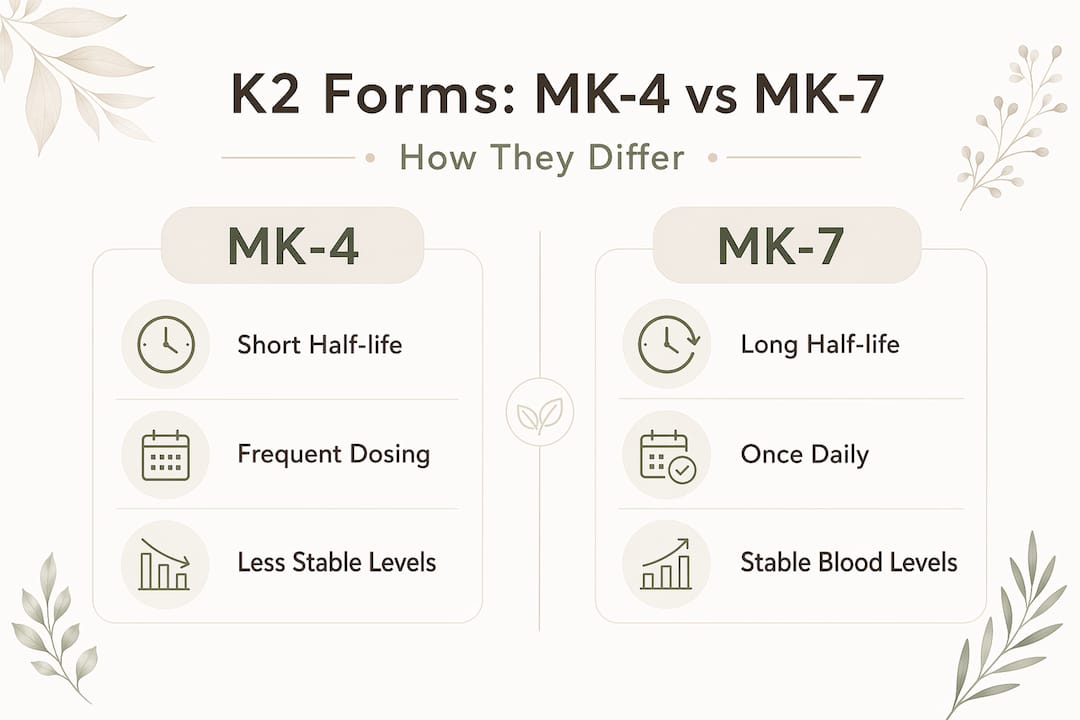
MK-7 vs. MK-4: a direct comparison
| Feature | MK-7 | MK-4 |
|---|---|---|
| Half-life | ~72 hours | ~6 hours |
| Dosing frequency | Once daily | Multiple times per day |
| Source | Fermented foods (natto) | Animal sources, synthetic |
| Clinical preference | High | Moderate |
| Bioavailability | Superior for sustained effect | Faster but short-lived |
MK-7’s half-life of approximately 72 hours means a single daily dose keeps blood levels stable around the clock. MK-4 clears your system in about six hours, which means you would need to dose three or more times per day to maintain consistent coverage. For most people, MK-7 is the practical and clinically preferred choice.

Now for D3 dosing. Most adults who are not deficient maintain adequate levels on 1,000 to 2,000 IU daily. Those with confirmed deficiency often need 2,000 to 5,000 IU under clinical guidance. For anyone taking more than 5,000 IU daily, pairing with 100 to 200 mcg of K2 as MK-7 is strongly recommended to keep calcium properly directed to bones rather than soft tissue.
One more thing most people overlook: both D3 and K2 are fat-soluble. That means your body absorbs them much more effectively when you take them with food that contains fat. Taking them with fat improves absorption by 30 to 50% compared to taking them on an empty stomach or with a fat-free meal. A handful of nuts, avocado, eggs, or olive oil with your supplement is enough to make a real difference.
You should also get your 25(OH)D blood levels tested before starting high-dose D3. This tells you your actual starting point and prevents you from overshooting into toxicity territory, which is a genuine risk at doses above 10,000 IU without monitoring.
Pro Tip: Take your D3 K2 supplement with your biggest meal of the day, which is usually the one most likely to contain fat. Pairing it with breakfast including eggs or with dinner containing olive oil makes absorption consistent without any extra effort.
Benefits beyond bone health
Most conversations about D3 K2 start and stop at bones. The reality is broader and, honestly, more compelling.
“High dietary intake of Vitamin K2 (primarily MK-7) was associated with a 50% reduction in arterial calcification and cardiovascular mortality over a 7 to 10 year period.”
That number deserves attention. Arterial calcification, where calcium deposits harden in blood vessel walls, is a major driver of cardiovascular disease. K2’s ability to activate MGP and clear those deposits is not a minor side benefit. It is one of the strongest documented reasons to pair these two vitamins together.
Here is a broader look at what the D3 and K2 combination supports:
- Bone density and structure: Osteocalcin activated by K2 helps calcium bind firmly into bone, reducing fracture risk and supporting density as you age.
- Cardiovascular protection: MGP activated by K2 prevents arterial stiffness caused by calcium buildup. Learn more about how calcium affects wellness and bone health.
- Immune function: D3 plays a direct role in modulating immune responses, helping your body react appropriately to threats without overreacting.
- Muscle function: Adequate D3 supports muscle contraction and reduces the risk of falls in older adults.
- Dental health: The same osteocalcin that strengthens bones also supports the mineralization of tooth enamel and dentin.
High-dose D3 without K2 can actually increase calcium buildup in arteries, contributing directly to vascular stiffness. This is what researchers call the “calcium paradox.” You take a supplement expecting health improvements and inadvertently create a condition that raises cardiovascular risk. The solution is not to stop D3. It is to pair it correctly with K2.
Safety, interactions, and precautions
Taking D3 and K2 is safe for most healthy adults. But “most” is doing real work in that sentence. There are specific situations where supplementing with these vitamins requires careful professional oversight.
-
If you take blood thinners. Vitamin K2 interacts with anticoagulant medications like warfarin. K2 can reduce the effectiveness of warfarin, which affects blood clotting. If you are on any anticoagulant, you should not adjust your K2 intake without your prescribing doctor’s involvement.
-
If you have kidney disease. The kidneys play a central role in converting D3 into its active hormonal form. Impaired kidney function can cause D3 to behave unpredictably, increasing the risk of hypercalcemia (too much calcium in the blood). Kidney disease and D3 supplementation require a nephrologist’s guidance.
-
If you have a calcium metabolism disorder. Conditions like sarcoidosis or hyperparathyroidism can amplify the calcium-raising effects of D3, making unsupervised supplementation risky.
-
Before starting high-dose D3. Get a 25(OH)D blood test first. This is not optional advice. It is the only way to know whether you are actually deficient, and it protects you from dosing into toxicity. Personalization matters more than any generic dosing chart.
-
If you are pregnant or breastfeeding. Both D3 and K2 needs shift during pregnancy. Standard supplementation guidance does not automatically apply. Work with your OB or midwife on appropriate levels.
For resources on how D3 and K2 fit into a broader supplement plan, the guide to combining supplements safely is worth reviewing before you stack multiple products together.
Pro Tip: Even if you feel healthy and symptom-free, high-dose D3 supplementation without a blood test is guesswork. A simple 25(OH)D test costs very little at most labs and gives you data that shapes every dosing decision you make going forward.
My take after years of watching this play out
By Gaurav
I’ve seen the same mistake repeated constantly: someone learns that Vitamin D3 is good for immunity, bones, and energy, so they start taking 5,000 IU or more daily. They feel fine for a while. They assume more is better. What they are not thinking about is what is happening to the calcium their body is now absorbing at a higher rate.
In my experience, the biggest gap in supplement education is not information about D3 or K2 individually. It is the failure to explain that D3 creates a demand for K2 to function properly. One without the other is not neutral. It can genuinely work against you.
What I have also found is that testing changes everything. People who get their 25(OH)D levels checked before supplementing consistently make better decisions than those who guess. And those who work with a clinician to monitor their levels over time do better still.
My practical advice: get tested, start with a quality MK-7 combined formula, take it with food containing fat, and revisit your levels every six months. Do not fall for the idea that a higher D3 dose is always more protective. Without adequate K2, it may be creating a problem while solving another one.
— Gaurav
Try Nutribliss D3 K2 for real results
If you’ve been taking D3 without K2, or you are ready to start a combination that is actually formulated to work together, Nutribliss has a solution worth your attention. The Nutribliss Vitamin K2 + D3 Supplement uses the MK-7 form of K2 for sustained daily coverage, paired with D3 at a dose that supports bone density, cardiovascular health, and immune function. It also includes BioPerine to further support absorption.

For those who want to understand the science behind the formulation, the Nutribliss science collection breaks down how each ingredient is selected and why it matters. Whether you are new to D3 K2 or refining a supplement stack you have been building for years, Nutribliss brings the research-backed specificity that guesswork cannot. Follow #nutribliss for ongoing wellness content, product updates, and tips from the team.
FAQ
What is D3 K2 used for?
D3 K2 is used to support bone density, cardiovascular health, and immune function. D3 increases calcium absorption while K2 directs that calcium into bones and away from arteries.
Why take K2 with Vitamin D?
K2 activates proteins that D3 cannot activate on its own. Without K2, the extra calcium absorbed due to D3 supplementation can deposit in arteries instead of bones, raising cardiovascular risk.
What is the best form of K2 to take with D3?
MK-7 is the preferred form because its 72-hour half-life supports stable blood levels with a single daily dose, unlike MK-4 which clears the body in roughly six hours.
How much K2 should I take with D3?
For those taking over 5,000 IU of D3 daily, clinical guidance recommends 100 to 200 mcg of K2 as MK-7. Lower D3 doses generally pair well with 90 to 100 mcg of K2 MK-7.
Can I take D3 and K2 without a doctor’s advice?
Healthy adults can safely take standard doses, but anyone on blood thinners, with kidney disease, or considering high-dose D3 should consult a healthcare provider. A 25(OH)D blood test before starting is always a smart first step.