

TL;DR:
- Creatine is a safe, naturally occurring supplement that enhances high-intensity performance and muscle gains.
- It increases phosphocreatine stores in muscles, supporting rapid energy regeneration during explosive efforts.
- Myths linking creatine to kidney damage, dehydration, or fat gain are false; it is well-supported by scientific research.
Creatine gets a bad reputation it simply does not deserve. Many athletes still picture it as a steroid-adjacent shortcut or a supplement that wrecks your kidneys, when the reality is almost the opposite. Creatine is one of the most studied, safest, and most effective ergogenic aids in sports science, with decades of peer-reviewed research backing it up. Whether you sprint, lift, play team sports, or just want to recover faster, this guide breaks down exactly what creatine is, how it works, what the science proves, how to use it correctly, and which myths you can finally stop believing.
Table of Contents
- What creatine is and how it works in your body
- Main benefits of creatine for athletes and fitness enthusiasts
- Safe and effective ways to take creatine
- Myths and safety: What creatine does not do
- Expert perspective: Why creatine stands apart from other supplements
- How to take the next step with creatine supplementation
- Frequently asked questions
Key Takeaways
| Point | Details |
|---|---|
| Creatine is naturally made | Your body produces creatine from amino acids and stores most of it in your muscles. |
| Boosts power and recovery | Supplementing creatine increases strength, muscle gains, and speeds up recovery for most athletes. |
| Safe and well-researched | Long-term studies show creatine monohydrate is safe for healthy people at recommended doses. |
| No cycling or timing stress | You don’t need to cycle creatine or obsess over timing—it works best with daily, consistent use. |
| Not just for bodybuilders | Any athlete or fitness enthusiast doing high-intensity exercise can benefit from creatine. |
What creatine is and how it works in your body
Creatine is not a synthetic drug. It is a naturally occurring compound, technically methylguanidine-acetic acid, that your body produces from three amino acids: arginine, glycine, and methionine. Your liver, kidneys, and pancreas all contribute to this synthesis, producing roughly 1 to 2 grams per day. You also get creatine from food, primarily red meat and fish, though cooking destroys a portion of it.
Once produced or consumed, creatine travels through the bloodstream to muscle tissue, where it is converted into phosphocreatine and stored. This is where things get interesting for athletes. Creatine is synthesized from amino acids and stored primarily in muscle as phosphocreatine, and that storage is what makes it so valuable for performance.
“Up to 95% of your body’s creatine is stored in muscle as phosphocreatine, acting as a rapid energy buffer for high-intensity efforts.”
Your muscles run on ATP (adenosine triphosphate), but they can only hold a few seconds’ worth at any given moment. During a heavy squat, a sprint, or an explosive jump, your body burns through available ATP almost instantly. That is where the ATP-PC system kicks in:
- Phosphocreatine donates a phosphate group to ADP (adenosine diphosphate)
- This rapidly regenerates ATP within the muscle cell
- The process happens without oxygen, making it critical for maximal efforts lasting 1 to 10 seconds
- Once phosphocreatine stores deplete, intensity must drop
- Supplementing creatine increases the total phosphocreatine pool, extending this high-power window
Think of phosphocreatine as a backup battery that recharges your primary battery (ATP) between explosive efforts. The bigger that backup battery, the more work you can do before fatigue sets in. Supplementing creatine expands that battery capacity beyond what diet alone typically provides, especially for vegetarians and vegans who get almost no dietary creatine.
Main benefits of creatine for athletes and fitness enthusiasts
The science on creatine is not thin or preliminary. It is built on hundreds of controlled studies across decades. Creatine supports high-intensity performance, muscle and strength gains, and reduces fatigue, making it one of the few supplements with a genuinely broad evidence base.
| Benefit | Magnitude | Evidence level | Best population |
|---|---|---|---|
| Strength and power output | 5 to 15% increase | Very strong | Resistance athletes |
| Lean muscle mass | 1 to 3 kg over weeks | Strong | All active adults |
| Sprint and repeat effort | Meaningful improvement | Strong | Team sport athletes |
| Recovery and reduced DOMS | Moderate reduction | Moderate to strong | All athletes |
| Cognitive performance | Modest benefit | Emerging | Older adults, sleep-deprived |
What does this look like in real training?
- You squeeze out 2 to 3 extra reps on your final set of bench press
- Your sprint times improve because you recover faster between efforts
- Muscle soreness after leg day is noticeably less severe
- You maintain power output later into a game or training session
- Recovery between sessions shortens, letting you train more frequently
Pro Tip: Creatine delivers its biggest performance gains when paired with consistent resistance or strength training. It amplifies the training stimulus, not just the supplement itself.
Creatine also supports lean body mass gains by drawing water into muscle cells, which increases cell volume and signals anabolic pathways. This is not fat gain. It is functional muscle hydration. If you want to understand how creatine stacks alongside other recovery tools, sports supplement benefits are worth exploring in detail. For athletes focused on overnight repair, pairing creatine with a slow-digesting protein like casein for muscle recovery creates a powerful combination for tissue repair.

Safe and effective ways to take creatine
Knowing creatine works is only half the equation. Using it correctly determines how fast you see results and whether you avoid the minor side effects some people report.
| Protocol | Loading phase | Daily maintenance | Time to full saturation |
|---|---|---|---|
| Loading approach | 20g/day split into 4 doses for 5 to 7 days | 3 to 5g/day | 5 to 7 days |
| Standard approach | None | 3 to 5g/day | 3 to 4 weeks |
| Pros | Fast saturation | Simpler, less GI discomfort | Varies |
| Cons | Possible bloating early | Slower to peak levels | Varies |
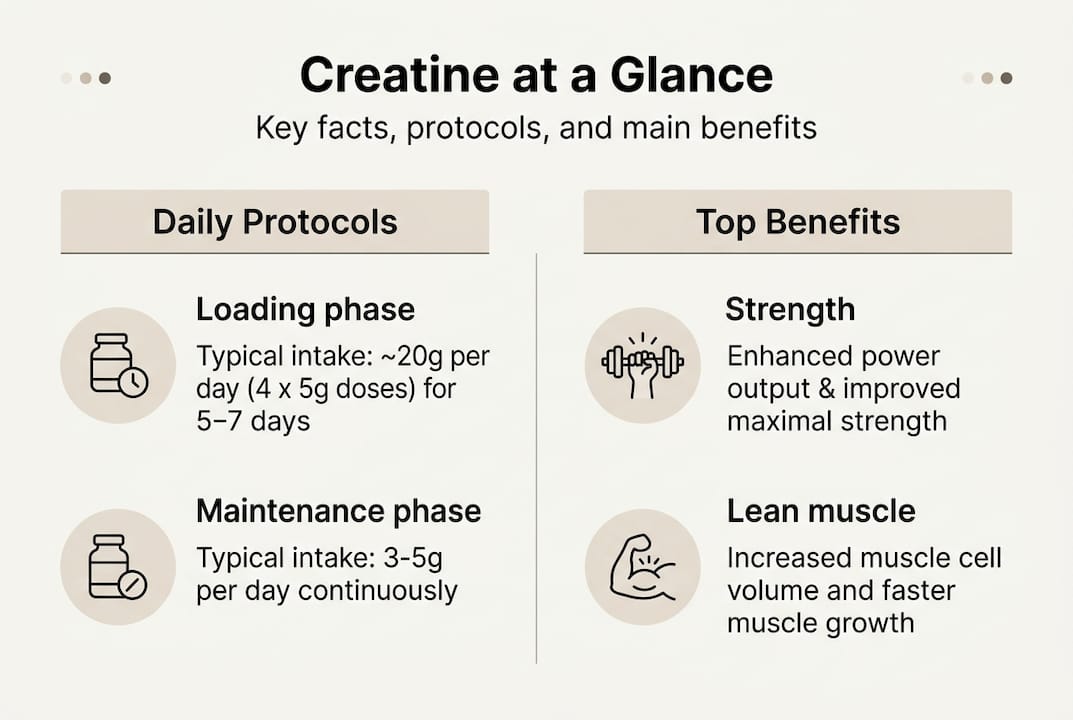
Both protocols reach the same end point. Loading just gets you there faster. Standard loading and maintenance dosing are well established with creatine monohydrate, and the ISSN confirms both are safe and effective.
Here is a simple step-by-step guide to start:
- Choose creatine monohydrate. It is the most researched form and no other version has proven superior in controlled trials.
- Decide on loading or standard dosing based on your timeline and tolerance.
- Mix your dose in water, juice, or a protein shake. It dissolves well in warm liquid.
- Take it consistently every day, including rest days.
- Stay well hydrated throughout, since creatine draws water into muscle tissue.
- Evaluate results after 4 to 6 weeks of consistent use.
Pro Tip: Timing matters less than consistency. Taking creatine post-workout with carbohydrates and protein slightly improves uptake, but missing the perfect window will not hurt your results. Just take it daily.
Vegans and vegetarians typically have lower baseline creatine stores and often respond more dramatically to supplementation. Older adults also benefit significantly, since natural creatine synthesis declines with age. Some people are labeled “non-responders,” but this is often due to already-high muscle creatine levels from a meat-rich diet. For detailed creatine monohydrate protocols, you can explore specific product options built around these evidence-based guidelines.
Myths and safety: What creatine does not do
This is where the conversation gets important. Persistent myths keep many athletes from using a supplement that could genuinely help them. Let’s address the most common ones directly.
Common creatine myths, debunked:
- It damages your kidneys. False. No kidney damage has been found in healthy individuals, even with long-term use at standard doses.
- It causes dehydration and cramping. False. Studies show creatine actually improves cellular hydration.
- It is a steroid. False. Creatine has no hormonal activity. It is a naturally occurring compound found in food.
- It is only for men. False. Women respond equally well and benefit from the same performance and recovery effects.
- It makes you fat. False. Any initial weight gain is intramuscular water, not body fat.
“Up to 30 grams daily for five years shows no adverse effects in healthy individuals.”
Multiple studies confirm no kidney damage, dehydration, or harmful water retention, even with long-term use in healthy adults. Creatinine levels in blood tests may rise slightly with creatine use, which can look alarming on paper, but this is a metabolic byproduct of creatine breakdown, not a sign of kidney stress.
That said, caution is appropriate in specific cases. If you have pre-existing kidney disease, creatine supplementation should only happen under medical supervision. Pregnant individuals should also consult a healthcare provider first, since safety data for that population is insufficient. For a broader look at sports nutrition misconceptions or to challenge other supplement misconceptions, these resources offer useful context.
Expert perspective: Why creatine stands apart from other supplements
After years of watching athletes chase the newest, most marketed supplement, the pattern becomes clear: most products promise a lot and deliver little. Creatine is the rare exception, and yet it remains one of the most avoided supplements among recreational athletes.
The ISSN has consistently cited creatine as the most effective legal ergogenic aid available. That is not a casual endorsement. It reflects decades of replicated research across diverse populations, sports, and conditions. And still, the myths persist.
Why? Because creatine is cheap, simple, and unglamorous. It does not come with a dramatic marketing story. The supplement industry profits more from selling novelty, so “advanced” creatine forms with premium price tags keep appearing despite no evidence of superiority over plain monohydrate.
The real lesson is this: most athletes underuse or completely avoid creatine because of fears rooted in misinformation from the 1990s. Meanwhile, they spend more money on trendy products with far less evidence. Understanding muscle protein synthesis basics helps put creatine’s role in context. It is not a magic pill. It is a reliable, well-understood tool that makes your training more productive and your recovery faster. That combination is genuinely rare.
How to take the next step with creatine supplementation
You now have the science, the protocols, and the myth-busting clarity to make a confident decision about creatine. The next step is finding a product you can actually trust.

At NutriBliss, we stock science-backed supplements with transparent labeling and no unnecessary fillers. Our creatine monohydrate is formulated to meet the dosing standards supported by current research, so you get exactly what the evidence recommends. Whether you are just starting out or optimizing an existing routine, our team and product resources are here to support your goals. Browse our full supplement range, read more performance guides, or reach out directly for personalized guidance.
Frequently asked questions
Is creatine safe for long-term use?
In healthy adults, creatine is safe for long-term use with no evidence of kidney or other organ damage, even with years of consistent supplementation.
Do you need to cycle off creatine?
No. Cycling is not necessary and continuous daily use is actually more effective at maintaining full muscle saturation than on-and-off approaches.
Will creatine cause water retention or make me look bloated?
Creatine increases muscle hydration, which is a performance benefit, but does not cause harmful water retention or bloating when used at recommended doses.
Is creatine only useful if you lift weights?
Not at all. Creatine improves repeated high-intensity efforts across sprinting, team sports, combat sports, and more, making it valuable far beyond the weight room.
Who should avoid or use caution with creatine?
If you have kidney disease or are pregnant, consult a healthcare provider before using creatine, since safety data for those specific populations remains limited.