

TL;DR:
- Check the Supplement Facts panel for EPA and DHA milligrams per serving, and verify third-party testing seals before buying. Most products contain fewer active omega-3s than their total capsule weight suggests, and oxidation risks mean freshness checks are essential. The best supplements are transparent about content, certified for purity, and suited to your specific dietary and health goals.
The short answer: check the Supplement Facts panel for actual milligrams of EPA and DHA per serving, confirm a third-party testing seal (IFOS, USP, or NSF), and verify the expiration date before you buy. Everything else is secondary.
The FDA recommends healthy adults stay under the recommended maximum daily limits for combined EPA and DHA, and to limit the amount coming from supplements. That ceiling matters because front-label claims like “1,000 mg fish oil” tell you almost nothing about actual active content.
Before you read another word, run through this:
- EPA + DHA mg per serving listed on the Supplement Facts panel (not the capsule weight)
- A third-party seal from IFOS, USP, or NSF on the label or product page
- Expiration date and storage instructions visible and current
- Form listed as triglyceride (TG), re-esterified triglyceride (rTG), or phospholipid (PL) when possible
Statistic to know: The FDA’s safety ceiling is 3,000 mg/day total EPA+DHA for healthy adults, with no more than 2,000 mg/day coming from supplements.
Table of Contents
- What should you check on the label before buying?
- What are EPA, DHA, and ALA, and which ones matter?
- Which supplement source is right for your diet and priorities?
- Does the molecular form of omega-3 affect how well it absorbs?
- How much EPA and DHA do you actually need?
- How do you verify that a supplement is actually what it claims?
- What safety risks and storage habits should you know about?
- Which type of omega-3 supplement fits your specific goal?
- Key Takeaways
- The mistake most buyers make — and how to fix it
- Nutribliss makes the checklist easy to act on
- Useful sources for further reading
What should you check on the label before buying?
This is the fastest way to filter out weak products before you spend a dollar.
- Find EPA mg and DHA mg separately on the Supplement Facts panel. A typical 1,000 mg fish oil softgel often contains only ~180 mg EPA and ~120 mg DHA — the front label is not the active dose.
- Check the serving size. Some products list EPA+DHA per two or three softgels, not one. The per-serving total is what matters for your daily target.
- Look for a third-party seal. IFOS, USP, and NSF each independently verify purity, potency, and oxidation levels. A seal on the label means a lab confirmed what’s inside.
- Identify the molecular form. Labels that say “triglyceride,” “rTG,” or “phospholipid” signal better absorption than “ethyl ester” (more on this below).
- Check expiration and storage. Liquid fish oils and softgels degrade faster than the label implies if stored warm or in light.
Pro Tip: If you’re buying online and can’t smell the product, search the brand name plus “COA” or “certificate of analysis.” Reputable companies post batch-specific COAs showing peroxide values and contaminant results. If a seller can’t produce one on request, move on.
What are EPA, DHA, and ALA, and which ones matter?
Not all omega-3s work the same way in your body, and the difference is worth understanding before you shop.
EPA (eicosapentaenoic acid) is a long-chain omega-3 with well-studied roles in cardiovascular health and inflammation. DHA (docosahexaenoic acid) is the structural fat your brain and retina depend on, and it’s the primary omega-3 prioritized during pregnancy and early development. These two are the bioactive forms that most clinical research targets.
ALA (alpha-linolenic acid) is a plant-based omega-3 found in flaxseed, chia, and walnuts. Your body can convert ALA to EPA and DHA, but the conversion rate is limited — typically in the single digits as a percentage. That means an ALA-only supplement (flaxseed oil capsules, for example) won’t meaningfully raise your blood EPA or DHA levels. ALA supplements are fine as a general dietary addition, but they’re not a substitute for EPA and DHA when those are your goal.
- EPA and DHA: Found in fatty fish (salmon, mackerel, sardines), fish oil, krill oil, and algal oil
- ALA: Found in flaxseed oil, chia seeds, hemp seeds, and walnuts
- Bottom line: For any clinical or therapeutic purpose, look for EPA+DHA, not just “omega-3s”
Which supplement source is right for your diet and priorities?
Fish oil
Fish oil is the most widely available and affordable source of EPA and DHA. It’s derived from small, oily fish like anchovies, sardines, and mackerel. Concentration varies by product, so reading the Supplement Facts panel is non-negotiable. Sustainability varies too: look for products that disclose their fishery source and carry certifications from the Marine Stewardship Council (MSC) or Friend of the Sea.

One important distinction: cod liver oil is not the same as standard fish oil. It provides EPA and DHA, but also contains vitamins A and D. At high doses, those fat-soluble vitamins can reach toxic levels, so you can’t dose cod liver oil the same way you’d dose a standard fish oil supplement.
Krill oil
Krill oil delivers EPA and DHA in phospholipid form, which some research suggests may improve absorption compared to ethyl ester fish oil. The tradeoff is cost: krill oil typically runs significantly more expensive per gram of EPA+DHA than fish oil. For a deeper look at krill oil’s phospholipid advantages, the evidence is real but the premium isn’t always necessary.
Algal oil
Algal oil is the only plant-derived source that provides preformed DHA and, in some products, EPA. Small studies show its DHA bioavailability is comparable to cooked salmon, which makes it the go-to for vegans, vegetarians, and pregnant people who want to avoid fish-derived products. It’s also the most sustainable option by a wide margin.
Plant ALA oils
Flaxseed, chia, and hemp oils provide ALA. They’re useful for general dietary variety but won’t substitute for EPA and DHA when those are the target. If you’re fully plant-based and need meaningful long-chain omega-3 levels, algal oil is the answer.
Pro Tip: When comparing fish oil products for sustainability, check whether the label or product page names the fishery or carries an MSC certification. Vague sourcing language like “deep sea fish” is a yellow flag.
Does the molecular form of omega-3 affect how well it absorbs?
Yes, and it’s one of the more overlooked label details.
- Ethyl ester (EE): The most common form in concentrated fish oil. Produced by processing natural triglycerides with ethanol. Lower bioavailability than TG forms, particularly when taken without a fat-containing meal.
- Natural triglyceride (TG): The form found in whole fish. Generally well-absorbed and doesn’t require the same dietary fat co-ingestion as EE.
- Re-esterified triglyceride (rTG): Starts as EE, then gets converted back to a triglyceride structure. This process often results in higher omega-3 concentration and improved bioavailability compared to unmodified EE products.
- Phospholipid (PL): The form in krill oil. Highly bioavailable and water-miscible, which may explain why krill oil performs well even at lower EPA+DHA doses.
Pro Tip: EE products aren’t automatically inferior — if the dose is high enough and you take it with a fatty meal, you can close much of the absorption gap. But if you’re choosing between two similarly priced products, TG or rTG is the better default.
How much EPA and DHA do you actually need?
Dosing depends on your goal, and the ranges vary considerably.
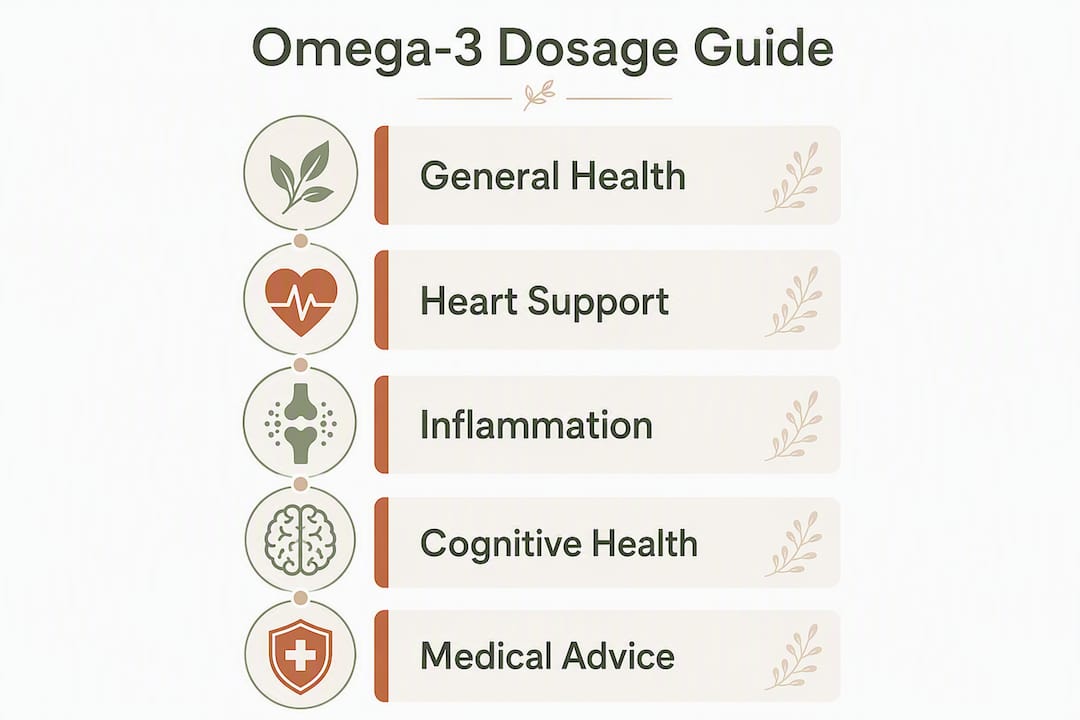
| Goal | Typical EPA+DHA Target | Source |
|---|---|---|
| General health / wellness | 250–500 mg/day | NIH/ODS guidance |
| Cardiovascular risk reduction | ~1,000 mg/day | American Heart Association |
| High triglycerides (therapeutic) | Up to 4,000 mg/day (Rx) | Clinician-supervised |
| Pregnancy / nursing | At least 250 mg DHA/day | NIH/ODS |
The NIH Office of Dietary Supplements emphasizes food first: two servings of fatty fish per week covers general needs for most adults. Supplements fill the gap when dietary intake falls short or when a specific therapeutic dose is needed.
For high triglycerides, prescription omega-3 formulations (like icosapentaenoic acid ethyl ester) are used at 4,000 mg/day under clinician supervision. Over-the-counter supplements at that dose are possible but require careful label math and provider input. When higher clinical doses are needed, clinician supervision is appropriate — OTC dosing often falls short of what’s needed for therapeutic triglyceride reduction.
Safety ceiling: The FDA recommends healthy adults not exceed 3,000 mg/day of EPA plus DHA total, with no more than 2,000 mg/day coming from dietary supplements.
Anyone on anticoagulants, antiplatelets, or NSAIDs should consult a healthcare provider before starting omega-3 supplements — omega-3s can extend bleeding time, and the interaction is clinically meaningful at higher doses. The same applies before planned surgery and during pregnancy.
How do you verify that a supplement is actually what it claims?
Some tested omega-3 supplements have failed to meet their label claims for EPA and DHA content. Third-party testing is the most reliable way to close that gap.
| What to check | What it tells you |
|---|---|
| IFOS certification | Active EPA+DHA content, contaminants, oxidation (TOTOX/peroxide values) |
| USP Verified seal | Meets label claims for identity, potency, and purity |
| NSF Certified for Sport | Purity + screens for banned substances (relevant for athletes) |
| Batch COA | Lot-specific lab results for the exact product you’re buying |
| Expiration date | Freshness baseline — avoid products close to expiry |
IFOS (International Fish Oil Standards) publishes its certification criteria publicly and tests for peroxide values, anisidine values, and TOTOX scores — the key oxidation markers. A COA that shows low peroxide and TOTOX values is a strong signal of fresh, stable oil.
- Look for the third-party seal directly on the label or product page
- Search the brand on the IFOS or USP database to confirm the certification is current
- If a COA isn’t posted publicly, email the company and ask for the most recent batch report
- A seller who won’t share a COA is a seller worth skipping
For a deeper look at what third-party testing actually verifies, the process covers far more than most buyers realize.
What safety risks and storage habits should you know about?
Drug interactions are the most important safety consideration. Omega-3s can extend bleeding time, and combining them with anticoagulants (warfarin, heparin), antiplatelets, or NSAIDs carries real risk. If you take any of these, talk to your provider before adding a supplement — especially at doses above 1,000 mg/day EPA+DHA.
Other situations that warrant a clinician conversation before starting:
- Pregnancy or nursing (dose and source matter)
- Scheduled surgery within two weeks
- Any bleeding disorder
Storage matters more than most labels suggest. Fish oil oxidizes when exposed to heat, light, and air. Keep softgels in a cool, dark place. Liquid oils should be refrigerated after opening. Never buy a product stored in a clear bottle on a sunny shelf.
Pro Tip: When you open a new bottle, smell it. Fresh fish oil has a mild, sea-like scent. A sharp, sour, or rancid odor means the oil has oxidized — rancid oil is less effective and may cause GI distress. Return it or discard it.
Which type of omega-3 supplement fits your specific goal?
- General wellness: A standard fish oil or algal oil with 250–500 mg EPA+DHA per day covers most adults. Affordable, widely available, and well-studied.
- Cardiovascular health: Target around 1,000 mg EPA+DHA per day, consistent with American Heart Association guidance. Fish oil in TG or rTG form is a practical choice here.
- High triglycerides: OTC supplements can reach therapeutic doses, but the math gets complicated fast. This is a situation for clinician guidance and possibly a prescription formulation.
- Pregnancy or nursing: Prioritize DHA. Algal oil is the cleanest option (no mercury risk, no vitamin A concerns), and some fish oil products carry pregnancy-specific certifications. Confirm with your OB or midwife.
- Vegan or vegetarian: Algal oil is the only reliable source of preformed DHA and EPA. Look for products that list both EPA and DHA on the Supplement Facts panel, not just DHA.
- Athletes and fitness: Timing, dose, and recovery goals add nuance. The omega-3 for fitness guide covers the evidence on dose, timing, and muscle recovery in detail.
Key Takeaways
Choosing a quality omega-3 supplement comes down to three non-negotiables: confirmed EPA+DHA milligrams per serving, a current third-party testing seal, and a freshness check before you open the bottle.
| Point | Details |
|---|---|
| Read the Supplement Facts panel | Find EPA mg and DHA mg per serving — ignore the front-label capsule weight. |
| Require third-party verification | IFOS, USP, or NSF seals confirm potency, purity, and oxidation levels. |
| Respect the FDA safety ceiling | Do not exceed 3,000 mg/day total EPA+DHA, with no more than 2,000 mg/day coming from dietary supplements, as per FDA guidance. |
| Match source to your diet | Algal oil for vegans and pregnancy; fish oil or krill oil for omnivores. |
| Nutribliss omega-3 option | Nutribliss offers a third-party tested fish oil softgel with clearly labeled EPA+DHA per serving. |
The mistake most buyers make — and how to fix it
Most people pick an omega-3 supplement by grabbing the biggest bottle with the highest milligram number on the front. That number almost always refers to total fish oil weight, not EPA+DHA content. A “3,000 mg fish oil” product might deliver less active omega-3 than a well-formulated 1,000 mg softgel from a brand that concentrates its formula.
The second mistake is skipping freshness entirely. Oxidized fish oil is a real problem — it’s less effective and harder on your stomach. Yet most buyers never smell the product, never check a COA, and never look up whether the brand’s IFOS certification is current. These take about three minutes combined.
The third mistake is treating all sources as interchangeable. If you’re vegan and buying flaxseed oil capsules expecting the same effect as fish oil, the limited ALA-to-EPA/DHA conversion rate means you’re likely not moving the needle on blood EPA or DHA levels at all. Algal oil is the fix.
The corrective action for all three is the same: read the Supplement Facts panel, check for a third-party seal, and verify freshness before you commit. That’s it. The rest of the label is mostly marketing. #nutribliss
Nutribliss makes the checklist easy to act on
Sorting through omega-3 labels is genuinely tedious. Nutribliss takes the guesswork out of it by doing the label math for you: the Nutribliss Omega-3 Fish Oil supplement lists EPA and DHA milligrams per serving clearly on the Supplement Facts panel, so you’re not converting capsule weight into active dose.

The product page includes third-party testing documentation and COA access, which means you can verify what’s inside before the bottle arrives. For readers who want to see the full range of science-backed formulations, the Nutribliss supplements collection covers the complete lineup with the same transparency standard applied across products. If you want to confirm the product fits your specific goal before ordering, the product page is the right starting point.
Useful sources for further reading
- NIH Office of Dietary Supplements — Omega-3 Fatty Acids Consumer Fact Sheet: Plain-language guidance on food sources, supplement use, and dosing for general adults.
- NIH ODS — Omega-3 Fatty Acids Health Professional Fact Sheet: Clinical-level detail on forms, bioavailability, evidence by condition, and safety.
- NCCIH — Omega-3 Supplements: What You Need to Know: Drug interactions, safety cautions, and a summary of the evidence base.
- IFOS / Nutrasource — How IFOS Certifications Work: Explains what IFOS tests for (active content, contaminants, oxidation) and how to find certified products.
- U.S. Food and Drug Administration (FDA): Source for the 3,000 mg/day total and 2,000 mg/day supplement safety ceilings.
This article is general information, not medical advice. Confirm dosing, interactions, and supplement choices with a qualified healthcare provider or registered dietitian before making changes, especially if you take medications or are pregnant.