

Magnesium can modestly ease stress and anxiety for some people, particularly those running low on the mineral, when taken in an absorbable form like glycinate at 150 to 400 mg of elemental magnesium daily. The evidence is real but not definitive: small trials and systematic reviews show consistent positive signals, not proof of a cure. Anyone pregnant, breastfeeding, on regular medication, or managing kidney disease should check with a clinician before starting.
TL;DR:
- Most small-scale trials show that doses between 250 and 400 mg of elemental magnesium daily tend to improve stress and sleep, especially in depleted or high-stress populations.
- Magnesium glycinate is the preferred form for daily stress and anxiety support because it is well tolerated, gentle on digestion, and effectively delivers magnesium.
- Magnesium supplementation generally requires at least four to six weeks of consistent use before noticeable stress relief effects become evident.
- Supplement safety is high for healthy individuals, with side effects mainly limited to gastrointestinal upset; kidney disease or medication interactions require medical consultation.
- Larger, standardized studies are needed to confirm magnesium’s efficacy, but current evidence supports its use as a low-risk adjunct for mild stress management.
Table of Contents
- What the Clinical Trials Say About Magnesium Stress Relief
- How Does Magnesium Affect the Body’s Stress Response?
- Which Magnesium Form Works Best for Stress and Anxiety?
- How Much Magnesium Should You Take for Stress Relief?
- Is Magnesium Safe? Side Effects and Drug Interactions
- How Do You Choose a Good Magnesium Supplement?
- A Practical Six-Week Plan to Try Magnesium for Stress
- Why Nutribliss Takes an Evidence-First Approach to Stress Support
- Magnesium vs. Therapy vs. Medication for Stress Relief
- How Long Does It Take Magnesium to Reduce Stress?
- What Does Magnesium for Stress Relief Cost?
- Combining Magnesium With Lifestyle Changes for Better Results
- When Should You Talk to a Doctor Before Taking Magnesium?
- Why the “More Is Better” Mindset Around Magnesium Is Wrong
- Nutribliss Products Built for Magnesium Stress Relief
- Sources
What the Clinical Trials Say About Magnesium Stress Relief
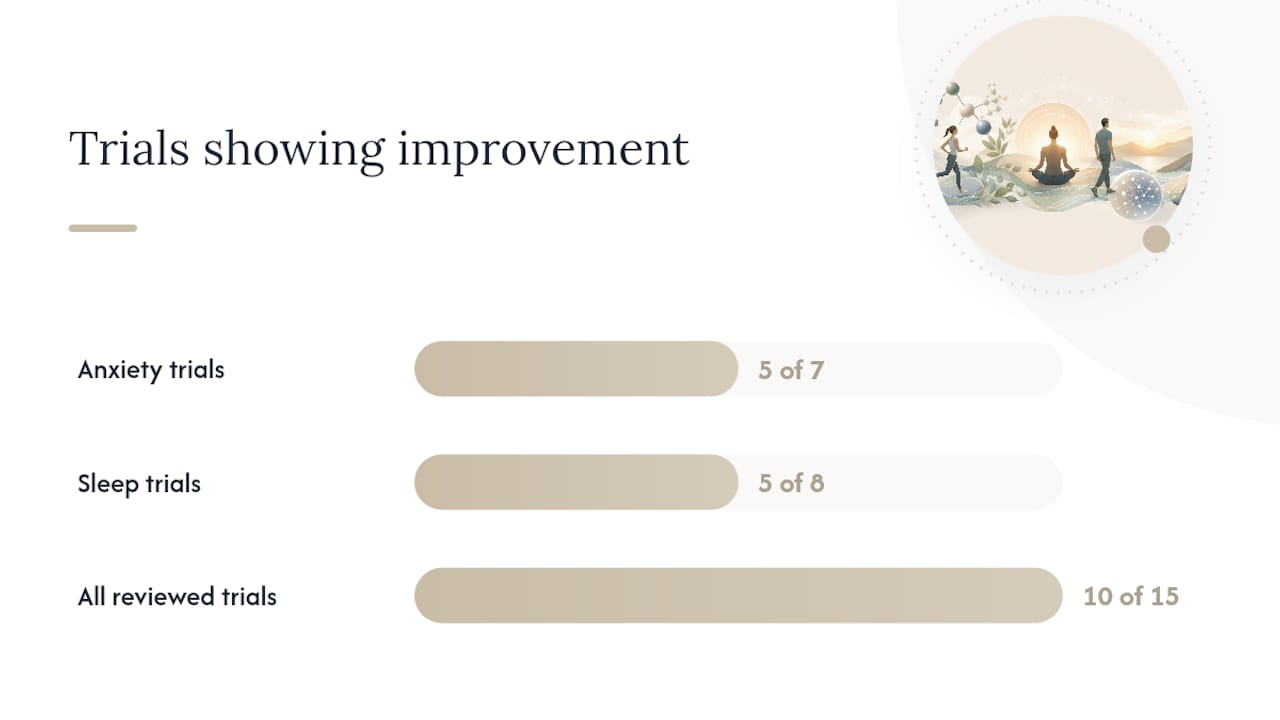
The research on magnesium stress relief is encouraging without being conclusive, and that distinction matters more than most product pages let on. A systematic review published in 2024 pulled together 15 interventional trials on magnesium supplementation, splitting them into eight that measured sleep outcomes and seven that measured anxiety outcomes. Five of the seven anxiety trials reported measurable improvement. Five of the eight sleep trials did too.
That is not a landslide of evidence, but it is a pattern researchers keep seeing across independent studies with different populations and doses.
Trial designs varied widely, which is part of the problem and part of the story. Some studies tracked postpartum women using the Hamilton Anxiety Rating Scale (HAM-A), a clinician-administered tool that scores symptoms like tension, fears, and physical complaints. Others used the DASS (Depression Anxiety Stress Scales), a self-report questionnaire, or the Pittsburgh Sleep Quality Index (PSQI) to capture how supplementation affected rest. Doses ranged from around 200 mg to over 400 mg of elemental magnesium daily, and trial lengths ran anywhere from a few weeks to a couple of months.
What the data actually shows:
- Most trials that showed improvement used doses in the 250 to 400 mg elemental range.
- Populations with documented low magnesium status or high physiological stress (postpartum women, students during exams, people with premenstrual symptoms) tended to show more consistent benefit than general healthy adults.
- Sleep quality and anxiety scores often moved together, suggesting the two outcomes may share a common mechanism rather than being separate effects.
- No trial in the review reported serious adverse events tied to supplementation at these doses.
Evidence snapshot: Across the reviewed trials, roughly two in three showed measurable improvement in anxiety or sleep. That is a meaningfully positive signal for a low-risk intervention, but it falls short of the kind of overwhelming consistency you’d want before calling magnesium a first-line treatment for clinical anxiety.
The main limitation running through nearly every study is sample size. Most trials enrolled fewer than 100 participants, and formulations varied enough (citrate in one study, glycinate in another, oxide in a third) that pooling results into one clean conclusion is difficult. Researchers reviewing this same territory describe a bidirectional relationship between stress and magnesium status, where chronic stress depletes magnesium through increased urinary excretion, and low magnesium in turn makes the body more reactive to stress. That feedback loop helps explain why results cluster more strongly in people who start out depleted.
The honest takeaway: magnesium supplementation for anxiety and stress has a coherent, repeatable signal across multiple small trials, but the field needs larger, standardized randomized controlled trials before anyone can call it proven. If you have generalized worry, disrupted sleep, or physical tension that lines up with a stressful stretch of life, the existing data gives you a reasonable, low-risk reason to try it. If you have a diagnosed anxiety disorder, magnesium belongs alongside treatment, not instead of it.
How Does Magnesium Affect the Body’s Stress Response?
Magnesium works on at least two separate systems that both touch your stress response, and understanding them explains why the effect feels subtle rather than dramatic.
The first is the HPA axis, short for hypothalamic-pituitary-adrenal axis, which is the command chain that releases cortisol when your brain perceives a threat. Magnesium appears to help regulate this axis, and some trials have measured the downstream effect directly: 250 mg per day for four weeks reduced serum cortisol in a study of students under academic stress, while 400 mg per day improved heart rate variability, a marker of how well your nervous system recovers between stressors, in adults undergoing physical training.
The second pathway runs through your brain’s excitability controls. Magnesium acts as a natural regulator of NMDA receptors, which respond to the neurotransmitter glutamate. Glutamate is your brain’s main excitatory signal. Too much unchecked glutamate activity is linked to the kind of racing, wired feeling that shows up in anxiety. Magnesium partially blocks NMDA receptor activity, which functions something like a dimmer switch on neural excitability rather than an off switch.
Here is where the feedback loop gets interesting:
- Stress raises cortisol and adrenaline.
- Those hormones increase how much magnesium your kidneys excrete in urine.
- Lower magnesium reduces your natural buffer against glutamate excitability.
- That heightened excitability makes you more reactive to the next stressor, which raises cortisol again.
This is the “vicious circle” mechanism that mineral researchers describe, and it is also why people under sustained stress, whether from illness, poor sleep, overtraining, or life circumstances, are more likely to be magnesium-depleted than people living calmer lives. It is not that magnesium is a sedative. It is that adequate magnesium status keeps your stress-response machinery from running hot, which shows up downstream as steadier sleep, less physical tension, and more stable mood regulation.
Which Magnesium Form Works Best for Stress and Anxiety?
Form matters more than most shoppers realize, and it is the single most common mistake people make when they buy the cheapest bottle on the shelf.
Magnesium glycinate pairs magnesium with the amino acid glycine, and clinical guidance consistently describes it as gentle on the stomach and well suited for stress, sleep, and anxiety support. Nebraska Medicine’s clinical guidance lists glycinate specifically as calming and easy to tolerate, which is why it shows up repeatedly in stress-focused formulations.
Magnesium L-threonate gets attention for its ability to cross the blood-brain barrier more readily than other forms in early research, making it theoretically attractive for cognitive and mood-related goals. The catch: there are not yet large randomized trials proving it outperforms other forms specifically for anxiety symptoms, so the brain-penetration story is promising but not proven at scale.
Magnesium taurate combines magnesium with taurine, an amino acid studied for cardiovascular and nervous system support, and some people tolerate it well for daily use.
By contrast, magnesium oxide, one of the most common (and cheapest) forms on store shelves, is poorly absorbed and considerably more likely to cause diarrhea, according to the same Nebraska Medicine guidance. Magnesium sulfate (Epsom salt) is typically used for baths or as a short-term laxative, not for daily stress support.
Quick comparison:
- Glycinate: Well tolerated, gentle on digestion, widely recommended for daily stress and sleep support.
- Threonate: Notable for brain penetration in early research, but lacking large-scale anxiety trials.
- Taurate: Reasonable tolerability, less commonly studied specifically for anxiety.
- Oxide: Cheap and common, but poorly absorbed and prone to causing loose stools.
- Citrate: Better absorbed than oxide but still more likely than glycinate to cause GI upset at higher doses.
Pro Tip: Delivery format, whether capsule, powder, or gummy, matters far less than the chemical form and elemental dose. Don’t let marketing on a gummy bottle distract you from checking whether it actually delivers a meaningful elemental amount.
If your priority is a form you can take every day without stomach trouble, glycinate remains the most defensible default based on current guidance. Our guide to magnesium glycinate supplements breaks down exactly how much elemental magnesium you get per capsule and how that compares to the compound weight listed on the label.
How Much Magnesium Should You Take for Stress Relief?
Most trials showing benefit for magnesium supplementation for relaxation used somewhere between 150 and 400 mg of elemental magnesium per day, and the number that actually matters is the elemental amount, not the total weight of the compound on the label.
A 500 mg capsule of magnesium glycinate delivers a fraction of that amount as actual elemental magnesium, typically less than a quarter of the total compound weight, not 500 mg. Always check the Supplement Facts panel, which is required to state elemental content separately.
A practical starting approach:
- Start low. Begin with 100 to 150 mg of elemental magnesium daily for the first week to assess tolerance, particularly digestive tolerance.
- Titrate up gradually. If tolerated, increase toward 200 to 300 mg elemental daily over two to three weeks, which lines up with the doses used in trials showing benefit.
- Give it 4 to 8 weeks. Most trials that reported improvement ran for at least a month; magnesium is not a same-day anxiolytic, and expecting instant results sets you up for disappointment.
- Stay under the supplemental upper limit. The NIH Office of Dietary Supplements sets 350 mg per day as the upper limit for supplemental (nonfood) elemental magnesium in adults, a figure that applies specifically to supplement sources, not magnesium from food.
Dosing snapshot: Trials reporting the strongest results tended to cluster around 250 to 400 mg elemental daily, sometimes combined with vitamin B6, though the combination evidence remains inconsistent rather than clearly superior to magnesium alone.
Doses above 350 mg supplemental do exist in therapeutic contexts, but those should only happen under a clinician’s supervision, particularly if blood testing has confirmed a deficiency that warrants a higher repletion dose.
Is Magnesium Safe? Side Effects and Drug Interactions
The most common side effect of magnesium stress relief supplementation is dose-dependent diarrhea, and it is almost always the first sign you have taken more than your gut can handle. This effect is more pronounced with oxide and citrate forms and considerably less common with glycinate.
Serious toxicity from oral magnesium supplements is rare in people with normal kidney function, because healthy kidneys excrete excess magnesium efficiently. That safety margin disappears in people with renal impairment, where magnesium can accumulate to dangerous levels. Anyone with kidney disease should not supplement without direct medical supervision.
Watch for these interactions and cautions:
- Certain antibiotics (including some tetracyclines and quinolones) bind to magnesium and lose effectiveness if taken too close together; separate dosing by at least two hours.
- Bisphosphonates used for bone density can have reduced absorption if taken alongside magnesium.
- Levothyroxine for thyroid function should be dosed at least four hours apart from magnesium to avoid absorption interference.
- Diuretics and blood pressure medications can interact with magnesium levels in ways that need clinical monitoring.
- Pregnancy and breastfeeding call for a conversation with an obstetric provider before starting any new supplement, magnesium included.
Signs of true magnesium excess, hypermagnesemia, include nausea, muscle weakness, irregular heartbeat, and in severe cases, difficulty breathing. This is rare outside of kidney disease or extremely high intravenous doses used in hospital settings, not something typical oral supplementation at standard doses is likely to cause. Still, if you experience unusual fatigue, muscle weakness, or heart rhythm changes after starting a supplement, stop and call your doctor.
How Do You Choose a Good Magnesium Supplement?
Picking a magnesium stress relief product comes down to three checks: the elemental amount, the form, and whether anyone has verified what’s actually in the bottle.
- Read the Supplement Facts panel for elemental magnesium. A label might say “Magnesium Glycinate 500 mg,” but scan for the line that specifies elemental magnesium content, often listed as “Magnesium (as Magnesium Glycinate) 100 mg.” That second number is what counts toward your daily target.
- Look for third-party testing seals. Certifications from USP (United States Pharmacopeia) or NSF International indicate a product has been independently verified for purity and label accuracy, which matters given how loosely the supplement industry is regulated compared to pharmaceuticals.
- Match the form to your goal and your gut. If digestive tolerance is your main concern, glycinate is the safer starting point. If you’re specifically chasing cognitive or brain-related benefits and are comfortable with less certain evidence, threonate is worth researching further.
- Consider combination formulas cautiously. Some products pair magnesium with vitamin B6, and small trials suggest this combination sometimes produces larger symptom reductions, though the evidence does not yet prove the combination is definitively superior to magnesium alone.
Pro Tip: Don’t assume a higher price tag means more elemental magnesium. Two bottles can list the same “500 mg” on the front label and deliver very different elemental amounts depending on the compound used. Do the math before you buy.
Our breakdown of high-absorption magnesium forms and our step-by-step buying guide both walk through label-reading in more detail if you want to compare specific products side by side.
A Practical Six-Week Plan to Try Magnesium for Stress
Treat this like a small personal experiment rather than a leap of faith. Structure gives you something to evaluate at the end instead of a vague impression.
- Week 0 (baseline): Note your current diet’s magnesium sources (leafy greens, nuts, whole grains), list any medications, and start a simple daily log rating stress, sleep quality, and digestion on a 1 to 10 scale.
- Weeks 1 to 2: Start at 100 to 150 mg elemental magnesium, taken in the evening if sleep is a target symptom. Watch for GI tolerance.
- Weeks 3 to 4: If well tolerated, increase to 200 to 300 mg elemental daily. Continue the daily log.
- Weeks 5 to 6: Hold your dose steady and compare your log against baseline. Look for trends in sleep quality and subjective stress, not day-to-day noise.
| Checkpoint | What to track | Action if no change | Action if worsening |
|---|---|---|---|
| Week 2 | GI tolerance, sleep onset | Continue titration | Reduce dose or switch form |
| Week 4 | Stress rating trend | Hold dose, continue log | Consult clinician |
| Week 6 | Overall pattern vs. baseline | Consider maintenance dose | Stop and seek medical advice |
Stop and seek medical advice if you notice muscle weakness, irregular heartbeat, or persistent diarrhea that doesn’t resolve with a lower dose. If six weeks pass with no meaningful change in your logged symptoms, magnesium may not be addressing your particular kind of stress, and that is useful information, not a failure.
Why Nutribliss Takes an Evidence-First Approach to Stress Support
Supplements work best as one piece of a larger approach to managing stress, not a replacement for sleep, movement, therapy, or medical care when those are needed. That framing shapes how Nutribliss builds and describes its formulas.
- Every product lists elemental magnesium content clearly on its Supplement Facts panel.
- Formulations prioritize well-absorbed and well-tolerated forms rather than the cheapest compound available.
- Product descriptions link back to primary research cited throughout this piece rather than vague wellness claims.
- The goal is transparency first: what’s in the bottle, how much of it is active, and what the evidence realistically supports.
That is the standard held across the product line, and it is the same standard one would want if reading a label.
Magnesium vs. Therapy vs. Medication for Stress Relief
Magnesium is not a substitute for cognitive behavioral therapy or prescribed anxiety medication, and no credible research suggests it should be treated as one. The honest comparison is about scale of effect and role, not competition.
Therapy, particularly cognitive behavioral therapy, has a substantially larger and more consistent evidence base for treating diagnosed anxiety disorders than any supplement currently does. It addresses thought patterns and behavioral responses directly, which magnesium cannot do. Prescription medications, including SSRIs and benzodiazepines for short-term use, work through entirely different neurochemical pathways and are appropriate for moderate to severe clinical anxiety that a mineral supplement was never designed to treat.
Where magnesium fits is at the milder end of the spectrum, alongside these interventions rather than instead of them. Someone in therapy for generalized anxiety disorder might reasonably add magnesium as a low-risk adjunct if their diet is poor or their stress is chronic enough to plausibly deplete their magnesium status. Someone with mild, situational stress from work or life circumstances might reasonably try magnesium first, given its low risk profile, before considering pharmaceutical options.
The mistake is expecting a mineral to do a medication’s job or a therapist’s job. Combine, don’t substitute, and be honest with your provider about everything you’re taking so they can watch for interactions.
How Long Does It Take Magnesium to Reduce Stress?
Most people should not expect same-week results, and setting that expectation early prevents the common mistake of quitting after four days because “nothing happened.”
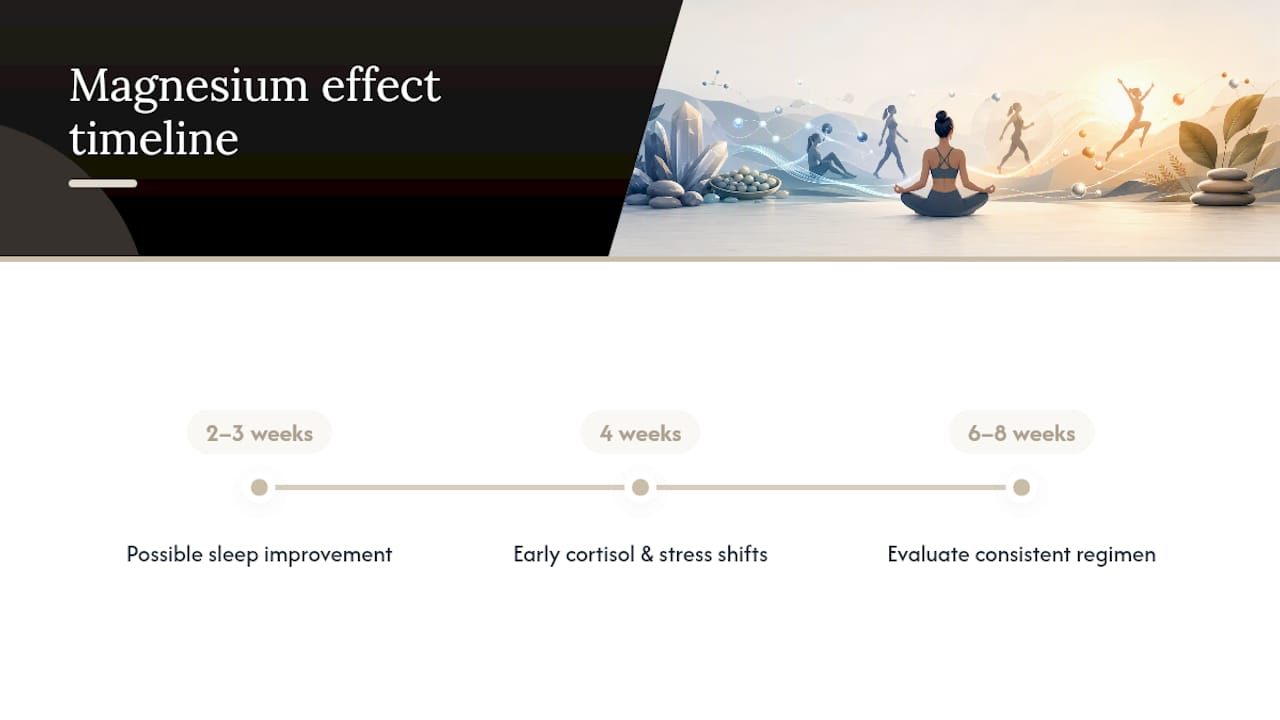
Trials showing measurable improvement in anxiety or sleep scores generally ran for at least four weeks, with several extending to six or eight weeks before assessing outcomes. The four-week mark tends to be where the earliest meaningful shifts in cortisol and subjective stress ratings show up in published research, while sleep quality improvements sometimes register slightly earlier, within two to three weeks, for people whose sleep was disrupted specifically by physical tension or nighttime restlessness.
This timeline makes physiological sense given the mechanism. Magnesium repletion, especially in someone who started out deficient, takes time to normalize cellular and serum levels and to exert its calming effect on NMDA receptor activity and HPA axis regulation. It is a gradual correction, not a fast-acting sedative.
The practical implication: give any magnesium regimen a full six to eight weeks, with consistent daily dosing, before deciding whether it is working for you. Sporadic use, skipping days, or switching forms every two weeks makes it impossible to tell whether the supplement failed or the routine did.
What Does Magnesium for Stress Relief Cost?
Prices vary widely depending on form, and understanding why helps you avoid overpaying for marketing rather than mineral content.
Basic magnesium oxide capsules are typically the cheapest option on store shelves, often priced lowest per bottle, but you get what you pay for in absorption. Because oxide delivers a lower percentage of usable elemental magnesium and causes more digestive upset, the effective cost per absorbed milligram can end up higher than it looks on the price tag.
Magnesium glycinate and magnesium citrate typically sit in a moderate price range, reflecting the more complex chelation process involved in binding magnesium to glycine or citric acid for better absorption. Magnesium L-threonate tends to command the highest price point among common forms, largely because of patented processing and the ingredient’s relative novelty compared to older, more commoditized forms like oxide.
Combination formulas that pair magnesium with vitamin B6 or other calming compounds like L-theanine often price somewhere between a standalone glycinate product and a specialty threonate formula, depending on ingredient sourcing and dose.
The smartest cost comparison is not bottle price. It is price per elemental milligram. A cheaper bottle that only delivers 50 mg of elemental magnesium per serving might cost more per effective dose than a pricier bottle delivering 200 mg per serving. Do that division before assuming the discount product is the better deal.
Combining Magnesium With Lifestyle Changes for Better Results
Magnesium supplementation for relaxation works best as one input into a broader routine, not a stand-alone fix, and the research on the stress-magnesium feedback loop actually supports this directly.
Since chronic stress increases urinary magnesium excretion, any lifestyle change that lowers your baseline stress load reduces the ongoing drain the supplement has to work against. That makes sleep hygiene, regular movement, and stress-reduction practices like breathing exercises or time outdoors genuinely complementary, not just generically “healthy” advice.
Diet matters just as much as the pill bottle. Leafy greens, nuts, seeds, legumes, and whole grains are naturally rich in magnesium, and building a diet around these foods reduces how much you need to rely on supplementation to reach adequate status in the first place. Someone eating a diet already rich in magnesium may notice less added benefit from supplementing than someone whose diet is heavy in processed foods that are typically low in the mineral.
Some people also pair magnesium with other calming compounds, such as L-theanine or adaptogenic herbs, though the evidence for these combinations is generally thinner than for magnesium alone and should be approached with the same measured expectations. If you’re building a broader stress-support routine, our roundup of evidence-based stress relief supplements covers how magnesium fits alongside other commonly used options.
Sleep, movement, and diet are not competitors to magnesium. They are the reason it works better for some people than others.
When Should You Talk to a Doctor Before Taking Magnesium?
Certain situations move magnesium supplementation from “reasonable self-experiment” to “talk to your doctor first,” and it’s worth being specific about which ones.
Pregnancy and breastfeeding top the list, not because magnesium is inherently risky in these situations, but because dosing needs and safety margins shift, and any supplement decision during this period deserves a provider’s input. Kidney disease is the other major flag, since impaired renal function removes your body’s ability to excrete excess magnesium efficiently, raising the risk of accumulation to unsafe levels.
Anyone taking prescription medications, particularly antibiotics, bisphosphonates, thyroid medication, diuretics, or blood pressure drugs, should mention magnesium supplementation to their prescriber or pharmacist before starting, given the interaction risks covered earlier in this guide. The same goes for anyone managing a diagnosed anxiety or mood disorder who is already in treatment: magnesium can be a reasonable adjunct, but starting or stopping any supplement should be a conversation with the clinician managing that treatment, not a solo decision made after reading a product label.
If you’re generally healthy, not pregnant, have normal kidney function, and aren’t on interacting medications, the risk profile of a standard glycinate supplement at recommended doses is low. Still, mentioning any new supplement at your next checkup costs nothing and closes a gap that occasionally matters more than people expect.
Why the “More Is Better” Mindset Around Magnesium Is Wrong
The biggest misconception about magnesium stress relief isn’t whether it works. It’s the assumption that a higher dose or a trendier form automatically means a better result. The trials showing benefit didn’t reward the highest doses; they rewarded consistency, appropriate elemental amounts, and, frequently, a baseline of actual deficiency to correct in the first place.
Conventional wellness advice tends to skip that last part entirely. It sells magnesium as a universal calm-down switch, when the real story is narrower and, frankly, more useful: it helps most reliably when it’s replacing something your body has genuinely lost to stress. That is why two people can take the same capsule and get different results.
What should actually guide your decision is elemental content, form tolerability, and patience over a six to eight week window, not the flashiest bottle on the shelf or the highest milligram number on the front label. Get the fundamentals of diet and sleep in order first. Magnesium fills a gap; it doesn’t create a foundation from nothing.
— GAURAV
Nutribliss Products Built for Magnesium Stress Relief
If you’re ready to try magnesium as part of your stress routine, the product you choose should match how you plan to use it. Nutribliss carries two options worth comparing for this exact purpose.

The Electrolytes Supplement is the better fit if you want magnesium alongside a broader mineral balance, particularly if you’re physically active and losing minerals through sweat on top of everyday stress. The Sleep Formula Supplement makes more sense if your stress shows up primarily as trouble winding down at night, since it combines calming ingredients with magnesium rather than isolating the mineral alone.
Whichever you pick, check the Supplement Facts panel for the elemental magnesium amount per serving and compare it against the 150 to 400 mg range discussed throughout this guide, and run the six-week plan outlined above to actually judge whether it’s working for you. If you’re pregnant, nursing, managing kidney disease, or taking regular medication, confirm with your doctor before adding either product to your routine. Explore both options and pick the one that matches your specific stress pattern.
Sources
- Examining the Effects of Supplemental Magnesium on Self-Reported Anxiety and Sleep Quality: A Systematic Review
- Magnesium - Health Professional Fact Sheet
- 7 types of magnesium: Which form is right for you? | Nebraska Medicine
- Magnesium status and stress: systematic findings (PubMed record)