

For most adults, the best way to take magnesium is 200–350 mg of elemental magnesium daily from a well-absorbed form like magnesium glycinate or citrate, taken in the evening with food. The NIH Office of Dietary Supplements sets the RDA at 310–320 mg/day for adult women and 400–420 mg/day for adult men, while the supplemental upper limit sits at 350 mg/day. If you have kidney disease or take antibiotics, bisphosphonates, or thyroid medication, talk to your clinician before starting.
- Form: Glycinate or citrate for most goals; citrate or hydroxide for constipation relief
- Dose: Stay at or below 350 mg of elemental magnesium from supplements per day
- Timing: Evening with a meal works for most people; split doses if GI tolerance is an issue
- Safety flag: Kidney disease raises hypermagnesemia risk; certain medications need a 2–6 hour spacing window
Pro Tip: Split your daily dose into two smaller portions, morning and evening. Research shows that fractional absorption rises when the same total intake is distributed across smaller doses rather than taken all at once, and GI side effects drop noticeably.
Key Takeaways
Consistent daily intake of the right magnesium form, at a dose within the 350 mg supplemental upper limit, is the most reliable path to the benefits most adults are looking for.
| Point | Details |
|---|---|
| Best daily routine | Take 200–300 mg elemental magnesium glycinate or citrate with an evening meal for most goals. |
| Form by goal | Glycinate for sleep and GI sensitivity; citrate for general use; oxide only for short-term constipation. |
| RDA and UL | Women need 310–320 mg/day total; men 400–420 mg/day; supplemental UL is 350 mg/day from supplements only. |
| Medication spacing | Space magnesium 2–6 hours from antibiotics, bisphosphonates, and levothyroxine; kidney disease requires clinician guidance. |
| Nutribliss resources | Browse the Nutribliss supplement catalog for third-party tested magnesium products with transparent elemental magnesium labeling. |
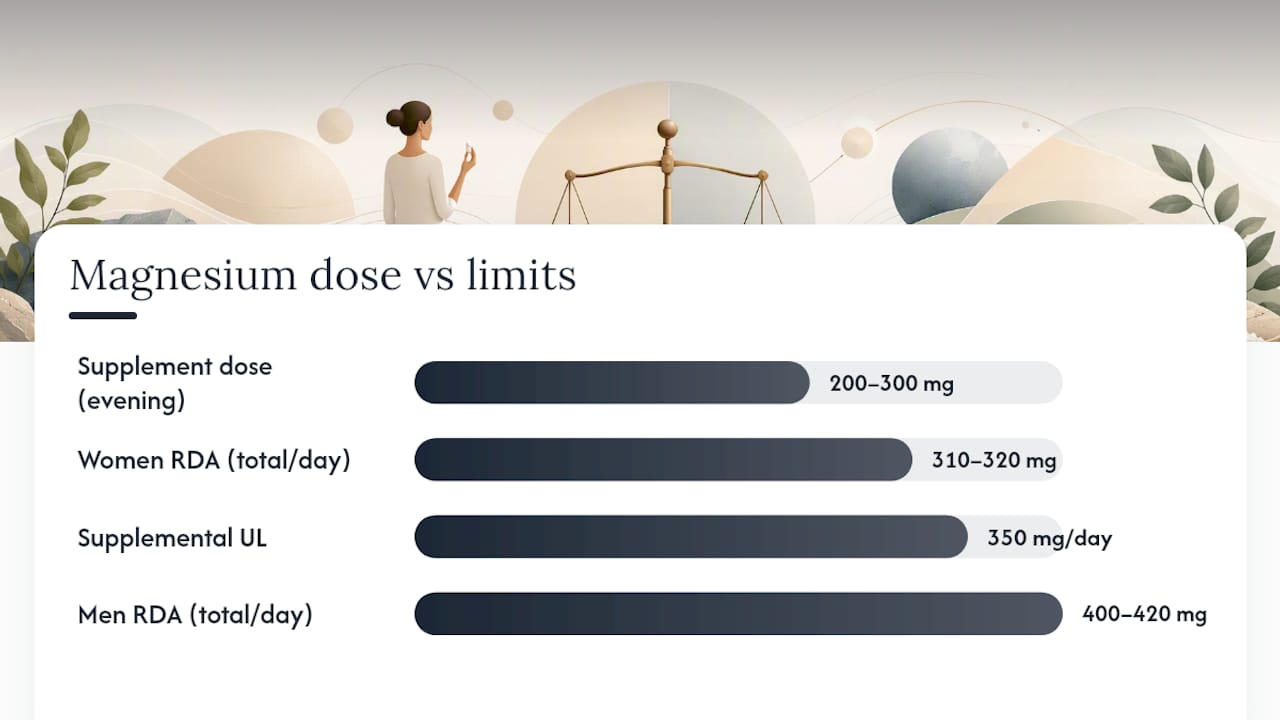
Table of Contents
- When should you take magnesium for your specific goal?
- Which magnesium form is right for your goal?
- What dose of magnesium do you actually need?
- How to get more magnesium from every dose you take
- Drug interactions and who should be cautious
- Side effects, deficiency signs, and red flags
- Ready-to-use magnesium schedules for three common goals
- How to choose a magnesium supplement that actually delivers
- What I actually tell people about magnesium
- Nutribliss can help you find the right magnesium product
- Sources
When should you take magnesium for your specific goal?
Timing matters less than consistency, but matching the clock to your goal does make a real difference. Harvard Health guidance recommends taking magnesium at the same time each day and with food if your stomach is sensitive.
By goal:
- Sleep and relaxation: Take your full dose 30–60 minutes before bed. Magnesium glycinate is the preferred form here; its calming effect pairs well with a wind-down routine. Clinical trials on magnesium and sleep quality show modest but positive results, particularly in older adults with low dietary intake.
- Muscle cramps and recovery: Post-workout or evening dosing works well. Muscles are most receptive to replenishment after exercise, and an evening dose also supports overnight repair.
- Constipation: Morning on an empty stomach tends to produce faster results for laxative-effect forms like citrate or hydroxide. Expect effects within 30 minutes to 6 hours.
- Migraine prevention: Some clinicians suggest splitting the dose morning and evening to maintain steadier serum levels throughout the day.
- General daily maintenance: Pick whichever time you’ll actually remember. After dinner or at bedtime pairs naturally with existing habits for most people.
Meal timing: Taking magnesium with food slows absorption slightly but reduces nausea and GI cramping for most people. On an empty stomach, absorption may be marginally faster but GI discomfort is more likely, especially with oxide or citrate.
What to avoid stacking: Don’t take magnesium at the same time as iron supplements or antibiotics. Space it at least 2 hours from iron and 2–6 hours from tetracyclines, quinolones, and bisphosphonates.
Pro Tip: Pair your magnesium dose with one existing daily habit, brushing your teeth, making tea, or setting your phone to charge. Habit stacking is the single most reliable way to stay consistent.
Which magnesium form is right for your goal?

Not all magnesium supplements deliver the same amount of usable magnesium to your cells. The salt attached to the magnesium ion determines how well it dissolves, how much your gut absorbs, and how likely it is to send you to the bathroom.
Examine confirms that citrate, glycinate, chloride, and gluconate show good bioavailability, while oxide is less absorbable and more likely to cause GI side effects.
- Magnesium glycinate / bisglycinate: Best for sleep, anxiety, and muscle relaxation. Chelated to glycine, it’s gentle on the gut and well-absorbed. The go-to form if GI tolerance has been a problem. Read more in The Ultimate Guide to Magnesium Glycinate Supplements.
- Magnesium citrate: Well-studied, reliably absorbed, and moderately laxative at higher doses. Good for general supplementation and constipation. Why take magnesium citrate covers its uses and safety in detail.
- Magnesium oxide: High elemental magnesium percentage on the label (about 60%), but poor fractional absorption. Commonly causes diarrhea. Useful for short-term constipation relief, not for daily maintenance.
- Magnesium chloride: Good bioavailability, available as liquid or topical. Often used in transdermal sprays and bath flakes, though evidence for transdermal absorption is limited compared to oral forms.
- Magnesium hydroxide (milk of magnesia): Primarily a laxative. Works fast but not intended for daily nutritional supplementation.
- Magnesium sulfate (Epsom salt): Dissolved in bath water, it’s popular for sore muscles, but oral absorption from baths is not well established. IV sulfate is used clinically for severe deficiency and eclampsia.
- Topical / transdermal forms: Convenient and GI-friendly, but the evidence for meaningful systemic absorption through skin remains weaker than for oral forms.
Formulation format matters too. A review of formulation and bioavailability found that effervescent tablets, powders, and granules that fully dissolve in water generally outperform compact tablets in absorption measures. If you’re choosing between a dense tablet and a powder version of the same salt, the powder usually wins.
Pro Tip: If you’ve tried magnesium before and quit because of diarrhea, switch to glycinate or bisglycinate and cut your dose in half. Most people who “can’t tolerate magnesium” are simply taking the wrong form at too high a dose.
What dose of magnesium do you actually need?
The RDA and the supplemental upper limit are two different numbers, and confusing them is one of the most common magnesium mistakes.
RDA and upper limit at a glance
Sources: NIH ODS Consumer Fact Sheet and NIH ODS Health Professional Fact Sheet.
The UL of 350 mg/day applies only to magnesium from supplements and medications, not from food. Dietary magnesium has no established upper limit because the kidneys efficiently excrete excess from food sources. This means you can eat magnesium-rich foods freely while keeping your supplement dose at or below 350 mg of elemental magnesium.
Reading a supplement label: Labels list the compound weight (e.g., “500 mg magnesium citrate”) not the elemental magnesium. Citrate contains a relatively low proportion of elemental magnesium by weight compared to oxide; for example, 500 mg of magnesium citrate provides a moderate amount of elemental magnesium, while oxide has a high elemental magnesium content on paper but is absorbed poorly.
Quick check: Always look for the “elemental magnesium” line in the Supplement Facts panel, not the compound weight. That number is what counts toward your RDA and UL.
The NIH guidance on dietary supplements frames food as the preferred magnesium source, with supplements filling the gap when diet falls short. Natural sources of magnesium worth prioritizing: pumpkin seeds, dark leafy greens, legumes, whole grains, nuts, and dark chocolate.
How to get more magnesium from every dose you take
Swallowing a supplement is step one. How much actually reaches your bloodstream depends on dose size, formulation, and what else is in your gut at the time.
The core principle: fractional absorption falls as single-dose size rises. Your gut absorbs a higher percentage of a 100 mg dose than a 400 mg dose. Splitting a 300 mg daily target into two 150 mg doses, morning and evening, delivers more usable magnesium than one 300 mg bolus.
Practical absorption tactics:
- Split your dose. Two smaller doses consistently outperform one large dose for fractional uptake.
- Take with food. A meal slows gastric emptying, giving the small intestine more contact time with dissolved magnesium. Matrix effects from food can enhance uptake, particularly with protein-containing meals.
- Choose soluble forms. Effervescent powders and liquid forms increase ionic magnesium availability in the small intestine compared with dense, slowly dissolving tablets.
- Avoid competing minerals at the same time. High-dose calcium taken simultaneously can compete for absorption pathways. Space calcium and magnesium by at least an hour if you take both.
- Watch dietary inhibitors. Very high phytate intake (from unsoaked legumes or bran) can bind magnesium in the gut. This is rarely a clinical issue for most people eating varied diets, but worth knowing.
A systematic review of magnesium bioavailability confirms that organic salts like citrate and glycinate generally outperform inorganic salts like oxide and carbonate in absorption studies.
Pro Tip: If you’re using a powder or effervescent form, let it fully dissolve before drinking. Partially dissolved granules reduce the ionic magnesium available for absorption in the upper small intestine.
Drug interactions and who should be cautious
Magnesium interacts with several common medications in ways that can reduce the drug’s effectiveness or raise your magnesium levels to unsafe ranges. The fix is usually simple: spacing.
Common interactions and spacing rules:
- Tetracycline and quinolone antibiotics (doxycycline, ciprofloxacin): Take magnesium at least 2 hours before or 4–6 hours after the antibiotic. Magnesium chelates the drug and blocks its absorption.
- Bisphosphonates (alendronate, risedronate): Space magnesium at least 2 hours away. These drugs are notoriously sensitive to mineral co-ingestion.
- Levothyroxine: Take thyroid medication on an empty stomach, at least 4 hours away from magnesium.
- Proton pump inhibitors (PPIs): Long-term PPI use can reduce magnesium absorption and cause hypomagnesemia. If you’re on a PPI long-term, ask your clinician to check magnesium levels periodically.
- Loop and thiazide diuretics: These increase urinary magnesium excretion, raising deficiency risk. Supplementation may be warranted, but dose should be guided by lab results.
Kidney disease is the most important contraindication. Impaired kidneys cannot excrete excess magnesium efficiently, and supplemental doses that are safe for healthy adults can cause hypermagnesemia, a condition marked by dangerously low blood pressure, slowed heart rate, and in severe cases, respiratory depression. Anyone with chronic kidney disease should not take magnesium supplements without direct medical supervision.
When to call your clinician before starting:
- You have kidney disease at any stage
- You take any of the medications listed above
- You’re pregnant (needs vary and supplementation should be guided)
- You’ve had unexplained muscle weakness, irregular heartbeat, or persistent GI symptoms
Side effects, deficiency signs, and red flags
Most GI side effects from magnesium are dose-dependent and form-dependent. They’re annoying, not dangerous, and usually fixable.
Common minor side effects:
- Loose stools or diarrhea, most common with oxide, citrate at high doses, and hydroxide
- Nausea or stomach cramping, especially on an empty stomach
- Bloating, more common with effervescent forms if taken too quickly
Signs of magnesium deficiency:
- Muscle cramps, twitches, or spasms (especially at night)
- Persistent fatigue and low energy
- Poor sleep quality
- Headaches or migraines
- In severe deficiency: cardiac arrhythmia, numbness, and personality changes
One important caveat: serum magnesium tests are a blunt tool. Normal serum levels don’t rule out depletion of tissue stores, because the body pulls magnesium from bone and muscle to keep blood levels stable. Mild deficiency often goes undetected on standard labs.
Serious toxicity signs (seek immediate care):
- Severe hypotension (very low blood pressure)
- Slowed or irregular heartbeat
- Difficulty breathing
- Extreme muscle weakness or loss of reflexes
These are rare in people with healthy kidneys taking oral supplements. They’re most likely in people with kidney impairment or those receiving IV magnesium.
Fixing mild GI effects: Lower the dose, split it across the day, switch from oxide or citrate to glycinate, or take it with a larger meal. Most people find a tolerable routine within one to two weeks of adjusting.
Ready-to-use magnesium schedules for three common goals
These are starting points. Run any schedule for two to four weeks, track your sleep quality and GI response, then adjust or discuss with your clinician.
Schedule A: Sleep-focused nightly dose
- Take 200–300 mg of elemental magnesium glycinate 30–60 minutes before bed.
- Pair with a consistent wind-down routine (dim lights, no screens) to amplify the relaxation effect.
- If you wake groggy, reduce to 150 mg and reassess after two weeks.
Schedule B: Split-dose daily maintenance
- Take 150 mg elemental magnesium (glycinate or citrate) with breakfast.
- Take another 150 mg with dinner.
- Total: 300 mg/day, staying within the 350 mg supplemental UL.
- This approach maximizes fractional absorption and minimizes GI side effects.
Schedule C: Short-term constipation relief
- Take 300–400 mg elemental magnesium citrate or hydroxide in the morning on an empty stomach.
- Drink a full glass of water with the dose.
- Limit to a few days at a time; this is not a long-term daily strategy.
- If constipation is chronic, discuss underlying causes with your clinician rather than relying on magnesium laxatives indefinitely.
Layering with other supplements:
- Space magnesium at least 1 hour from calcium supplements
- Take iron supplements at a different meal entirely
- Keep thyroid medication 4 hours away from magnesium
- For athletes, post-workout magnesium pairs well with protein and electrolytes. See why magnesium matters for exercise for sport-specific dosing context.
How to choose a magnesium supplement that actually delivers
The supplement aisle is full of products that look identical on the front label and differ enormously in what’s inside. Here’s what to check before buying.
Selection checklist:
- Elemental magnesium per serving: Find this in the Supplement Facts panel, not the compound weight. Aim for 100–200 mg per dose if splitting, or up to 300 mg for a single nightly dose.
- Salt form by goal: Glycinate for sleep and GI sensitivity; citrate for general use and mild constipation; chloride or gluconate for liquid formats; avoid oxide for daily maintenance.
- Formulation: Powder, effervescent, or chelated capsule over dense compressed tablets when absorption is the priority.
- Third-party testing: Look for USP, NSF International, or Informed Sport certification. These verify that the elemental magnesium content matches the label and that the product is free of contaminants.
- Label transparency: The label should list elemental magnesium explicitly, disclose all excipients, and carry a clear allergen statement. Avoid proprietary blends that lump multiple minerals together without individual amounts.
- Batch COA availability: Reputable brands make certificates of analysis available on request or on their website.
For a deeper look at how to evaluate products, the Nutribliss guide to choosing a magnesium supplement walks through each criterion with practical examples.
The FDA’s qualified health claim linking magnesium intake to reduced risk of high blood pressure is a useful signal that regulatory bodies take magnesium’s cardiovascular role seriously, though the claim is qualified and applies under specific conditions.
Pro Tip: If GI tolerance is your main obstacle, glycinate or bisglycinate is almost always the answer. Switching from oxide to glycinate resolves diarrhea in most people without reducing the dose.
What I actually tell people about magnesium
Most of the confusion around magnesium comes from treating it like a drug with one correct protocol. It’s a mineral your body needs daily, and the goal is consistent, adequate intake, not a perfect single dose at a perfect time.
Start low: 100–150 mg of elemental magnesium from a quality glycinate or citrate product. Add food. Give it two weeks. If your sleep improves, your cramps ease, or your digestion normalizes, you’ve found your dose. If nothing changes, titrate up slowly, staying within the 350 mg supplemental UL. If you’re on medications or have any kidney history, that conversation belongs with your clinician, not a supplement label.
The #nutribliss approach to supplementation is the same: evidence first, then personalization. No single form or timing rule works for everyone, but the fundamentals, consistent dosing, the right salt, and spacing from interacting medications, apply across the board.
Nutribliss can help you find the right magnesium product
Knowing what to take is half the battle. Finding a product that actually delivers what the label promises is the other half.

At Nutribliss, the magnesium and electrolyte products are selected with label transparency and third-party testing in mind. You can browse the full supplement catalog, check product specifications, and find recommended-use guides that match the form-by-goal framework covered here. The science page covers COAs and research summaries for those who want to verify before they buy. Whether you’re starting with a basic glycinate for sleep or looking for a combined electrolyte formula, the catalog gives you the specifics you need to make a confident choice. #nutribliss
Sources
- Magnesium - Consumer
- Intestinal Absorption and Factors Influencing Bioavailability of Magnesium-An Update - PMC
- Magnesium benefits, dosage, and side effects
- What can magnesium do for you and how much do you need?
- FDA announces qualified health claim: magnesium and reduced risk of high blood pressure
This article provides general health information and is not a substitute for professional medical advice. Confirm dosing, interactions, and suitability with your clinician or pharmacist, particularly if you have kidney disease, are pregnant, or take prescription medications.