

This evidence-first list covers the most commonly used nutritional supplements and the specific health uses that have credible support behind them. Under the Dietary Supplement Health and Education Act, these products are meant to supplement your diet, not diagnose or treat disease. Below, you’ll find categories organized by evidence strength, safety notes, and practical dosing guidance. Always check labels and talk to your clinician before starting anything new.
TL;DR:
- Most supplements are not approved by the FDA before sale, making third-party verification and label transparency essential for safety and efficacy.
- Dosages and evidence support vary: vitamin D supports bones, B12 corrects deficiency, omega-3s lower triglycerides, and magnesium may aid migraine prevention with small doses.
- High doses of fat-soluble vitamins or minerals like iron and calcium can cause toxicity, kidney stones, or cardiovascular risks, especially if taken without medical supervision.
- Supplement quality differs widely; select products with seals from USP or NSF, detailed ingredient disclosure, and batch-specific Certificates of Analysis.
- Always start new supplements individually, space out timing of minerals and vitamins, and verify actual ingredient content before incorporating them long-term.
Table of Contents
- What Counts as a Dietary Supplement, and How Labeling Works
- The Core List of Supplements and Their Evidence-Backed Uses
- Safety Rules and Interaction Warnings You Need Before You Start
- How to Choose a Higher-Quality Supplement
- How to Add Supplements to Your Routine Without Overdoing It
- Supplement Rules Vary a Lot Depending on Where You Live
- Common Myths About Supplements That Won’t Go Away
- Who Needs Extra Caution: Pregnancy, Aging, and Athletic Training
- Reading Between the Lines of Supplement Marketing
- Author Perspective: What Actually Matters Before You Buy Anything
- Where to Find These Supplements With Transparent Labels
- Where to Verify Any Claim in This List
- Sources
- FAQ
What Counts as a Dietary Supplement, and How Labeling Works
A dietary supplement is legally defined, and that definition shapes everything on the label you’re reading at the store. Under DSHEA, a supplement is a product taken by mouth that contains a vitamin, mineral, herb, amino acid, enzyme, or other dietary ingredient intended to add to what you already get from food. It is not classified as a drug, and it cannot legally claim to diagnose, treat, cure, or prevent a disease.
That distinction drives the language you see on packaging. Manufacturers can make structure/function claims, such as “supports bone health” or “helps maintain healthy joints,” but the FDA requires a disclaimer stating the claim hasn’t been evaluated by the agency. Cross into disease-claim territory, like “treats osteoporosis,” and the product would legally need to be regulated as a drug instead.
Here’s the part that surprises most people: the FDA does not review or approve supplements before they hit shelves. The agency only steps in after a safety problem surfaces. That reactive model is exactly why label transparency and third-party verification matter so much for supplement shoppers.
A few resources make it easier to check what you’re actually buying:
- The NIH Office of Dietary Supplements fact sheets summarize evidence for individual ingredients in plain language.
- The Dietary Supplement Label Database lets you search label-declared ingredients for thousands of products sold in the United States.
- The Dietary Supplement Ingredient Database estimates actual ingredient content across product categories, which sometimes differs from what’s printed on the label.
Reading a Supplement Facts panel with this context turns a confusing label into something you can actually evaluate.
The Core List of Supplements and Their Evidence-Backed Uses
Survey data consistently show multivitamins, vitamin D, and omega-3s are the most commonly used supplements among American adults. Here’s how the broader field breaks down by category, evidence strength, and practical use.
Vitamins
Vitamin D. Supports bone health and calcium absorption; deficiency is common in people with limited sun exposure. Typical maintenance doses are commonly recommended within a range considered sufficient for most adults, though some clinicians individualize dosing based on blood testing. Evidence for bone benefits is solid; evidence for immune or mood benefits is weaker than marketing often suggests.
Vitamin B12. Essential for nerve function and red blood cell production. Older adults and people on metformin or long-term acid-reducing medications absorb B12 less efficiently, and vegans need a reliable source since it occurs almost exclusively in animal foods. Deficiency correction has strong evidence; benefits beyond correcting a deficiency are unproven.
Vitamin C. Supports immune function and collagen synthesis. Regular use modestly shortens cold duration in some studies but doesn’t reliably prevent colds in the general population. High doses may cause gastrointestinal upset in some people.
Folate (Vitamin B9). Critical during early pregnancy for neural tube development. This is one of the clearest, most consistent findings in nutrition science, which is why folic acid is fortified into flour in many countries.
Minerals
Calcium. Works with vitamin D for bone density maintenance. Evidence is solid for bone health, but very high supplemental calcium intake has been linked to kidney stone risk and, in some studies, cardiovascular concerns, so more isn’t automatically better.
Iron. Treats and prevents iron-deficiency anemia, particularly in menstruating women, pregnant women, and people with certain gastrointestinal conditions. This is a genuinely well-supported use, but iron should never be taken without a blood test confirming deficiency, since iron overload is toxic and cumulative.
Magnesium. Involved in muscle function, nerve signaling, and sleep quality. Modest evidence supports use for migraine prevention and constipation relief (in the citrate form specifically). High doses cause loose stools before they cause anything more serious, which is a useful early warning sign.
Zinc. Supports immune function and wound healing. Lozenges show modest benefit for shortening cold duration when started within 24 hours of symptoms. Long-term high-dose use can interfere with copper absorption.
Omega-3s (Fish Oil)
Omega-3 supplements supply EPA and DHA, the fatty acids most associated with cardiovascular benefits. Clinical evidence from Mayo Clinic supports meaningful triglyceride lowering and modest blood pressure reductions, though effects on hard cardiovascular outcomes like heart attacks are mixed across studies. Supplement doses for triglyceride management are often in the gram range of combined EPA/DHA and are usually taken under medical supervision at higher doses.
Pro Tip: Fish oil thins the blood slightly. If you take warfarin, clopidogrel, or even daily aspirin, mention your fish oil dose to your doctor before any planned surgery.
Protein and Performance Supplements
Whey and plant-based protein powders. Support muscle protein synthesis, particularly useful when whole-food protein intake falls short of the roughly 1.2 to 2.0 grams per kilogram of body weight that active adults often need. Evidence for muscle-building benefit is strong when combined with resistance training.
Creatine monohydrate. One of the most researched sports supplements available, with consistent evidence for improved strength, power output, and lean mass gains. Standard dosing is 3 to 5 grams daily; loading protocols (20 grams daily for five to seven days) speed up saturation but aren’t required.
Probiotics and Prebiotics
Evidence supports specific probiotic strains for specific conditions, not probiotics as a blanket category. Certain strains show benefit for antibiotic-associated diarrhea and some irritable bowel symptoms, while general “gut health” claims for random probiotic blends have thinner support. Prebiotic fibers, like inulin, feed beneficial gut bacteria and may work better paired with a probiotic than alone.
Fiber
Psyllium husk. Supports regularity and modestly lowers LDL cholesterol when taken consistently. This is one of the better-supported uses in this entire list, backed by decades of clinical data. Start with a small dose and plenty of water to avoid bloating.
Botanicals and Adaptogens
Ashwagandha. Traditionally used for stress support; several small trials show reduced cortisol markers and self-reported stress scores. Effects typically build over several weeks of consistent daily use rather than appearing immediately, and it isn’t recommended during pregnancy.
Turmeric (curcumin). Contains anti-inflammatory compounds studied for joint discomfort and general inflammation. Curcumin is poorly absorbed on its own, so formulations paired with black pepper extract or lipid carriers perform better in studies than plain turmeric powder.
Joint and Skin Support
Collagen peptides. Some trials show improved skin elasticity and hydration with consistent use over 8 to 12 weeks. Evidence for joint pain reduction is more mixed, with modest benefit in some studies of active adults and osteoarthritis patients.
Glucosamine and chondroitin. Long studied for osteoarthritis-related joint pain, with results split between meaningful benefit and no benefit depending on the trial. If you don’t notice improvement after three months, it’s reasonable to stop.
Specialty Nutrients
Coenzyme Q10 (CoQ10). Supports cellular energy production; often used by people on statin medications, since statins can lower natural CoQ10 levels. Evidence for reducing statin-related muscle aches is mixed but promising enough that many cardiologists suggest a trial.
Electrolytes (sodium, potassium, magnesium blends). Support hydration and muscle function during intense exercise, heat exposure, or illness with fluid loss. This is a genuinely practical use case with strong physiological rationale, particularly for endurance athletes and anyone sweating heavily.
Multivitamins. Function as nutritional insurance rather than a targeted treatment for anything specific. Large population studies generally haven’t shown multivitamins reduce mortality or major disease risk in well-nourished adults, though they can help fill genuine dietary gaps.
Safety Rules and Interaction Warnings You Need Before You Start
Fat-soluble vitamins, A, D, E, and K, store in body fat and build up over time, which means chronic overuse carries real toxicity risk in a way water-soluble vitamins like B and C generally don’t. Mineral overdose is a separate but equally serious concern.
- Iron overdose is one of the leading causes of accidental poisoning death in young children who get into a bottle of adult supplements.
- Excess calcium intake has been associated with kidney stones and, in some research, cardiovascular risk markers.
- Vitamin A in high supplemental doses can cause liver damage and birth defects if taken during pregnancy.
Drug interactions deserve equal attention. Fish oil and vitamin E can amplify the effect of blood thinners like warfarin. St. John’s Wort, a common mood-support herb, speeds up liver metabolism of many drugs, including birth control pills and certain antidepressants, which can make those medications less effective. Calcium and iron supplements can block absorption of thyroid medication if taken too close together. Anyone managing high blood pressure should know that licorice root, sometimes found in digestive or adrenal-support blends, can raise blood pressure and deplete potassium.
Talk to a clinician before starting supplements if you’re pregnant, managing a chronic condition, taking multiple prescription medications, or scheduled for surgery. Mayo Clinic guidance consistently recommends this step, particularly for anyone combining supplements with existing prescriptions.
Pro Tip: Keep a running list of every supplement and medication you take, doses included, on your phone. Hand it to any new doctor or pharmacist before they prescribe something new. This single habit catches more dangerous interactions than any warning label ever will.

If something goes wrong, adverse events can be reported to the FDA’s MedWatch system, and it’s worth checking for active recalls before assuming a symptom is unrelated to what you’re taking.
How to Choose a Higher-Quality Supplement
Because the FDA doesn’t pre-approve supplement formulas, product quality varies more than most shoppers realize. Two bottles with identical labels can contain meaningfully different amounts of the active ingredient. Research using the Dietary Supplement Label Database has documented this kind of label variability across product categories, which is exactly why third-party verification matters.
Look for these signals before you buy:
- A third-party testing seal from USP, NSF, or a similarly independent lab, confirming the product contains what the label claims and isn’t contaminated.
- A Certificate of Analysis (COA) available on request, showing actual tested potency for that batch.
- A clear Supplement Facts panel listing exact amounts per ingredient, not vague “proprietary blend” totals that hide individual dosages.
- Full ingredient disclosure, including inactive ingredients and allergen warnings.
Nutribliss walks through this exact evaluation process in its guide to third-party tested supplements, which covers how contamination risks show up even in reputable-looking products.
| What to check | Why it matters | Where to verify |
|---|---|---|
| Third-party seal (USP/NSF) | Confirms label accuracy and screens for contaminants | Product packaging |
| Certificate of Analysis | Shows actual batch-tested potency | Manufacturer website or request |
| Full ingredient list | Reveals hidden fillers or allergens | Supplement Facts panel |
| Dose per serving | Prevents accidental over or underdosing | Supplement Facts panel |
How to Add Supplements to Your Routine Without Overdoing It
- Separate fat-soluble and water-soluble timing. Take fat-soluble vitamins (A, D, E, K) with a meal containing some dietary fat for better absorption. Water-soluble vitamins like B and C absorb fine on an empty stomach.
- Space iron away from calcium and coffee. Iron absorption drops significantly when taken alongside calcium supplements or caffeine, so separate them by at least two hours.
- Introduce one new supplement at a time. Adding three things at once makes it impossible to know what’s actually helping, or causing a reaction, if something changes.
- Give it a real trial period. Most supplements need four to twelve weeks of consistent use before you can honestly judge whether they’re doing anything. Ashwagandha and joint-support ingredients tend toward the longer end of that window.
- Recheck with bloodwork where relevant. Iron, vitamin D, and B12 levels are all measurable. If you started supplementing because of a deficiency, retest in three to six months to confirm it’s corrected.
A supplement schedule guide can help you map out timing if you’re juggling more than two or three products at once.
Pro Tip: Set a phone reminder tied to an existing habit, like brushing your teeth, instead of a random alarm. Supplement routines that piggyback on something you already do daily have much better long-term adherence than standalone reminders.
Supplement Rules Vary a Lot Depending on Where You Live
Supplement regulation is not the same everywhere, and that matters if you’re comparing products across borders or buying internationally online. In the United States, DSHEA treats supplements as a food category, placing the safety burden on manufacturers with no FDA premarket approval required.
The European Union takes a more restrictive approach for certain categories. The EU maintains harmonized rules on vitamin and mineral forms permitted in supplements, along with maximum permitted levels that vary by member state in some cases, and it operates a more centralized approval process for novel ingredients than the American system does. Herbal and botanical products in the EU often fall under separate traditional-use registration frameworks rather than the general food-supplement category.
Canada requires supplements to carry a Natural Product Number after Health Canada reviews safety and label claims, which is a meaningfully more active premarket review than the US model. Australia’s Therapeutic Goods Administration similarly requires most supplements to be listed or registered before sale, with ingredient restrictions that can be stricter than either the US or EU frameworks.
The practical takeaway: a supplement legally sold and labeled a certain way in one country may carry different permitted claims, ingredient limits, or dosage forms elsewhere. If you’re ordering internationally, don’t assume the label claims translate directly across borders, because the underlying regulatory standard behind them often doesn’t.
Common Myths About Supplements That Won’t Go Away
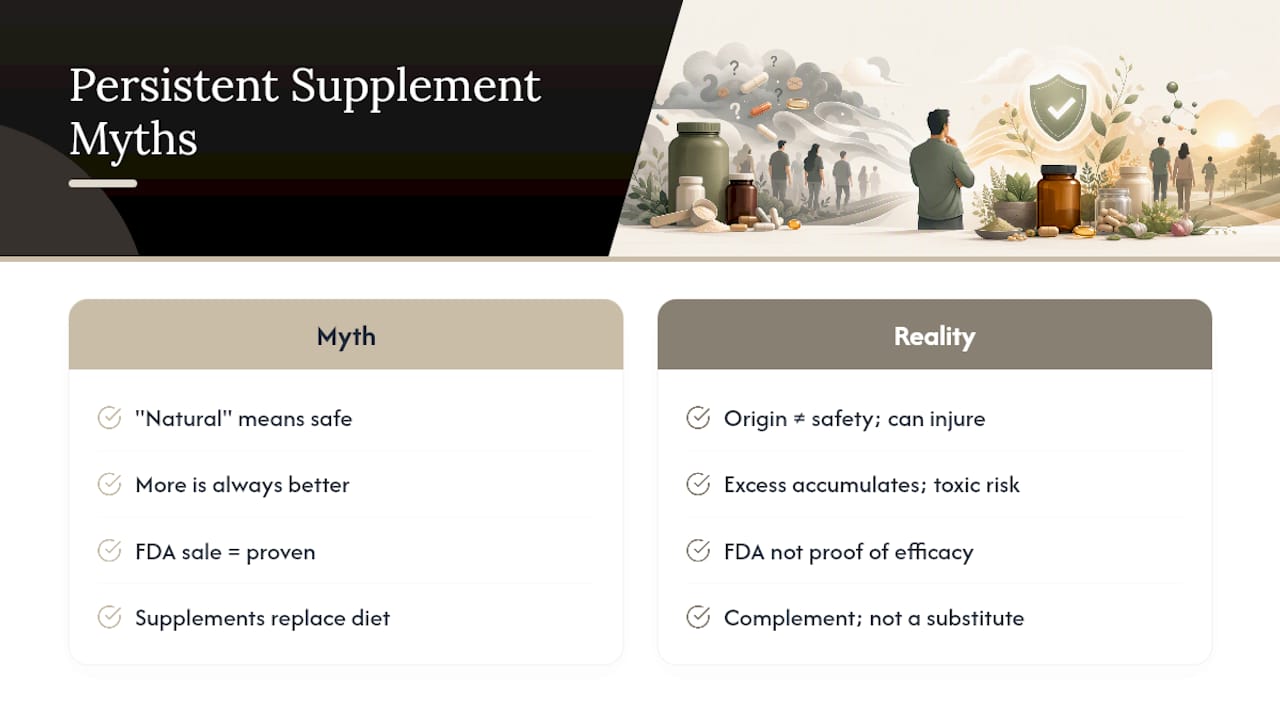
Myth: “Natural” means safe. Plenty of natural compounds are potent and dangerous in the wrong dose. Comfrey, kava, and certain concentrated herbal extracts have caused documented liver injury. Natural describes origin, not safety profile.
Myth: More is always better. This is one of the most common and costly misunderstandings in supplement use. Excess fat-soluble vitamins accumulate in tissue, excess iron is toxic, and excess calcium carries its own risks. Dosing above the evidence-backed range doesn’t add benefit; it usually just adds risk.
Myth: If the FDA allows it to be sold, it’s been proven to work. The FDA’s role is largely reactive rather than a stamp of proven efficacy, since supplements don’t go through the premarket approval process drugs do. A product being legally on shelves says nothing about whether clinical evidence backs its specific claims.
Myth: Supplements can replace a poor diet. No pill delivers the full complexity of nutrients, fiber, and compounds found in whole foods. Supplements work best as a complement to a reasonably balanced diet, not a substitute for one, a point nutrition-focused resources consistently reinforce when discussing how to eat well even while traveling or busy.
Myth: Everyone needs the same supplements. Needs vary enormously by age, diet pattern, health status, and even geography (sun exposure affects vitamin D status, for instance). A blanket supplement stack marketed to everyone is a marketing convenience, not a clinical recommendation.
Who Needs Extra Caution: Pregnancy, Aging, and Athletic Training
Pregnant women face some of the highest stakes in supplement decisions. Folate is well-established as protective against neural tube defects, but vitamin A in supplemental (not food) form carries real teratogenic risk at high doses, and many herbal supplements, including several adaptogens, lack safety data in pregnancy and are generally avoided. Prenatal vitamins are formulated specifically to address this balance, which is why generic multivitamins aren’t an adequate substitute during pregnancy.
Older adults absorb certain nutrients less efficiently, particularly B12 and vitamin D, making deficiency more common with age even on a reasonable diet. At the same time, older adults are more likely to be on multiple medications, which raises interaction risk substantially. Polypharmacy, taking five or more medications, is common enough in this population that any new supplement should be screened against the full medication list before starting.
Athletes and highly active people have genuinely elevated needs for some nutrients, protein, electrolytes, and iron in particular, but they’re also a population heavily targeted by supplement marketing making claims well beyond the evidence. Creatine and protein have strong performance evidence behind them. Many “performance blend” products marketed specifically to athletes lean on ingredients with far thinner support, so the same evidence-first evaluation applies regardless of how the product is marketed.
Reading Between the Lines of Supplement Marketing
Supplement marketing language often sounds more definitive than the underlying evidence supports, and learning to spot the gap protects both your health and your wallet.
Watch for these specific phrasing patterns:
- Vague structure/function language stretched to imply disease treatment. “Supports healthy blood sugar” is a legal claim; “reverses diabetes” would not be, so notice when marketing copy nudges right up against that line without crossing it explicitly.
- Citations to studies that don’t match the product. A brand might cite a study on a specific compound at a specific dose, then sell a product with a fraction of that dose or a different delivery form entirely.
- Testimonials substituting for data. Individual stories are not clinical evidence, no matter how compelling they sound.
- “Doctor-formulated” or “clinically proven” without a specific citation attached. Ask what clinical study, specifically, backs the claim, and check if it’s actually about that ingredient at that dose.
- Proprietary blends hiding individual doses. If a label lists a blend total but not the amount of each ingredient inside it, there’s no way to know if you’re getting a meaningful dose of anything.
The most reliable check is always the same: look up the specific ingredient on an independent source like the NIH’s fact sheets rather than trusting the marketing copy on the bottle in front of you.
Author Perspective: What Actually Matters Before You Buy Anything
Most people reach for a supplement before they’ve addressed the basics: sleep, protein intake, and whether they actually have a deficiency in the first place. That order is backwards. Bloodwork identifying an actual gap, iron, vitamin D, B12, tells you far more than any marketing claim ever will, and it turns supplementation from a guess into a targeted fix.
Once you know what you need, the selection checklist above, third-party testing, a real Supplement Facts panel, transparent dosing, is what separates a useful product from a wasted purchase. Use it every time, follow #nutribliss for ingredient-focused breakdowns, and run anything new past your clinician if you’re on medication or managing a chronic condition.
— GAURAV
Where to Find These Supplements With Transparent Labels
Two categories from this list come up constantly once you start paying attention to what your body actually needs: hydration support and sleep support. Nutribliss builds both around the same principle covered throughout this guide, full ingredient transparency and clear dosing per serving, instead of hidden proprietary blends.

The Nutribliss electrolytes supplement is formulated for rehydration during exercise, heat exposure, or general daily fluid balance, with a labeled breakdown of sodium, potassium, and magnesium content rather than a vague blend total. For nighttime routines, the Nutribliss sleep formula is designed to support a healthy sleep routine using ingredients disclosed at their actual dosed amounts on the label.
Neither product is intended to diagnose, treat, cure, or prevent any disease, consistent with how every supplement in this list is legally classified. If you want a product built around the same label transparency and quality checks this guide recommends, start by reading the full ingredient panel on either product page, and pick the one that matches what your routine is actually missing.
Where to Verify Any Claim in This List
- The NIH Office of Dietary Supplements publishes ingredient-specific fact sheets for consumers and clinicians.
- The FDA’s supplement Q&A page explains labeling rules and regulatory boundaries in plain language.
- The Dietary Supplement Label Database lets you search actual label contents for thousands of marketed products.
- Mayo Clinic’s drug and supplement reference pages summarize clinical evidence and interaction risks for specific ingredients.
- PubMed remains the best starting point for locating the original clinical trials behind any specific claim you want to verify yourself.
Sources
- Questions and Answers on Dietary Supplements | FDA
- Dietary Supplement Fact Sheets | NIH Office of Dietary Supplements (ODS)
- Fish oil - Mayo Clinic
- Dietary Supplement Label Database (DSLD) | NIH ODS
FAQ
Can you give me a list of dietary supplements?
Common categories include vitamins (D, B12, C), minerals (calcium, iron, magnesium, zinc), omega-3 fish oil, protein and creatine, probiotics, fiber like psyllium, botanicals like ashwagandha and turmeric, collagen, CoQ10, and electrolytes, each covered above with its specific evidence-backed uses.
What are the 13 essential vitamins and their uses?
The essential vitamins include A, C, D, E, K, and the B vitamins; they support functions ranging from vision and immunity (A, C) to bone health (D), blood clotting (K), and nerve and energy metabolism (the B group).
What are the top supplements most people consider taking daily?
Vitamin D, omega-3 fish oil, magnesium, a multivitamin, and probiotics are among the most commonly used daily supplements, though the right choice depends on individual diet gaps and confirmed deficiencies rather than a universal list.
What is the best all-in-one nutritional supplement?
No single product covers every nutrient need, since requirements vary by age, diet, and health status; a well-formulated multivitamin can help close general gaps, but targeted supplements based on bloodwork typically address specific deficiencies more effectively.
How do I know if a supplement is high quality?
Look for third-party testing seals (USP or NSF), a full ingredient list with exact doses rather than a proprietary blend, and a Certificate of Analysis available from the manufacturer, and always confirm your choice with a clinician if you take other medications.