

Pick one goal (better sleep, faster recovery, steadier stress, more endurance), then choose one single-ingredient plant-based supplement and start at the lowest labeled dose. Run it for two to four weeks while you track basic metrics, and keep sleep, protein intake, and consistent training as the real foundation. That is how to support plant medicine integration without guessing which change actually worked.
TL;DR:
- Most people should focus on a single goal and one plant-based supplement at a time, running it consistently for two to four weeks.
- Check for interactions with medications such as blood thinners, blood pressure meds, or diabetes treatments, and consult a healthcare professional if needed.
- Verify supplement quality through third-party testing, standardization, and transparent sourcing, avoiding proprietary blends and mystery formulation claims.
- Timing herbal intake is crucial: calming herbs go at night, energizing herbs before activity, and anti-inflammatory botanicals with meals.
- Track baseline metrics and monitor progress before making adjustments, recognizing that inconsistency and impatience commonly hinder successful integration.
Table of Contents
- How to support plant medicine integration in your first month
- What interactions and health conditions should you check first?
- What makes a plant-based supplement actually trustworthy?
- When should you take herbal supplements around training and sleep?
- How do you know if the supplement is actually working?
- Working through the emotional side of adding something new
- Respecting the traditions these plants come from
- Why does integration stall, and how do you get past it?
- Where can you get help if you have questions or concerns?
- What are the legal and ethical lines to know?
- The Nutribliss approach to plant medicine integration
- Ready to start your one-supplement trial?
- Sources
How to support plant medicine integration in your first month
Most people fail at this before they even start, not because the herb doesn’t work, but because they change five things at once and can’t tell what helped. A trial built around one product and one goal, lasting a reasonable period, fixes that.
Here’s the protocol:
- Name the goal. Sleep, recovery, stress resilience, or endurance. Pick one. Not all four.
- Choose a single-ingredient product. Skip blends for now. If your goal is sleep, that means one calming herb, not a five-ingredient “nighttime formula” with unclear individual doses.
- Start at the low end of the labeled range. You can go up later. You can’t easily un-react to a dose that hit too hard.
- Anchor the timing. Take it at the same time relative to your training or bedtime every day, so the variable stays consistent.
- Log a baseline before you start. Write down your current sleep quality, resting heart rate, mood, or perceived recovery for three to five days before you take the first dose.
- Hold the course for 2 to 4 weeks. Don’t add a second supplement mid-trial. Don’t change your training program at the same time if you can help it.
- Review and decide. Continue, adjust the dose, or stop, based on what you logged, not on how you feel about it after one good night.
Athletes and lifters get impatient here, and it’s the most common reason integration efforts flop. Sports-nutrition research is fairly consistent that botanicals and plant compounds contribute real value to recovery and antioxidant load, but only when they’re layered onto solid training and nutrition, not used to patch over a bad program.
Pro Tip: Take your starting photo of “baseline you” seriously. A five-day average of resting heart rate or sleep score, jotted in a notes app, is worth more than a month of vague impressions about whether you “feel better.”
What interactions and health conditions should you check first?
Plant compounds are still active compounds, and some interact meaningfully with common medications. This is the section people skip and shouldn’t.
Three interaction categories come up most often:
- Blood thinners. Herbs with mild anticoagulant activity can compound the effect of warfarin or similar medications, raising bleeding risk.
- Blood pressure medications. Some adaptogens and stimulating botanicals can shift blood pressure enough to matter if you’re already on hypertensives.
- Diabetes medications. Certain herbs affect blood sugar, which can stack with insulin or oral hypoglycemics in ways that cause unexpected lows.
If you’re pregnant, breastfeeding, managing a chronic condition, or scheduled for surgery in the next few weeks, talk to a clinician before starting anything new. Because herbal supplements aren’t regulated to the same standard as prescription drugs, potency and formulation can vary between brands and even between batches, which makes it harder for you or a clinician to predict how a product will behave in your body.
Keep a written list of everything you take, doses included, and bring it to appointments. Pharmacists and doctors can’t screen for interactions they don’t know about, and clinicians trained in integrative or functional medicine are especially equipped to fold botanical use into your broader health picture. One safety checklist worth bookmarking covers documentation in more depth.
Seek immediate medical attention for unusual bruising, chest pain, severe headache, swelling, or any sudden allergic reaction. Don’t wait it out.
What makes a plant-based supplement actually trustworthy?
Label claims are cheap. Verification isn’t.
Start with certain baseline signals:
- Third-party testing. Look for a certificate of analysis covering identity, potency, and contaminants like heavy metals or microbial content, not just a badge on the bottle.
- cGMP manufacturing. Current Good Manufacturing Practice compliance means the facility follows consistent quality controls, which matters given how much formulation variability exists across the category.
- Standardized extracts. A product that states “standardized to 5% withanolides” tells you something. A product that just says “ashwagandha root powder” tells you much less.
- No mystery blends. If a label lists a “proprietary complex” with a single combined milligram count for eight ingredients, you have no way to know if any one of them is at an effective dose.
- Transparent sourcing pages. Brands willing to show you their testing standards and quality process are usually the ones with less to hide.
Independent, third-party verification of raw materials and finished products is one of the most reliable ways to cut your risk of contamination or mislabeling. Traceability back to the raw material source is the next layer worth checking, and it’s a growing focus across the supplement quality assurance space as manufacturers respond to consumer demand for proof, not just promises.
When should you take herbal supplements around training and sleep?
Timing isn’t an afterthought. It’s half of whether the herb does what you want it to do.
- Calming herbs go at night. If the goal is sleep or evening stress relief, take it 30 to 60 minutes before bed, consistently.
- Energizing or adaptogenic herbs go earlier. Anything with a stimulating profile belongs in the morning or pre-training window, not the afternoon.
- Anti-inflammatory botanicals pair with food. Take these with a meal or shortly post-workout, when absorption and gut tolerance are both better.
- Never trial a new herb on a competition or a max-effort training day. You don’t know your individual response yet, and race day is the wrong place to find out.
- Respect standardized clinical dose ranges. Athletes trialing adaptogens tend to see the clearest results, and fewest surprises, sticking near the low to moderate end of studied ranges rather than assuming more is better.
- Hold off stacking stimulants. If you already drink coffee or use pre-workout, don’t add a stimulating herb on top until you know how your body handles the herb alone.
Pro Tip: Pair a calming herb with a fixed evening ritual, like five minutes of stretching or a breathing exercise. The pairing itself seems to reinforce the habit and can make the perceived effect stronger, independent of the herb.
How do you know if the supplement is actually working?
Track before you judge. Four weeks of data beats four weeks of vibes.
- Baseline first. Note sleep quality, perceived recovery, training fatigue, mood, and any side effects for several days before starting.
- Keep it simple. A one-line daily log (1 to 10 scale) is enough. You don’t need an app suite.
- Give it real time. Two to four weeks minimum per herb; longer for goals tied to chronic stress or slow-moving markers.
- Loop in a clinician for anything persistent. Ongoing fatigue, mood changes, or GI issues that don’t resolve deserve lab work or a professional opinion, not another supplement layered on top.
- Rule out the obvious first. If sleep or training didn’t actually change during your trial, don’t credit or blame the herb for the outcome. Isolate one variable at a time, the same principle behind most adaptogen protocols, so you can trust what the data is actually telling you.
Working through the emotional side of adding something new
Integration isn’t only physical. Adding a plant-based supplement to a daily routine often comes with an emotional undercurrent, especially for people who’ve tried and abandoned supplements before.

Expect some psychological friction in week one. You might feel skeptical, overly hopeful, or impatient for results that take time to show up. Naming that reaction, rather than letting it drive an early decision to quit or double the dose, keeps your trial honest.
A useful technique: separate “did I feel different today” from “did my logged numbers move this week.” The first question is noisy and swayed by a bad night’s sleep or a stressful meeting. The second is more stable and harder to fool yourself with.
Some people also carry guilt or hesitation around using plant-based remedies at all, often shaped by family attitudes toward “natural” versus “medical” approaches to health. That tension is worth acknowledging rather than pushing past. You don’t need to resolve it to run a responsible trial, but recognizing it helps you interpret your own results more clearly instead of unconsciously wanting the herb to fail or succeed.
Journaling a few lines alongside your tracking log, not just numbers but how the process feels, tends to surface patterns that a pure metrics sheet misses. If a supplement makes you anxious about “doing it right,” that anxiety itself is data worth noting.
Respecting the traditions these plants come from
Many botanicals now sold as capsules and extracts, ashwagandha, rhodiola, turmeric, ginseng, carry centuries of use within specific cultural and medical traditions, including Ayurvedic and traditional Chinese medicine systems. Treating them as interchangeable “wellness ingredients” strips out context that matters.
Practically, this means a few things for a fitness-minded buyer. Learn where an herb comes from and how it was traditionally used before treating it purely as a performance hack. Support brands that source ethically and credit the traditional systems that identified these plants’ properties long before modern extraction methods existed. Avoid language that reduces a plant with deep cultural roots to a trendy buzzword stripped of its origin.
This isn’t about gatekeeping who can use these supplements. It’s about approaching them with the same seriousness you’d want applied to your own health decisions, recognizing that “traditional use” data, referenced in resources like MedlinePlus, reflects generations of observation, not marketing copy. A little curiosity about an herb’s actual history tends to produce more thoughtful, more consistent use anyway.
Why does integration stall, and how do you get past it?
The most common failure point isn’t a bad reaction. It’s inconsistency.
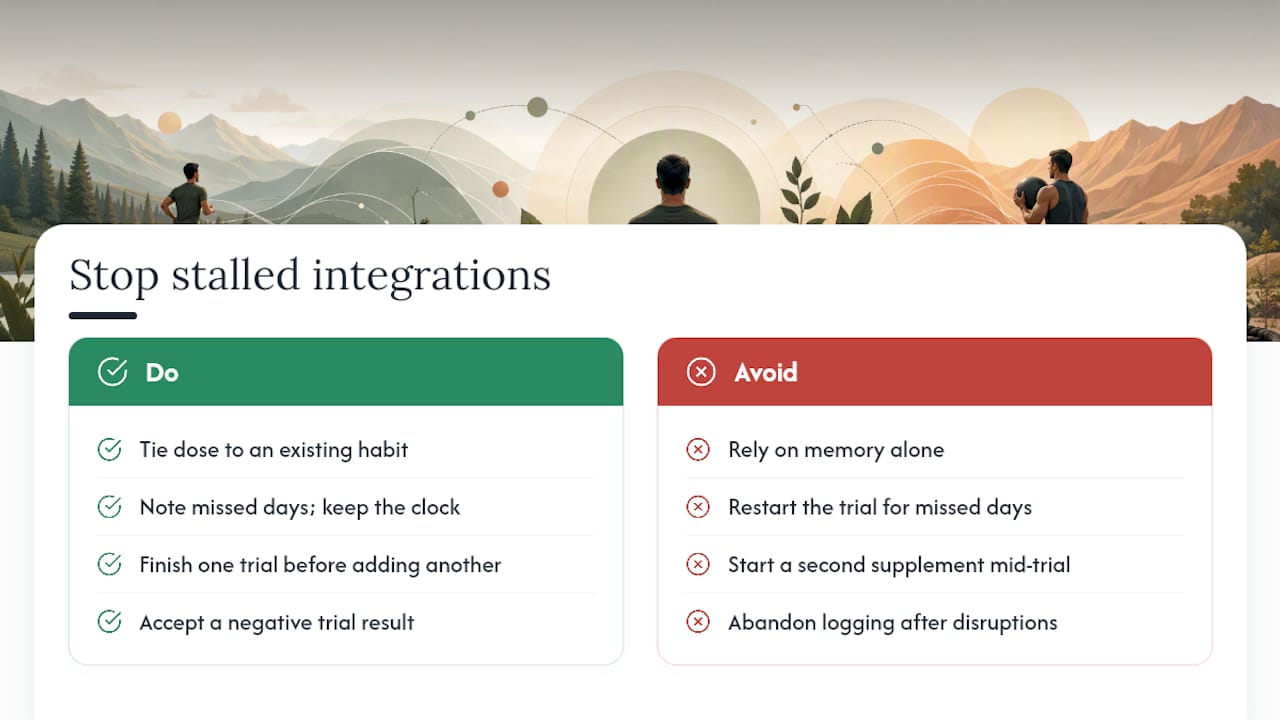
People forget doses, get impatient waiting for results, or start a second supplement before finishing the trial of the first, which muddies the data and the outcome. Travel, schedule changes, and stress spikes also throw off logging, which then makes the whole trial feel pointless and gets abandoned.
A few fixes that actually work: tie the dose to an existing habit, like brushing your teeth or your pre-workout shake, rather than relying on memory alone. If you miss a few days, don’t restart the whole trial clock. Just note the gap and keep going; a couple of missed doses in a 28-day window won’t invalidate your data.
If you genuinely feel nothing after a full trial period at an appropriate dose, that’s a valid result too. Not every herb suits every body, and a negative trial still tells you something useful: cross it off and move to the next candidate rather than assuming you did something wrong.
Where can you get help if you have questions or concerns?
You don’t have to figure this out alone, and for anything beyond a low-risk single-herb trial, you probably shouldn’t.
Registered dietitians, integrative medicine physicians, and pharmacists are all reasonable resources depending on your question. Pharmacists in particular are underused here. Most can check a supplement against your prescription list in a few minutes if you bring in the label or a written list. For more complex cases, an integrated care approach that folds supplement use into your broader treatment plan tends to catch issues a single specialist working alone might miss.
Online communities and forums can offer anecdotal support, but treat them as a place to ask better questions, not a substitute for a clinician’s answer about your specific medications or conditions. For general reference on typical doses and known interactions for a given herb, resources like MedlinePlus remain a solid, non-commercial starting point before you buy anything.
What are the legal and ethical lines to know?
Regulatory status varies by country and by product category, so a claim that’s accurate in one market may not hold in another. In the United States, herbal supplements are regulated as dietary supplements, not drugs, which means manufacturers can’t legally claim they treat, cure, or prevent disease, even when a customer sees anecdotal benefit.
Ethically, sourcing matters as much as legality. Overharvesting has put real pressure on wild populations of some botanicals, and buying from brands that disclose sourcing practices helps you avoid contributing to that problem unknowingly. Labor practices in botanical supply chains vary widely too, and transparency pages are a reasonable, if imperfect, way to check a brand’s stated commitments.
None of this should paralyze a reasonable, low-risk trial of a well-sourced, single-ingredient supplement. It’s a reason to buy from brands that answer these questions openly rather than ones that dodge them.
The Nutribliss approach to plant medicine integration
The gap between what supplements promise and what they deliver almost always comes down to sequencing. Sleep, protein intake, and consistent training have to come first; a botanical layered on top of a shaky foundation won’t fix the foundation.
A trial-first, single-ingredient approach isn’t cautious for caution’s sake. It’s the only way to actually know what’s working, which matters more than most people admit once they’re a few weeks into a routine that “feels fine.” Before you add anything, get clear on what quality signals to look for. Nutribliss’s own breakdown of supplement quality standards is a reasonable place to start comparing labels honestly. #nutribliss
— GAURAV
Ready to start your one-supplement trial?
If recovery is your goal, Nutribliss’s Electrolytes Supplement is built for exactly the kind of single-variable trial this article walks through: one product, transparent labeling, and a clear fit for hydration and post-training recovery instead of a ten-ingredient stack you can’t isolate. If sleep is the goal instead, the Sleep Formula Supplement follows the same calming-herb-at-night logic covered above, with dosing and ingredients listed plainly rather than buried in a proprietary blend.
Every Nutribliss product page lists ingredient amounts and sourcing details up front, so you can check them against the quality signals covered here before you buy anything. That’s the whole point of a trial-first approach: pick one product, know exactly what’s in it, and give it a fair four-week run. Start with one, track it honestly, and decide from there whether it earns a permanent spot in your routine.
Sources
- Functional Medicine | Cleveland Clinic
- Herbal Supplements - StatPearls - NCBI Bookshelf
- Herbs and supplements — MedlinePlus