

TL;DR:
- The strongest evidence for improving body composition supports supplementing with whey protein, creatine monohydrate, and caffeine alongside resistance training.
- These supplements enhance training quality and muscle growth but do not replace consistent exercise and proper nutrition.
The three supplements with the strongest evidence for improving body composition are whey protein (or a complete plant alternative), creatine monohydrate, and caffeine — and all three work as adjuncts to resistance training and a sound calorie strategy, not replacements for them. Here is what to do today:
- Hit your daily protein target first. Aim for 0.7–1.0 g per pound of bodyweight. Food first; powder to fill the gap.
- Start creatine monohydrate at 3–5 g/day. No loading phase required. Take it consistently, any time of day.
- Use caffeine strategically before key training sessions. Roughly 3–6 mg per kg of bodyweight, timed 30–60 minutes pre-workout.
Expect measurable strength changes within a few weeks on creatine and visible body-composition shifts over several weeks of consistent training and dieting. Before starting any new supplement, check for contraindications with a healthcare provider, especially if you take medication or have kidney, liver, or cardiovascular concerns.
Table of Contents
- TL;DR: Quick picks and dosing at a glance
- Why supplements alone won’t change your body composition
- Top-tier supplements: what the evidence actually says
- Mid-tier and conditional supplements: when they actually help
- How to stack these supplements and what a real day looks like
- Safety, side effects, and how long to expect results
- What recent meta-analyses actually show
- Key Takeaways
- A practitioner’s perspective on what actually works
- Nutribliss has the core supplements you actually need
- Key sources and further reading
TL;DR: Quick picks and dosing at a glance
Short on time? These are the supplements worth your money, ranked by evidence strength.
- Whey protein (or complete plant protein): Supports muscle protein synthesis and satiety. Use it to hit your daily protein target when whole food falls short.
- Creatine monohydrate: The most-researched supplement for lean mass gains and fat percentage reduction. Cheap, safe, and proven.
- Caffeine: Reliable performance booster that lets you train harder, which indirectly drives better body composition over time.
| Supplement | Typical Daily Dose | When to Take | Evidence Level |
|---|---|---|---|
| Whey / complete protein | Moderate protein dose per serving; daily intake aligned with bodyweight | Post-workout or any meal gap | High (multiple meta-analyses) |
| Creatine monohydrate | Consistent daily dosing in the range of a few grams | Any time — consistency matters | High (143+ trials) |
| Caffeine | Dose adjusted to bodyweight within a moderate range | 30–60 min pre-workout | High (replicated RCTs) |
| Omega-3 fatty acids | 2–3 g EPA+DHA/day | With a meal | Moderate (conditional) |
| Beta-alanine | 3.2–6.4 g/day | Split doses with meals | Moderate (performance-specific) |
Stack priority: Get protein and creatine dialed in before adding anything else. Everything else is optional.
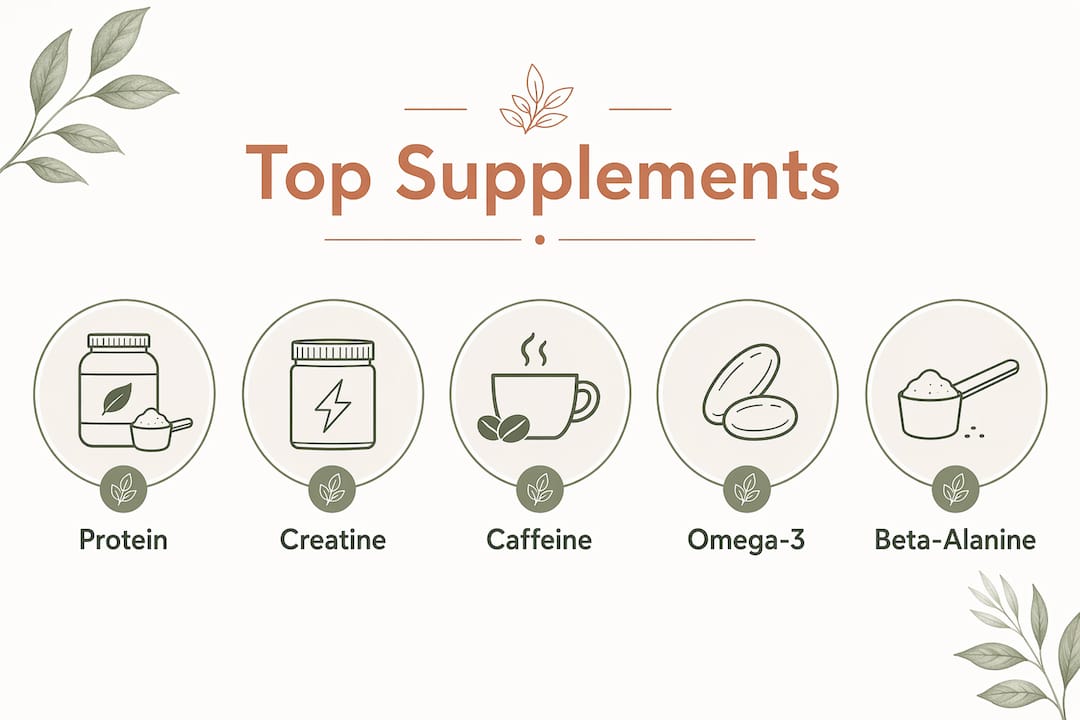
Why supplements alone won’t change your body composition
Supplements amplify what you are already doing. They do not create the conditions for change on their own.

The hierarchy matters here. Progressive resistance training is the primary driver of muscle retention and growth. Calorie balance determines whether you lose fat or gain it. Adequate daily protein protects muscle during a deficit and fuels synthesis during a surplus. Supplements sit at the top of that stack, not the bottom. Lean mass and fat reduction benefits from creatine and protein are diminished or absent without consistent training.
A practical way to think about it: protein powder helps you hit a daily target that whole food alone might not cover, especially during a calorie deficit when you are eating less. Creatine improves training quality, which means you can lift more volume over time, which drives more muscle stimulus. Neither supplement does anything meaningful if you are sedentary.
Population differences matter too. Older adults lose muscle faster and often eat less protein than they need, so muscle mass strategies become more urgent. Vegetarians and vegans typically have lower baseline creatine stores, which means they tend to respond more strongly to supplementation. Women benefit from the same core supplements as men — the dosing is the same relative to bodyweight.
Top-tier supplements: what the evidence actually says
Protein (whey and complete alternatives)
Protein is the foundation. Whey protein consistently ranks among the top evidence-backed options for muscle protein synthesis and satiety support during fat loss. It is fast-digesting, rich in leucine (the amino acid most responsible for triggering muscle protein synthesis), and practical to use.
Dosing and timing:
- Total daily protein: 0.7–1.0 g per pound of bodyweight (higher end during a calorie deficit)
- Per serving: 20–40 g of protein, ideally spread across 3–4 meals
- Whey post-workout or between meals; casein before bed for slower overnight release
- Plant-based options (pea + rice blend, soy) work well when leucine content is matched
Who benefits most: Anyone not hitting daily protein targets through food alone. Older adults, vegetarians, and people in a calorie deficit have the most to gain.
Safety note: Well-tolerated by most healthy adults. Those with dairy intolerance should use a plant-based alternative. Kidney concerns are not supported by evidence in healthy individuals at normal intakes.
Evidence callout: Systematic reviews on protein supplementation confirm whey’s role in fat-free mass gains and satiety when combined with resistance training.
Creatine monohydrate
Creatine is the single most-studied supplement for body composition. A meta-analysis of resistance training studies found it increases lean body mass by approximately 1.14 kg (95% CI: 0.69–1.59 kg), reduces body fat percentage by 0.88%, and cuts fat mass by roughly 0.73 kg in adults under 50.
Dosing and timing:
- Maintenance dose: 3–5 g/day, taken consistently
- Loading (20 g/day for 5–7 days) is optional — it speeds saturation but is not necessary
- Any time of day works; some research favors post-workout, but the difference is small
- Creatine monohydrate is the form with the most evidence; no need for fancier variants
Who benefits most: Anyone doing resistance training. Vegetarians and vegans see larger initial gains due to lower baseline muscle creatine stores.
Myth check: The initial weight gain from creatine is partly intracellular water, but imaging studies using MRI and ultrasound confirm real increases in upper-body muscle thickness of 0.10–0.16 cm with training. The tissue growth is real.
Evidence callout: A synthesis of 143+ creatine trials confirmed genuine muscle-thickness increases via imaging, separating actual tissue growth from water retention.
Safety note: Safe for healthy adults at standard doses. People with pre-existing kidney conditions should consult a clinician before starting.
Caffeine
Caffeine does not directly build muscle or burn fat in a meaningful way on its own. What it does is let you train harder, longer, and with more focus — and that training quality compounds over weeks and months into real body-composition changes.
Dosing and timing:
- 3–6 mg per kg of bodyweight, taken 30–60 minutes before training
- Start at the lower end (3 mg/kg) to assess tolerance
- Avoid within 6 hours of sleep to protect sleep quality
- Cycle off periodically (1–2 weeks every few months) to prevent tolerance buildup
Who benefits most: Anyone whose training intensity or volume is limited by fatigue or motivation. Less useful for low-intensity steady-state activity.
Evidence callout: A 2026 evidence synthesis found caffeine improves strength outcomes with a standardized mean difference of 0.20 across randomized trials.
Safety note: Avoid stacking with other stimulants. People with anxiety, hypertension, or heart arrhythmias should consult a clinician. Pregnancy is a contraindication for high caffeine intake.
Mid-tier and conditional supplements: when they actually help
These are not useless. They are just situational. The mistake most people make is buying these before they have protein and creatine sorted.

HMB (beta-hydroxy beta-methylbutyrate): Most useful for beginners or people returning after a long break. Evidence for trained individuals is weak. Typical dose: 3 g/day. Cost-to-benefit ratio drops sharply once you are past the novice stage.
Betaine: Some evidence for modest fat reduction and power output. A 2022 meta-analysis found betaine supplementation produced small improvements in body composition, though effect sizes are smaller than creatine. Typical dose: 2.5 g/day. Worth considering if creatine and protein are already covered.
Omega-3 fatty acids (EPA + DHA): Not a direct fat-loss tool, but omega-3s support joint health, reduce exercise-induced inflammation, and may help with muscle protein synthesis in older adults. A 2022 systematic review found omega-3 supplementation had a positive effect on muscle mass in older adults. Dose: 2–3 g EPA+DHA per day with a meal.
Beta-alanine: Buffers lactic acid during high-intensity efforts, which can extend training volume. The performance benefit is real but specific to efforts lasting 1–4 minutes. Dose: 3.2–6.4 g/day split across meals to reduce tingling (paresthesia). Not a body-composition supplement per se — it helps training quality in specific contexts.
BCAAs (branched-chain amino acids): If you are already hitting your daily protein target, BCAAs add nothing. The leucine, isoleucine, and valine you need are already in your protein powder and food. BCAA-only products frequently lack clinical advantage once total dietary protein and training are adequate. Save the money.
Fat-burner blends and proprietary stacks: Most lack robust validation for the ingredients beyond caffeine. The risks of proprietary blends include underdosed actives and undisclosed ingredient ratios. Spend that budget on protein or creatine instead.
Pro Tip: Omega-3s are one of the few mid-tier supplements worth adding even before your training is fully dialed in — the joint and inflammation benefits apply regardless of training status.
How to stack these supplements and what a real day looks like
One principle covers most of this: get protein and creatine right first, use caffeine around your hardest training sessions, and add mid-tier options only when the basics are consistent.
Stacking rules, in order:
- Protein first. Hit your daily target (0.7–1.0 g/lb) before worrying about anything else.
- Add creatine. 3–5 g/day, any time, every day — including rest days.
- Use caffeine selectively. Pre-workout on your 2–3 hardest training days per week. Not every session.
- Add omega-3s if recovery is a concern. 2–3 g EPA+DHA with a meal.
- Consider beta-alanine only if your training involves sustained high-intensity intervals. It is not a general body-composition supplement.
- Skip BCAAs and most fat-burner blends unless you have a specific, evidence-backed reason.
For practical mixing and timing guidance, the supplement stacking tips guide covers common combinations and what to avoid.
Example day templates:
Muscle-gain day (training in the afternoon):
- Morning: Creatine 5 g with breakfast
- Pre-workout (60 min before): Caffeine 200–300 mg
- Post-workout: Whey protein shake (25–40 g protein)
- Evening meal: Omega-3s 2 g with dinner
Fat-loss cut day (training in the morning):
- Pre-workout (45 min before): Caffeine 200 mg + creatine 5 g
- Post-workout: Whey protein shake (30–40 g protein)
- Lunch: Omega-3s 2 g with meal
- Evening: Casein protein if total daily protein is still short
Morning training day (early session):
- Pre-workout: Caffeine 150–200 mg (lower dose to protect sleep)
- Post-workout: Whey protein 25–40 g
- Creatine: Any time during the day with food
Pro Tip: Add one supplement at a time and give it 3–4 weeks before evaluating. If you add creatine, protein, and caffeine simultaneously, you will not know which one is driving the change.
Safety, side effects, and how long to expect results
Safety checklist by supplement
Protein (whey/plant): Safe for healthy adults. Lactose-intolerant individuals should use isolate or plant-based options. Not a concern for kidney health at normal intakes in people without pre-existing kidney disease.
Creatine monohydrate: Extensively studied and well-tolerated. The main side effect is a small initial weight increase from intracellular water. GI discomfort is rare at 3–5 g/day. Anyone with kidney disease should get medical clearance first.
Caffeine: The most common issues are anxiety, elevated heart rate, and disrupted sleep. Do not stack with other stimulants (pre-workout blends, energy drinks, ephedrine). People with hypertension, arrhythmias, or anxiety disorders should consult a clinician. Avoid during pregnancy at high doses.
Omega-3s: Generally safe. High doses (above 3 g/day) may have mild blood-thinning effects — relevant if you take anticoagulants.
Beta-alanine: The tingling (paresthesia) is harmless but uncomfortable. Split doses across meals to reduce it.
Realistic timelines
- Creatine: Muscle saturation takes 3–4 weeks at 3–5 g/day. Measurable strength gains typically appear within 2–4 weeks of consistent training.
- Protein: Muscle protein synthesis responds acutely, but meaningful lean mass changes take 8–12 weeks of consistent training and adequate intake.
- Fat loss: Depends almost entirely on calorie deficit. Supplements do not accelerate fat loss beyond their indirect training benefits. Expect gradual fat loss in a moderate deficit.
- Caffeine: Performance effects are acute — you feel them the same session.
Common misconceptions
“Creatine makes you fat.” It does not. The initial weight gain is water inside muscle cells, and the meta-analytic data shows fat mass actually decreases slightly with creatine plus training.
“More protein is always better.” Above roughly 1.0 g/lb/day, additional protein does not produce additional muscle gain. The excess is oxidized for energy.
“Fat burners speed up results.” Most proprietary fat-burner blends lack strong RCT evidence for additive body-composition effects beyond what caffeine alone provides.
Track progress with body measurements, progress photos, and training performance markers rather than scale weight alone. Scale weight fluctuates with water, food volume, and glycogen — none of which reflect actual fat or muscle change.
What recent meta-analyses actually show
The highest-quality evidence for body-composition supplements comes from meta-analyses and systematic reviews, which pool data across many trials to identify consistent effects.
Recent research supports creatine and protein as the highest-evidence supplements for increasing fat-free mass when combined with resistance training. Caffeine has replicated performance benefits across dozens of randomized controlled trials.
Key evidence points:
- Creatine + resistance training: Meta-analysis of RT studies found LBM gains of +1.14 kg, fat mass reduction of −0.73 kg, and fat percentage reduction of −0.88%.
- Imaging confirmation: MRI/ultrasound data from 143+ trials showed upper-body muscle thickness increases of 0.10–0.16 cm with creatine plus training.
- Caffeine strength effect: A 2026 synthesis found a standardized mean difference of 0.20 for strength outcomes across randomized trials.
- Whey protein: Systematic reviews confirm fat-free mass gains and satiety support with resistance training.
- Omega-3s in older adults: A 2022 systematic review found positive effects on muscle mass in older populations.
- Betaine: A 2022 meta-analysis showed small but measurable body-composition improvements.
| Supplement | Key Finding | Source Type |
|---|---|---|
| Creatine monohydrate | +1.14 kg LBM; −0.73 kg fat mass | Meta-analysis (RCTs) |
| Whey protein | Fat-free mass gains + satiety support | Systematic review |
| Caffeine | SMD 0.20 for strength outcomes | Evidence synthesis |
| Omega-3s | Positive muscle mass effect in older adults | Systematic review |
| Betaine | Small body-composition improvements | Meta-analysis |
Study limitations worth knowing: Most creatine and protein trials use DXA or imaging in trained young adults. Effects in older adults, women, and untrained populations may differ in magnitude. Real-world results depend heavily on training consistency and calorie control — supplements cannot compensate for either.
Key Takeaways
Protein and creatine monohydrate are the two supplements with the strongest evidence for improving body composition when combined with consistent resistance training.
| Point | Details |
|---|---|
| Protein is the foundation | Hit 0.7–1.0 g per pound of bodyweight daily; use whey or a complete plant protein to fill gaps. |
| Creatine monohydrate delivers real gains | Meta-analyses show +1.14 kg lean mass and −0.73 kg fat mass with resistance training. |
| Caffeine improves training quality | A standardized mean difference of 0.20 for strength; dose at 3–6 mg/kg, 30–60 min pre-workout. |
| Skip low-evidence products | BCAAs and most fat-burner blends add nothing when total protein and training are adequate. |
| Nutribliss for implementation | Browse the Nutribliss supplement collection for creatine, protein, and electrolyte options that map directly to these recommendations. |
A practitioner’s perspective on what actually works
The gap between what supplement marketing promises and what the evidence delivers is wide. Most people overestimate what supplements do and underestimate how much training quality and sleep matter.
The honest hierarchy: fix sleep first (7–9 hours is where muscle protein synthesis and recovery actually happen), then training consistency, then calorie and protein targets, then supplements. Creatine and protein are genuinely worth adding once the first three are in place. Everything else is conditional.
A few pitfalls worth naming. Buying a complex pre-workout blend before you have established a baseline protein intake is a common and expensive mistake. The caffeine in that blend is doing most of the work anyway. Single-ingredient supplements give you control over what you are taking and what is actually driving results.
For an older adult (say, 55+), the priority shifts slightly: protein intake becomes even more critical because muscle protein synthesis becomes less efficient with age, and omega-3s are worth adding for joint health and the muscle-mass evidence in that population. For a vegetarian or vegan, creatine supplementation tends to produce stronger initial results because baseline muscle creatine stores are lower — the response is often noticeably larger than in omnivores.
Cost matters too. Creatine monohydrate is one of the cheapest supplements per gram of active ingredient. Whey protein concentrate is more affordable than isolate and works just as well for most people. Spending more on a proprietary blend rarely buys more results. The fitness supplement trends worth watching in 2026 are mostly refinements of these basics, not new categories.
Nutribliss has the core supplements you actually need
The “Big 3” strategy (protein, creatine, caffeine) does not require a complicated shopping list. Nutribliss carries single-ingredient, science-focused options that map directly to these recommendations, without the proprietary blends or undisclosed ratios that make it impossible to know what you are actually taking.

The Nutribliss creatine monohydrate is a straightforward 3–5 g/day option with no fillers. The full supplement collection includes protein powders, electrolytes for training-day hydration, and vitamins that support the recovery side of body composition. For those curious about the formulation standards behind the products, the science behind superfoods page explains the research rationale. This article is general information, not medical advice — consult a healthcare provider before starting any new supplement if you have existing health conditions or take medication. Browse the #nutribliss collection and start with the two supplements the evidence supports most: protein and creatine.
Key sources and further reading
The recommendations in this guide are grounded in meta-analyses, systematic reviews, and imaging studies rather than single trials or marketing claims. These are the primary sources worth reading if you want to go deeper.
- Morton et al. (2018) — A meta-analysis on protein supplementation and resistance training outcomes. PubMed
- Lanhers et al. (2017) — Creatine supplementation and upper-limb strength performance: a meta-analysis. PubMed
- Delpino et al. (2022) — Omega-3 supplementation and muscle mass in older adults: systematic review. PubMed
- Cholewa et al. (2022) — Betaine supplementation and body composition: meta-analysis. PubMed
- Stares & Bains (2020) — The additive effects of creatine supplementation and exercise training on muscle strength: a systematic review. PMC
- Creatine body-composition meta-analysis (143+ trials) — Imaging-confirmed muscle thickness increases and LBM/fat mass data. FitChef
- Creatine + resistance training meta-analysis — LBM +1.14 kg; fat mass −0.73 kg. NSCA Journal
- Systematic review on whey protein and fat-free mass — Confirms satiety and muscle protein synthesis support. PMC
Evidence in this field evolves. Effect sizes in studies reflect averages across populations — your individual response depends on training status, diet, genetics, and consistency. For personalized guidance, consult a registered dietitian or sports medicine clinician.