

You would take magnesium to correct a shortfall in one of the body’s most overworked minerals, and to support specific, measurable functions: muscle and nerve signaling, exercise recovery, and a handful of targeted clinical uses like migraine prevention and mild blood pressure support. It’s not a cure-all, but the reasons that hold up in research are specific enough to act on.
- Correcting deficiency. Magnesium acts as a cofactor in over 300 metabolic reactions, so low intake ripples across energy production, glucose control, and heart rhythm.
- Muscle, nerve, and recovery support. Magnesium stabilizes ATP, the molecule your cells burn for energy, which is why heavy sweat losses or intense training can create a real, functional need.
- Targeted clinical uses. Trials support modest blood pressure reductions and probable benefit for migraine prevention, according to neurology and headache societies.
Key Takeaways
Magnesium supplementation is most justified by confirmed deficiency, specific clinical uses like migraine prevention, and modest blood pressure support, not vague symptom chasing.
| Point | Details |
|---|---|
| Deficiency is often silent | Mild insufficiency rarely causes clear symptoms, so risk factors matter more than how you feel. |
| Evidence strength varies | Blood pressure and migraine benefits are moderate; cramp relief lacks strong trial support. |
| Stick under the Upper Limit | Keep supplemental intake at or below 350 mg daily unless a clinician advises otherwise. |
| Kidney disease changes the math | Reduced kidney function raises the risk of magnesium buildup, so get medical guidance first. |
| Nutribliss offers targeted formulas | Its Sleep Formula Supplement uses magnesium’s neuromuscular role for evening relaxation support. |
This article is general information, not a substitute for advice from a qualified doctor. Consult a qualified healthcare professional about your own circumstances before acting on anything here.
Table of Contents
- Why Would You Take Magnesium? Understanding the Core Role
- What Health Benefits Does Magnesium Supplementation Actually Have?
- Who Actually Needs to Supplement Magnesium?
- How Much Magnesium Should You Take and in What Form?
- Can You Get Enough Magnesium From Food Alone?
- Are There Side Effects or Risks to Taking Magnesium?
- When Should You See a Doctor About Magnesium Levels?
- Sources
Why Would You Take Magnesium? Understanding the Core Role
Magnesium is an essential mineral and electrolyte, meaning your body can’t manufacture it and depends entirely on food or supplements. Roughly 25 grams sit in the average adult body, and about 50 to 60% of that lives in bone, acting as a mineral reservoir the body draws from when intake runs short.
The rest works in soft tissue and blood, where it earns its keep as a cofactor in hundreds of enzymatic reactions:
- Stabilizing ATP, the energy currency every cell runs on
- Regulating neuromuscular conduction, the signal that tells muscles when to contract and relax
- Supporting bone mineral density alongside calcium and vitamin D
- Helping maintain a normal heart rhythm and vascular tone
That reservoir system explains why blood tests can look normal even when tissue levels are already running low, a wrinkle worth understanding before you assume a “normal” lab result rules out a problem.
What Health Benefits Does Magnesium Supplementation Actually Have?
Not every claimed benefit of magnesium carries the same weight of evidence. Sorting them by evidence strength gives you a realistic picture instead of marketing hype.
Strong evidence: Magnesium corrects diagnosed deficiency and supports normal neuromuscular and cardiac function. This is the least glamorous benefit and the most well established one.
Moderate evidence: Blood pressure trials show systolic reductions of roughly 2 to 4 mmHg in some studies, with larger effects at higher supplemental doses. That’s not dramatic, but it’s a real, reproducible signal, particularly when combined with a DASH-style eating pattern rich in potassium and calcium. Migraine prevention falls in this tier too. The American Academy of Neurology and American Headache Society consider magnesium probably effective for prevention, based on the trials available.
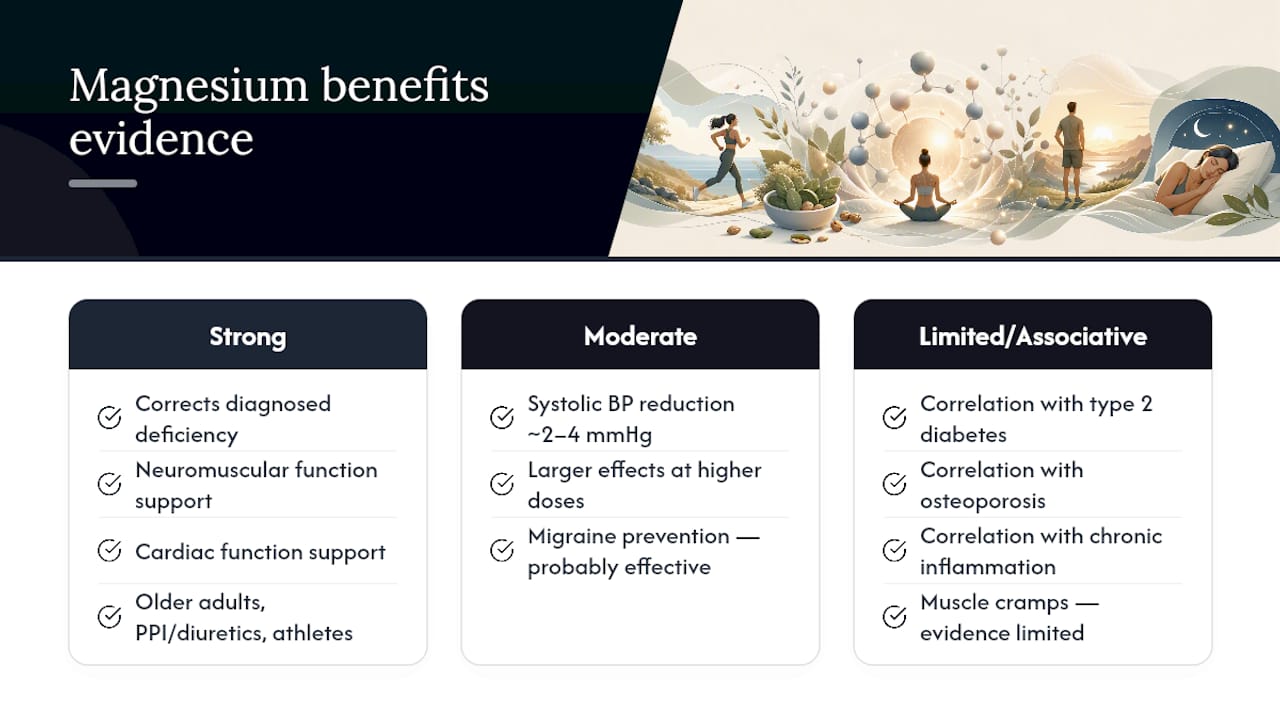
Limited or associative evidence: Low dietary magnesium correlates with higher rates of type 2 diabetes, osteoporosis, and chronic inflammation, but correlation isn’t the same as proof that supplementing reverses those risks in someone who isn’t deficient. Muscle cramps sit here too. Cramps are common and non-specific, and Nutribliss’s guide to magnesium for exercise covers why cramping alone isn’t a reliable deficiency signal.
Pro Tip: Older adults, people on long-term PPIs or diuretics, and athletes losing significant fluid through sweat are the subgroups most likely to see a measurable benefit from supplementation, since these are the groups with the clearest mechanisms for magnesium loss.
Who Actually Needs to Supplement Magnesium?
Magnesium loss usually traces back to a specific mechanism, not bad luck. Recognizing your own risk factors is more useful than guessing from symptoms alone.
- Older adults, who absorb magnesium less efficiently and often eat less magnesium-rich food
- People with GI conditions like Crohn’s disease or celiac disease that impair absorption
- Chronic alcohol use, which increases urinary magnesium loss
- Uncontrolled diabetes, where high blood sugar drives magnesium excretion
- Long-term use of proton pump inhibitors or diuretics
- Athletes with heavy, sustained sweat losses
- Pregnant people in the third trimester and those breastfeeding
Mild insufficiency is frequently silent. Severe depletion, by contrast, produces defined signs. According to MedlinePlus, most people stay symptom-free until serum magnesium drops below about 1.2 mg/dL. If you’re dealing with recurrent cramps despite a decent diet, or a clinician finds refractory low potassium or calcium, that’s a reasonable trigger for testing.
How Much Magnesium Should You Take and in What Form?
The Recommended Dietary Allowance sits around 310 to 420 mg daily depending on age and sex, but the number that matters more for supplement shoppers is the Tolerable Upper Intake Level: 350 mg per day from supplements specifically, separate from food-based magnesium.
Different salts behave differently in the gut:
- Magnesium citrate: well absorbed, commonly used, mild laxative effect at higher doses
- Magnesium oxide: cheap and high in elemental magnesium by weight, but poorly absorbed
- Magnesium glycinate: gentler on digestion, often chosen for daily use without GI upset
- Magnesium chloride and sulfate: used in topical or IV contexts more than routine oral dosing
For mild depletion, 300 to 600 mg of elemental magnesium daily is a typical range, often split into two doses to ease absorption and reduce GI upset. Nutribliss’s guide on how to take magnesium breaks down timing in more detail.
Pro Tip: Take magnesium with food and split your dose morning and evening rather than one large hit at bedtime. It reduces the loose-stool effect that sends people back to the shelf looking for a gentler form.

Can You Get Enough Magnesium From Food Alone?
Diet is the right starting point for most people, and it’s easier than it sounds to hit meaningful numbers without a supplement bottle in sight.
- Leafy greens like spinach: about 78 mg per cooked cup
- Almonds: roughly 80 mg per ounce
- Legumes, particularly black beans and lentils
- Pumpkin seeds and other seeds
- Whole grains and some fortified cereals
- Certain fish, including salmon and mackerel
Pairing magnesium-rich foods with calcium and vitamin D sources supports bone density more effectively than any single nutrient alone, a point echoed in bone-focused nutrition guidance on food-based strategies.
Pro Tip: A handful of almonds plus a cup of cooked spinach gets you close to 160 mg of magnesium before lunch, no supplement required.

Are There Side Effects or Risks to Taking Magnesium?
Magnesium is generally well tolerated, but it’s not risk-free, especially at higher supplemental doses or for certain medical situations.
- Diarrhea and abdominal cramping are the most common complaints, especially with citrate or oxide forms
- Nausea, low blood pressure, and in severe excess, cardiac irregularities can occur with very high intake
- People with reduced kidney function are at particular risk of magnesium buildup (hypermagnesemia) since the kidneys can’t clear the excess
- Magnesium can interact with certain antibiotics and bisphosphonates, reducing their absorption
If you have kidney disease or take medications that interact with magnesium, talk to a clinician before starting a supplement, particularly at doses above the RDA. Nutribliss’s zinc and magnesium guide covers a few other nutrient interactions worth knowing about.
Pro Tip: If you take tetracycline or fluoroquinolone antibiotics, separate them from magnesium by at least 2 to 4 hours. Taken together, magnesium binds the antibiotic and blunts its absorption.
When Should You See a Doctor About Magnesium Levels?
Some symptoms need urgent care, not a supplement aisle decision. Treat these as red flags:
- Irregular heartbeat or palpitations
- Seizures
- Severe, unexplained muscle weakness
For less urgent but persistent symptoms, especially alongside risk factors like long-term PPI or diuretic use, ask your physician about testing. Severe hypomagnesemia typically requires IV correction under medical supervision, not oral capsules.
An Evidence-First Take on Supplementing
I’ve spent years looking at how nutrition claims hold up against actual trial data, and magnesium is one of the few minerals where the hype and the evidence mostly line up, as long as you match the right form to the right reason. That’s the standard Nutribliss builds its formulas around. #nutribliss
A Practical Next Step If You’re Considering Magnesium for Sleep
Magnesium’s role in neuromuscular relaxation is one reason it shows up in sleep-support formulations, particularly for people whose restlessness is tied to muscle tension rather than a sleep disorder. If you’ve read this far and suspect your evening routine could use that kind of support, Nutribliss’s Sleep Formula Supplement is formulated with ingredient transparency in mind, so you can see exactly what you’re taking and why.

Check the product page for the full ingredient breakdown and current availability, and decide from there whether it fits into your routine.
Sources
- Magnesium: Health Effects, Deficiency Burden, and Future Public Health Directions (PMC)
- Magnesium deficiency: MedlinePlus Medical Encyclopedia
- Magnesium — Health Professional Fact Sheet (Office of Dietary Supplements, NIH)
- Hypomagnesemia — StatPearls (NCBI Bookshelf)