

For most healthy adults, omega-3 supplements are safe when taken at typical over-the-counter doses. The people who need real caution are those on blood thinners, anyone facing surgery, and pregnant or breastfeeding patients who should loop in a clinician first. The FDA advises no more than 5 grams a day of combined EPA and DHA from supplements, and most clinicians get cautious once intake climbs past 3 grams daily because of rising bleeding risk. The side effects you’ll actually run into are mostly nuisance-level: fishy aftertaste, burping, mild heartburn, occasional loose stools. Rarer but more serious concerns, like abnormal bleeding or an irregular heartbeat, show up mainly at high doses or in people with existing risk factors.
Key Takeaways
Omega-3 supplements are safe for most healthy adults under 3 grams a day, but bleeding risk and rare cardiac effects rise at higher doses and in people on blood thinners.
| Point | Details |
|---|---|
| Mild side effects are common | Fishy aftertaste, burping, and mild GI upset affect a minority of people taking omega-3s and usually fade within two weeks. |
| Know the dose thresholds | Most adults tolerate up to 3 g/day; the FDA’s upper limit is 5 g/day, with AF risk signals appearing above 4 g/day in some trials. |
| Bleeding risk is dose-dependent | Anyone on warfarin, DOACs, or antiplatelet drugs should talk to a clinician before starting or increasing omega-3s. |
| Formulation fixes most complaints | Taking capsules with food, splitting doses, and freezing softgels resolve most fishy aftertaste and reflux issues. |
| Nutribliss offers a transparent option | The Nutribliss Omega-3 Fish Oil Supplement is formulated with ingredient transparency for readers who want a vetted, science-backed choice. |
Table of Contents
- What Are the Common Omega-3 Side Effects?
- What Serious Risks Should You Watch For?
- Which Medications Interact With Omega-3 Supplements?
- How Much Omega-3 Is Too Much?
- How Can You Reduce Fish Oil Side Effects?
- When Should You Stop and Call a Doctor?
- What Does the Research Actually Show?
- Sources
What Are the Common Omega-3 Side Effects?
Most people who take fish oil describe the same handful of common side effects, and none of them are dangerous. They’re the reason so many people quit a bottle halfway through instead of the reason to see a doctor.
- Fishy or metallic aftertaste that lingers after swallowing
- Bad breath or fishy-smelling sweat
- Burping, especially soon after a dose
- Heartburn or mild reflux
- Nausea or general stomach discomfort
- Loose stools or diarrhea
- Headache
According to MedlinePlus, these digestive complaints affect a minority of people taking omega-3s, while genuinely serious reactions are uncommon. That’s a wide range, and it depends heavily on dose, formulation, and whether you’re taking capsules on an empty stomach.
Timing matters here. Most of these effects show up within the first few days of starting a new supplement, often easing within one to two weeks as your body adjusts. If symptoms haven’t faded by then, or they’re getting worse rather than better, that’s usually a formulation problem, not something you need to push through.

What Serious Risks Should You Watch For?
The mild stuff is common. The serious stuff is rare but worth understanding before you assume more omega-3 is always better.
- Bleeding risk rises with dose, and it compounds sharply if you’re already on an anticoagulant or antiplatelet drug.
- Atrial fibrillation has shown a dose-dependent signal in trials, with risk becoming more apparent at daily intakes above roughly 4 grams, according to the MSD Manual. People with existing heart disease or known AF risk factors are the ones most likely to be affected.
- LDL cholesterol increases and liver enzyme changes have been documented with some DHA-containing prescription formulations, per StatPearls, which is why bloodwork monitoring is part of the picture for higher-dose regimens.
- Allergic reactions are a real concern for anyone with a seafood allergy, since refining doesn’t always remove every trace allergenic protein, according to Health Canada.
Pro Tip: If you have a diagnosed heart rhythm issue, mention any omega-3 supplement to your cardiologist even if it’s “just” an over-the-counter brand. Dose and cardiac history both factor into that risk conversation.
Which Medications Interact With Omega-3 Supplements?
The interaction list is shorter than people expect, but it matters. Omega-3s at higher doses can enhance the blood-thinning effect of several drug classes, so combining them without medical input isn’t a great idea.
- Warfarin and other anticoagulants, where the NIH’s Office of Dietary Supplements flags a real interaction risk requiring monitoring
- Direct oral anticoagulants (DOACs) like apixaban or rivaroxaban
- Antiplatelet agents, including aspirin and clopidogrel
- Some antihypertensives, since omega-3s can modestly lower blood pressure on their own
- Immunosuppressants, where effects are less studied but still worth flagging to a clinician
If you have elective surgery scheduled, most surgical teams recommend stopping high-dose fish oil roughly one to two weeks beforehand, mirroring standard precautions for other agents that affect clotting. Pregnant and breastfeeding patients generally tolerate moderate omega-3 intake well, though evidence on very high supplemental doses during pregnancy is thinner than the evidence for dietary fish. Anyone managing multiple prescriptions should treat “just a supplement” as a real variable and mention it at every appointment.
How Much Omega-3 Is Too Much?
Most over-the-counter softgels deliver somewhere between 250 mg and 1,000 mg of combined EPA and DHA per capsule, which means hitting even 2 grams a day usually takes two or three pills. WebMD notes that doses of 3 grams or less daily are considered likely safe for most adults, while the FDA’s ceiling for supplemental EPA and DHA sits at 5 grams a day.
- Under 3 g/day: generally well tolerated, minimal bleeding concern for most healthy adults
- 3 to 5 g/day: the FDA’s upper limit range, where clinical caution starts to apply
- Above 4 g/day: trial data shows a dose-dependent uptick in atrial fibrillation risk in some populations
Prescription omega-3 products deserve a separate mention here. Formulations like purified EPA ethyl esters are studied and dosed very differently from a generic drugstore fish oil capsule, and they’re prescribed for specific triglyceride or cardiovascular indications, not casual wellness use. If you’re trying to figure out how to choose a good omega-3 supplement, understanding this distinction between clinical-grade dosing and everyday supplementation matters more than chasing the highest milligram count on the label.
How Can You Reduce Fish Oil Side Effects?
Most of the common complaints are fixable without giving up on omega-3s entirely.
- Take capsules with a meal, ideally one containing some fat, to improve absorption and cut down on reflux
- Split your daily dose into two smaller servings instead of one large one
- Try enteric-coated softgels, which delay breakdown until the capsule clears the stomach
- Freeze your capsules. Pharmacists have long recommended freezing fish oil softgels to reduce fishy burps, and it works for a lot of people.
Pro Tip: If dose-splitting and freezing still leave you with daily heartburn, talk to a clinician about a lower dose or a different EPA/DHA ratio before writing off omega-3s completely.
When Should You Stop and Call a Doctor?
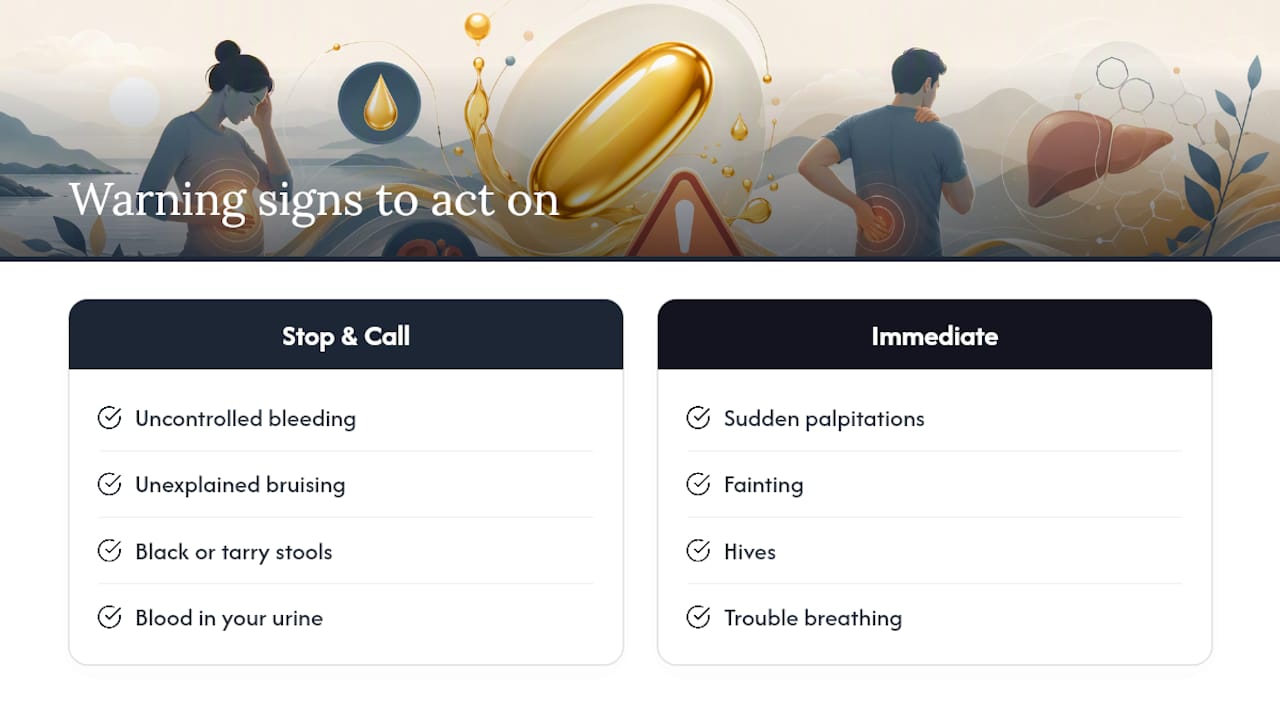
Certain symptoms cross the line from annoying to urgent. Stop the supplement and contact a clinician if you notice uncontrolled bleeding, unexplained bruising, black or tarry stools, or blood in your urine. Sudden palpitations, fainting, hives, or trouble breathing warrant immediate medical attention.
When you do call, have your dose, how long you’ve taken it, and any other medications ready to share. Significant reactions can also be reported to the FDA’s MedWatch program.
What Does the Research Actually Show?
Trial evidence tells a more layered story than most supplement marketing suggests. Triglyceride lowering has solid support, and some cardiovascular outcome data looks promising, but a lot of that benefit traces back to prescription-grade EPA ethyl ester formulations, not the fish oil sitting on a drugstore shelf.
Cardiovascular benefit signals in major trials are largely tied to purified prescription EPA products studied at specific, monitored doses. Generic over-the-counter fish oil varies in purity and concentration and hasn’t consistently replicated those same outcomes.
Evidence on broader claims, like cancer risk reduction or cognitive protection, remains mixed at best. Clinicians tend to reach for prescription formulations specifically when triglycerides are significantly elevated, precisely because those products come with defined dosing and lab monitoring that OTC supplements don’t.
A grounded take on omega-3 safety
Nutribliss builds every formula around evidence, not hype, because a whole-lifestyle approach to wellness only works when the science actually holds up. Omega-3s are genuinely useful for most people, but “more is better” is exactly the kind of thinking that gets people into trouble with dosing. #nutribliss
Where to Find a Science-Backed Omega-3 Option
If you want an omega-3 supplement built around transparent, evidence-based formulation rather than guesswork on the label, the Nutribliss Omega-3 Fish Oil Supplement is worth a look, alongside the research behind it on the Nutribliss Science page. Neither replaces a conversation with your clinician, especially if you’re on blood thinners, pregnant, breastfeeding, or managing a chronic condition. Check the product page for current EPA and DHA amounts per serving and decide whether it fits the dosing guidance covered above before adding it to your routine.
Sources
- Omega-3 Fatty Acids: MedlinePlus Drug Information
- Omega-3 Fatty Acids — Health Professional Fact Sheet, Office of Dietary Supplements (NIH)
- Omega-3 Fatty Acids - StatPearls
This article is general information, not a substitute for advice from a qualified doctor. Consult a qualified healthcare professional about your own circumstances before acting on anything here.