

TL;DR:
- Prioritizing wellness spending means focusing on supplements with the strongest clinical evidence for your needs. Starting with foundational nutrients like vitamin D3, omega-3s, and multivitamins provides the best health returns and affordability. Verifying quality through third-party certifications and retesting health markers ensures effective, data-driven supplement use.
Prioritizing wellness supplement spending means allocating your budget to supplements with the strongest clinical evidence for your specific nutritional gaps, not the loudest marketing claims. Most people waste money on trendy products before covering foundational needs. The global supplement market gives consumers thousands of options, but the evidence supports a much shorter list of true essentials. Knowing how to prioritize wellness supplement spending starts with three anchors: your personal health data, third-party quality verification through bodies like USP and NSF, and a cost-per-effective-dose calculation that reveals true value. Nutribliss builds its entire product approach around these same principles.
How to prioritize wellness supplement spending: start with foundational nutrients
The most clinically supported supplements are also the most affordable. Multivitamins, vitamin D3, and omega-3 fish oil form the foundation of any evidence-based supplement plan. These three address the most common nutritional gaps in the American diet, including widespread vitamin D insufficiency and low omega-3 intake from food alone.
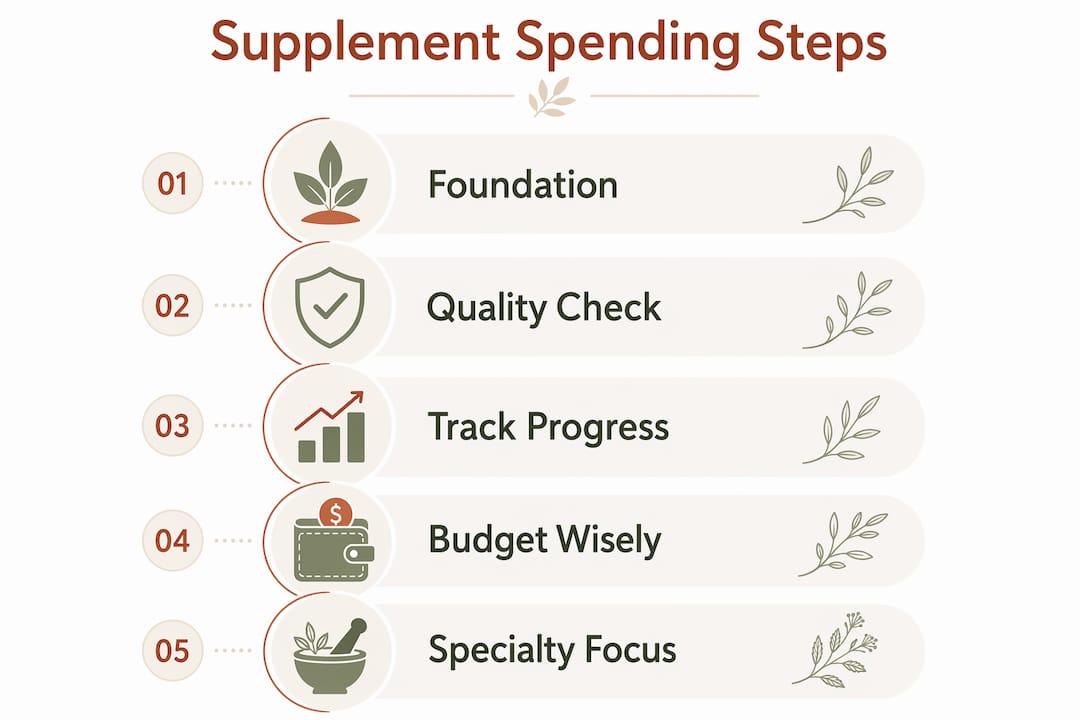
Budgeting for wellness supplements follows a clear tier structure. Foundation-level supplements, including a quality multivitamin and vitamin D3, typically run $40–$60 per month. Anti-inflammatory and omega-3 products sit in the $60–$90 range. Performance and specialty supplements occupy the $90–$120 tier. That hierarchy exists for a reason: you get the most health return per dollar at the foundation level.
Supplements serve as nutritional insurance, not a replacement for food. If you can address a deficiency through diet, such as eating fatty fish twice a week for omega-3s, that is always the better first move. Supplementation fills gaps when diet alone cannot close them reliably.
- Vitamin D3: Deficiency is widespread and linked to immune function, bone health, and mood regulation. A standard dose costs well under $1 per day.
- Omega-3 fish oil: Supports cardiovascular and cognitive health. Look for products listing EPA and DHA content, not just “fish oil.”
- Magnesium: Commonly depleted by stress and poor diet. Magnesium glycinate or malate forms absorb better than magnesium oxide.
- Multivitamin: Covers micronutrient gaps without requiring you to track every vitamin individually.
Pro Tip: Buy vitamin D3 paired with K2. K2 directs calcium to bones rather than arteries, which makes the combination more effective than D3 alone.
How do you verify supplement quality before buying?
The FDA does not require premarket safety or efficacy approval for dietary supplements. Under the Dietary Supplement Health and Education Act (DSHEA), a supplement only needs to be “reasonably expected to be safe.” Efficacy proof is not mandatory before a product reaches store shelves. That regulatory gap means the burden of quality verification falls entirely on you.
Third-party certifications fill that gap. USP (United States Pharmacopeia), NSF/ANSI 173, and GMP (Good Manufacturing Practice) certification each signal that an independent body has tested the product for label accuracy, contamination, and manufacturing standards. A guide to third-party tested supplements explains what each certification covers and how to read the seals correctly.
Certificates of Analysis (COA) are the most direct proof of quality. A COA is a lab report showing the actual tested content of a supplement, including active ingredients and contaminants. Reputable brands make COAs available on request or on their website. If a company cannot produce one, that is a red flag.
Watch for these warning signs when evaluating any product:
- Claims that a supplement “cures,” “treats,” or “prevents” a disease. The FDA prohibits these claims for supplements.
- Proprietary blends that hide individual ingredient doses behind a single total weight.
- No listed manufacturer address or batch number on the label.
- Prices dramatically below market rate for the same ingredient and dose.
Pro Tip: Check the active ingredient form, not just the name. “Magnesium” on a label could mean magnesium oxide (poorly absorbed) or magnesium glycinate (well absorbed). The form determines whether you actually benefit.
How does tracking health markers guide smarter supplement spending?
Measuring outcomes is the single most effective way to avoid wasting money on supplements that are not working for you. Effective supplement budgeting moves away from vague goals toward measurable health markers like lab results, heart rate variability (HRV), sleep scores, and physical performance metrics.

The standard evaluation window is 8–12 weeks. After starting a new supplement, retest the relevant blood marker at the end of that window. For vitamin D, the target range is 40–60 ng/mL. If your level has not moved after 8–12 weeks, the dose is wrong or the product is low quality. Retesting at 8–12 weeks gives you objective data to decide whether to continue, adjust, or stop spending on that product.
A practical tracking approach uses four data sources:
- Blood panels: Test vitamin D, omega-3 index, ferritin, magnesium (RBC), and B12 at minimum. These are the markers most directly tied to common supplement categories.
- HRV and sleep scores: Wearables like WHOOP or Oura Ring track these daily. Magnesium and ashwagandha, for example, often show measurable sleep score improvements within 4–6 weeks.
- Physical performance: Track strength, endurance, or recovery time. Creatine and beta-alanine have measurable performance benchmarks within 4–8 weeks.
- Subjective logs: Rate energy, mood, and focus weekly. Subjective data is less precise but catches changes that lab panels miss between testing cycles.
Tools like PRYM Wellness help you track health markers at home, which makes it easier to connect supplement changes to real outcomes without waiting for a clinic appointment. Treat every new supplement as an experiment with a defined end date and a measurable success criterion.
What budgeting strategies maximize your supplement value?
Cost-per-effective-dose is the correct metric for comparing supplements, not price per bottle. A $15 bottle of vitamin D3 with 5,000 IU per capsule delivers more value than a $10 bottle with 400 IU per capsule if your blood levels require a higher dose. True supplement value comes from dividing the price by the number of clinically relevant doses, not by capsule count.
Buying in bulk vs. buying small quantities
Stable supplements with long shelf lives, including vitamin D3, magnesium, and creatine, are good candidates for bulk purchasing. Buying a 180-count bottle versus a 60-count bottle often cuts the per-dose cost by 30–40%. Sensitive supplements, such as probiotics and fish oil, degrade faster. Buy these in smaller quantities and store them correctly to avoid paying for a product that has lost potency.
Managing subscriptions without overspending
Subscriptions work well for foundational supplements you use every day without exception. They work poorly for specialty products you cycle or use situationally. Audit your subscriptions every 90 days. Cancel any product you have more than a 60-day supply of already stocked. Excess inventory is money sitting on a shelf, not working in your body.
| Supplement type | Best purchase strategy | Reason |
|---|---|---|
| Vitamin D3, magnesium, creatine | Bulk or subscription | Stable, daily use, long shelf life |
| Fish oil, probiotics | Small quantity, frequent | Sensitive to heat and oxidation |
| Specialty adaptogens | Single purchase first | Test response before committing |
| Protein powder | Bulk when flavor confirmed | High volume, stable, costly per serving |
Pro Tip: Use a price-tracking browser extension to monitor supplement prices over time. Many products cycle through sales every 6–8 weeks. Buying at the low point on foundational supplements can reduce your annual spend meaningfully.
Starting from personal health data rather than marketing claims is the most reliable way to avoid costly mistakes. Work backward from your labs and diet gaps, not forward from a product page.
Which specialty supplements are worth the extra budget?
Specialty supplements earn their place only after foundational needs are covered. The evidence supports a short list of performance and recovery products for people with active lifestyles or specific health goals.
- Creatine monohydrate: One of the most studied supplements in sports science. Supports strength, power output, and cognitive function. Effective at 3–5 grams per day.
- Collagen peptides: Supports joint health and connective tissue recovery. Most relevant for people with high training volume or joint discomfort.
- Ashwagandha (KSH-66 extract): Clinically studied for cortisol reduction and stress resilience. The KSH-66 form has the strongest research backing.
- Zinc and selenium: Often missing from standard multivitamins in therapeutic doses. Relevant for immune function and thyroid health.
Avoid impulse purchases on products with fewer than three independent clinical trials behind them. Trendy ingredients cycle through the market quickly. Most disappear within two years because the evidence never materializes. Use a supplement selection framework that requires clinical evidence before adding any new product to your routine.
Consistency matters more than variety. A person who takes vitamin D3, omega-3s, and magnesium every day for a year will see more measurable benefit than someone who cycles through ten different specialty products without tracking any of them.
Key Takeaways
Prioritizing wellness supplement spending requires starting with clinically supported foundational nutrients, verifying quality through third-party certifications, and measuring outcomes with blood markers every 8–12 weeks to confirm value before continuing any product.
| Point | Details |
|---|---|
| Foundation first | Spend $40–$60/month on vitamin D3, omega-3s, and a multivitamin before adding specialty products. |
| Verify quality independently | Look for USP, NSF, or GMP certification and request a Certificate of Analysis for any product you buy. |
| Measure outcomes at 8–12 weeks | Retest blood markers after each supplement cycle to confirm the product is working before continuing spend. |
| Calculate cost-per-effective-dose | Divide price by clinically relevant doses, not capsule count, to find true value. |
| Specialty supplements come last | Add creatine, collagen, or adaptogens only after foundational gaps are covered and evidence supports your specific goal. |
What I’ve learned from years of watching people spend wrong on supplements
The most common mistake I see is not buying cheap products. It is buying the right products in the wrong order. People spend $80 a month on collagen and adaptogens while their vitamin D level sits at 18 ng/mL. That is backwards. The foundation always comes first, and the labs tell you what the foundation actually needs.
The second mistake is trusting marketing language over manufacturing transparency. A product that claims to “support cellular energy” without a COA or third-party seal is not a supplement. It is a bet. I have seen people spend hundreds of dollars a month on products with no verifiable quality standard and wonder why they feel no different.
What actually works is treating your supplement routine like a small clinical trial. Set a measurable goal, run the protocol for 8–12 weeks, test the outcome, and decide based on data. That process eliminates waste faster than any budget spreadsheet. It also builds a routine you can sustain because every product in it has earned its place. Brands like Nutribliss that publish their science and support third-party testing make that process easier. The #nutribliss approach to transparency is what evidence-driven spending looks like in practice.
— GAURAV
Nutribliss and the science of spending smarter on supplements

Nutribliss was built on the premise that supplement quality and price transparency should not be in conflict. Every product in the Nutribliss catalog is formulated with clinically relevant doses and supported by a research-backed approach to ingredient selection and manufacturing standards. You can review the science directly before you buy, which is exactly what evidence-driven spending requires.
For people focused on performance and recovery, the fitness supplement collection covers the specialty tier with products that meet the same quality standards as the foundational range. Whether you are building your first supplement stack or auditing an existing one, Nutribliss gives you the product transparency and quality verification to spend with confidence.
FAQ
What supplements should I buy first on a tight budget?
Start with vitamin D3, omega-3 fish oil, and a quality multivitamin. These three address the most common nutritional gaps and deliver the highest evidence-based return per dollar spent.
How do I know if a supplement is actually working?
Retest the relevant blood marker 8–12 weeks after starting the supplement. If the marker has not moved toward your target range, the dose or product quality needs to change.
Does the FDA approve supplements before they are sold?
No. The FDA does not require premarket safety or efficacy approval for dietary supplements. Look for USP, NSF/ANSI 173, or GMP certification as independent quality verification instead.
What does cost-per-effective-dose mean?
Cost-per-effective-dose is the price of a supplement divided by the number of clinically relevant doses in the bottle. It reveals true value better than price per capsule or price per bottle.
When should I add specialty supplements to my routine?
Add specialty supplements only after your foundational nutrients are covered and your blood markers confirm no major deficiencies. Choose products with at least three independent clinical trials supporting the specific health goal you are targeting.