

TL;DR:
- Magnesium glycinate offers superior absorption and fewer gastrointestinal side effects compared to other forms like oxide or citrate due to chelation with glycine. It supports sleep by activating GABA-A receptors and promoting relaxation through its dual-action effects, with clinical evidence showing modest but consistent benefits. For safe and effective use, start with low doses, stay within the NIH limit, and adjust gradually to enhance relaxation and nerve support without adverse effects.
Magnesium glycinate is defined as magnesium bound to the amino acid glycine, and it is the superior supplemental form for most adults because it delivers higher absorption rates and far fewer gastrointestinal side effects than magnesium oxide, citrate, or sulfate. The NIH, Mayo Clinic, and Banner Health all recognize this chelated form as one of the most bioavailable options available. If you are taking magnesium for sleep, muscle relaxation, or digestive comfort, the form you choose determines how much of that magnesium your body actually uses. Magnesium glycinate advantages go beyond simple absorption. The glycine component adds its own calming effects, making this form uniquely suited to nervous system support.
Why is magnesium glycinate better absorbed than other forms?
Magnesium glycinate’s absorption advantage comes directly from chelation. When magnesium binds to glycine, it travels through the intestinal wall using amino acid transport pathways rather than relying on passive diffusion. This bypasses the bottleneck that limits other forms. By contrast, magnesium oxide has roughly 4% bioavailability, meaning most of the dose is excreted before it ever reaches the bloodstream. That low absorption rate is also why oxide-based supplements so frequently cause diarrhea. Your gut is essentially trying to flush out what it cannot absorb.
Banner Health and Mayo Clinic describe magnesium glycinate as well absorbed and easier on digestion than most other supplemental forms. The practical implication is straightforward: you get more usable magnesium per capsule, with less risk of spending the next hour near a bathroom. For anyone who has tried magnesium citrate and found it too harsh, switching to glycinate is the logical next step.
The glycine component adds a second layer of benefit that other forms simply cannot replicate:
- Calming neurotransmitter activity: Glycine acts as an inhibitory neurotransmitter in the central nervous system, reducing neural excitability independently of magnesium’s own effects.
- Improved tolerability: The chelated structure resists dissociation in the gut, keeping the compound intact until absorption occurs.
- Dual-action relaxation: Magnesium and glycine both contribute to muscle and nervous system relaxation, creating a compounding effect.
- No laxative threshold: Because so little reaches the colon unabsorbed, the osmotic laxative effect that plagues oxide and citrate forms is largely eliminated.
Pro Tip: If you have switched magnesium forms before because of stomach upset, try magnesium glycinate at a lower starting dose, around 100 to 150 mg elemental magnesium, and build up over two weeks. This titration approach lets your body adjust without triggering GI discomfort.
How does magnesium glycinate support sleep and muscle relaxation?
Magnesium glycinate supports sleep through two distinct but complementary mechanisms. First, magnesium itself activates GABA-A receptors in the brain. GABA-A receptor activation increases inhibitory tone in the nervous system, calming the mental arousal that keeps people awake at night. Unlike prescription sedatives, magnesium does this without suppressing REM sleep, which means you wake up feeling rested rather than groggy. Second, glycine promotes slow-wave sleep and relaxation independently, reinforcing the calming signal already sent by magnesium.

The clinical evidence backs this up. A 2025 randomized controlled trial found that magnesium bisglycinate at 250 mg of elemental magnesium daily significantly reduced Insomnia Severity Index scores and improved sleep efficiency after just four weeks. That is a meaningful result for a non-pharmaceutical intervention. A 2021 meta-analysis added further support, showing that magnesium supplementation improved sleep onset by about 17 minutes and sleep duration by about 16 minutes in older adults. The effect sizes are modest but consistent, and they come without the dependency risks associated with sleep medications.
The table below summarizes the clinical evidence for magnesium glycinate’s key benefits:
| Benefit | Evidence | Strength of data |
|---|---|---|
| Sleep quality improvement | 2025 RCT: reduced Insomnia Severity Index scores in 4 weeks | Strong (RCT) |
| Sleep onset latency | 2021 meta-analysis: ~17-minute reduction | Moderate (older adults) |
| Sleep duration | 2021 meta-analysis: ~16-minute increase | Moderate (older adults) |
| Muscle relaxation | Magnesium’s role in neuromuscular signaling | Well established |
| Nervous system calming | GABA-A activation and glycine inhibitory action | Mechanistic evidence |
For muscle relaxation specifically, magnesium regulates calcium channels in muscle cells. When magnesium levels are adequate, muscles contract and release efficiently. Deficiency disrupts this balance, contributing to cramps, spasms, and tension. The glycinate form’s superior absorption means you are more likely to actually correct a deficiency rather than simply passing most of the supplement through your digestive tract. You can read more about magnesium for sleep and muscle health to understand the full physiological picture.
It is worth noting that magnesium glycinate supports sleep by calming nervous system pathways rather than acting as a sedative. The benefits are strongest in individuals with deficiency or stress-related insomnia. If your sleep issues stem from pain, sleep apnea, or severe anxiety disorders, magnesium alone will not resolve them.
How does magnesium glycinate compare to other supplement forms?
Not all magnesium supplements are created equal, and the differences between forms are clinically significant. The table below breaks down the four most common forms you will encounter:
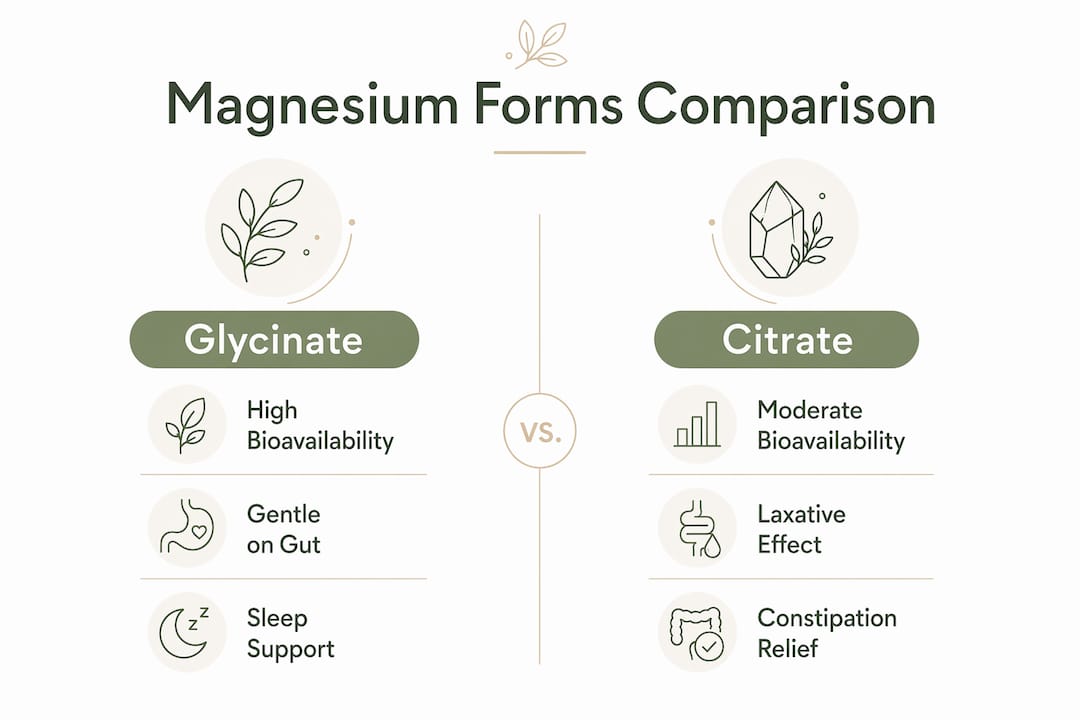
| Form | Bioavailability | GI tolerance | Best use case |
|---|---|---|---|
| Magnesium glycinate | High | Excellent | Sleep, relaxation, daily use |
| Magnesium citrate | Moderate to high | Moderate (laxative effect) | Constipation relief, general use |
| Magnesium oxide | Very low (~4%) | Poor (frequent diarrhea) | Low-cost filler, not recommended |
| Magnesium threonate | High (brain-targeted) | Good | Cognitive support, memory |
Magnesium citrate is a reasonable choice for people who need both magnesium and relief from constipation. Its moderate bioavailability makes it effective for general supplementation, but the laxative effect limits how much you can take before GI problems appear. Magnesium oxide is the most common form found in cheap multivitamins, and its roughly 4% bioavailability makes it largely ineffective for correcting deficiency. Magnesium threonate is the only form shown to cross the blood-brain barrier efficiently, which makes it interesting for cognitive applications, but it is significantly more expensive and less relevant for sleep and muscle support.
Switching to the glycinate form is a well-documented strategy for resolving diarrhea caused by other magnesium supplements without reducing total magnesium intake. This is a practical point that many people miss. If your current supplement is causing GI distress, the answer is not to take less magnesium. The answer is to take a form your body can actually absorb. For a thorough breakdown of how each form compares, the ultimate guide to magnesium glycinate covers absorption profiles and side effect considerations in detail.
What are the practical guidelines for taking magnesium glycinate safely?
Dosage and timing both matter when it comes to getting the most from magnesium glycinate. The NIH sets the tolerable upper intake level at 350 mg/day of elemental magnesium from supplements for adults. Exceeding this threshold increases the risk of diarrhea and, in rare cases with severe excess, more serious effects. Note that this limit applies to supplemental magnesium only. Dietary magnesium from food does not count toward this ceiling.
Follow these practical steps to use magnesium glycinate effectively:
- Start low and titrate up. Begin with 100 to 150 mg of elemental magnesium per day for the first week. Increase by 50 mg every five to seven days until you reach your target dose or notice any GI sensitivity.
- Time it for your goal. Take magnesium glycinate in the evening, roughly 30 to 60 minutes before bed, if your primary goal is sleep support. For muscle recovery or general supplementation, timing is more flexible.
- Stay within the NIH upper limit. Keep supplemental intake at or below 350 mg of elemental magnesium per day unless directed otherwise by a physician.
- Check for kidney conditions. People with chronic kidney disease should consult a doctor before supplementing, since impaired kidneys cannot excrete excess magnesium efficiently.
- Pair with complementary nutrients. Magnesium works alongside calcium and vitamin D in bone and muscle metabolism. A diet that includes all three supports better outcomes than magnesium alone. Magnesium also plays a documented role in bone repair and recovery, which is relevant for anyone managing musculoskeletal health.
Pro Tip: Evening intake of magnesium glycinate aligns with its relaxation and sleep-supporting properties. Taking it with a small meal or snack further reduces any residual chance of stomach discomfort.
One question that comes up regularly is: why does magnesium glycinate give me a headache? This is uncommon but not unheard of. Headaches after starting magnesium supplementation often reflect a detoxification-like adjustment response or a temporary shift in blood pressure as magnesium relaxes blood vessels. Starting at a lower dose and increasing gradually typically resolves this within one to two weeks.
Key takeaways
Magnesium glycinate is better than other supplemental forms because its chelated structure delivers higher bioavailability, fewer gastrointestinal side effects, and dual-action nervous system calming through both magnesium and glycine.
| Point | Details |
|---|---|
| Superior bioavailability | Chelation with glycine enables amino acid transport, far exceeding magnesium oxide’s ~4% absorption rate. |
| Gentler on digestion | Fewer GI side effects make it the preferred form for people sensitive to other magnesium supplements. |
| Sleep and relaxation support | Activates GABA-A receptors and glycine pathways, improving sleep quality without sedative effects. |
| Safe dosage ceiling | Stay at or below 350 mg/day of elemental magnesium from supplements per NIH guidelines. |
| Best timing for sleep | Take 30 to 60 minutes before bed, starting at a low dose and titrating upward over two weeks. |
What I have learned from watching people use magnesium glycinate
People often come to magnesium glycinate after a frustrating cycle of trying other forms, experiencing diarrhea or stomach cramps, and concluding that magnesium supplements just do not work for them. That conclusion is almost always wrong. The form was the problem, not the mineral.
What I find most interesting about magnesium glycinate is that its benefits are not dramatic in the way a pharmaceutical is dramatic. You do not feel sedated. You do not wake up foggy. What most people notice after two to three weeks is that they fall asleep faster, they feel less tense in the evenings, and their muscles recover better after exercise. Those are quiet, cumulative improvements. They are easy to dismiss if you are expecting a knockout effect.
The research gap I keep coming back to is this: most of the strongest clinical data comes from populations with documented magnesium deficiency or poor sleep at baseline. If your magnesium levels are already adequate and your sleep is generally fine, the benefits will be smaller. That is not a failure of the supplement. It is just how nutritional interventions work. You cannot meaningfully top up what is already full.
My honest recommendation is to treat magnesium glycinate as a foundation supplement rather than a quick fix. Pair it with consistent sleep habits, adequate dietary magnesium from sources like leafy greens and nuts, and realistic expectations. For stress-related sleep issues and muscle tension, it genuinely delivers. For everything else, it supports rather than solves. You can explore magnesium for stress relief to see how it fits within a broader nervous system support strategy.
— GAURAV
Support your wellness goals with Nutribliss magnesium glycinate
Nutribliss formulates its magnesium glycinate supplement with the same evidence-based standards discussed throughout this article, prioritizing elemental magnesium content, chelation quality, and clean ingredient profiles. If you have been searching for a form that delivers real absorption without the GI side effects, this is where to start.

The Nutribliss magnesium glycinate supplement is designed specifically for sleep support, muscle relaxation, and daily wellness. Every formulation decision at Nutribliss is grounded in published research, which you can review directly on the Nutribliss science page. Use #nutribliss to share your experience and connect with others on the same wellness path.
FAQ
What makes magnesium glycinate better than magnesium oxide?
Magnesium oxide has roughly 4% bioavailability, meaning most of the dose is excreted before absorption. Magnesium glycinate uses amino acid transport pathways to achieve significantly higher absorption with far fewer gastrointestinal side effects.
Why does magnesium glycinate help with sleep?
Magnesium activates GABA-A receptors to calm nervous system arousal, while glycine independently promotes slow-wave sleep. Together, they support faster sleep onset and better sleep quality without suppressing REM sleep.
How much magnesium glycinate should I take per day?
The NIH sets the tolerable upper intake level for supplemental magnesium at 350 mg of elemental magnesium per day for adults. Starting at 100 to 150 mg and titrating upward reduces the risk of any gastrointestinal side effects.
Why does magnesium glycinate give me a headache?
Headaches after starting magnesium glycinate are uncommon and typically reflect a temporary adjustment response, often related to blood vessel relaxation. Starting at a lower dose and increasing gradually over one to two weeks usually resolves this.
Is magnesium glycinate safe for long-term use?
Magnesium glycinate is considered safe for long-term use at doses within the NIH upper limit of 350 mg/day from supplements. Individuals with chronic kidney disease should consult a physician before supplementing, as impaired kidneys cannot efficiently excrete excess magnesium.