

TL;DR:
- GMP certification ensures manufacturing standards but does not guarantee supplement efficacy.
- Third-party organizations like NSF and USP verify actual GMP compliance beyond claims.
- Consumers should look for certified seals and request product-specific testing for safety.
Just because a supplement sits on a store shelf doesn’t mean it’s safe. Most consumers assume that if a product is legal to sell, someone has already checked its quality. That assumption is wrong. The dietary supplement industry is largely self-regulated, and the FDA does not pre-approve products before they hit the market. GMP certification is the manufacturing standard designed to fill that gap, and understanding what it actually means will change how you shop for supplements.
Table of Contents
- What does GMP certified mean?
- How do companies achieve GMP certification?
- Why does GMP certification matter for supplement safety?
- What are the limits of GMP certification?
- The truth about GMP: It’s a starting point, not a gold standard
- Looking for GMP certified supplements and real transparency?
- Frequently asked questions
Key Takeaways
| Point | Details |
|---|---|
| GMP = safety standard | GMP certification signals a facility uses strict safety and quality controls for supplements. |
| Certification covers processes | GMP audits focus on how supplements are made, not on individual product purity or effectiveness. |
| Third-party matters | Verified, independent audits offer better assurance than self-claimed GMP compliance. |
| Supplements are not FDA approved | Supplements are not pre-approved by the FDA even when GMP certified. |
| Pair with further testing | Best protection comes from GMP certification plus third-party finished product testing. |
What does GMP certified mean?
GMP stands for Good Manufacturing Practice. For dietary supplements sold in the United States, the specific standard is current Good Manufacturing Practice, commonly called cGMP, established under 21 CFR Part 111 by the FDA. These are legally enforceable rules that apply to every facility involved in manufacturing, packaging, labeling, or holding dietary supplements.
The FDA cGMP standards require controls across the entire supply chain, from raw material sourcing to the moment a bottle reaches a warehouse. The goal is to ensure product identity, purity, strength, and composition in every batch produced. This is critical because without these controls, a capsule labeled “500 mg of vitamin C” could contain significantly more, less, or something entirely different.
Here is a quick breakdown of what cGMP covers:
| Area covered | What it means |
|---|---|
| Raw materials | Identity and purity testing before use |
| Manufacturing processes | Written procedures and batch records |
| Equipment | Regular calibration and cleaning validation |
| Packaging and labeling | Accuracy and consistency checks |
| Sanitation | Facility cleanliness requirements |
| Record-keeping | Documented audit trail for every batch |
Key areas regulated under 21 CFR Part 111 include:
- Testing raw ingredients for identity and purity
- Written master manufacturing records
- Production and process controls
- Quality control unit approval before product release
- Sanitation programs for facilities and equipment
- Complaint and recall procedures
Important: Being “GMP certified” refers to a facility meeting these process standards, not a guarantee about one specific finished product. The certification is about how a supplement is made, not whether it works.
For a broader look at the regulatory environment around supplements, the supplement regulation overview at NutriBliss breaks down how federal oversight fits into your buying decisions.
How do companies achieve GMP certification?
Here is something that surprises most people: the FDA does not issue GMP certificates. The agency sets the legal standards and can inspect facilities, but the actual certification seals you see on supplement labels come from independent third-party organizations like NSF International, the Natural Products Association (NPA), and the United States Pharmacopeia (USP).
So what does the path to certification actually look like? Companies must build documented systems that satisfy every requirement under 21 CFR Part 111. The component testing provisions require at minimum one confirmed identity test per ingredient component before it enters production. This alone weeds out a large portion of low-quality operations.
Here are the core steps a facility typically takes:
- Qualify suppliers. Every raw material source must be evaluated for reliability and consistency.
- Test incoming components. Each ingredient undergoes identity and purity testing before any batch is made.
- Develop master manufacturing records. Every formula, process step, and specification is documented.
- Implement production controls. Staff follow written procedures for every step of manufacturing.
- Calibrate and validate equipment. Scales, mixers, and encapsulators are tested and documented regularly.
- Establish a quality control unit. An independent team reviews and approves every batch before release.
- Maintain complaint and recall systems. There must be a clear process for investigating and responding to consumer complaints.
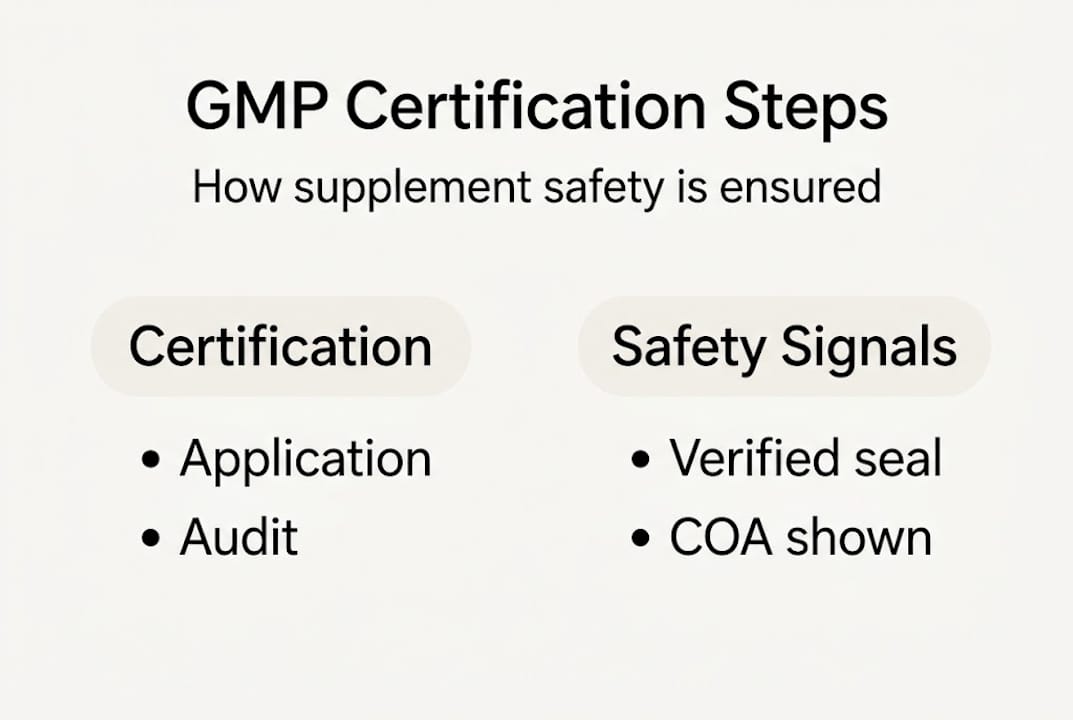
- Invite third-party audits. Organizations like NSF or USP inspect the facility against these standards independently.
The key distinction consumers need to understand is this: a company can claim GMP compliance without any outside verification. Third-party audited certification, on the other hand, requires passing a rigorous on-site inspection.
| Type of GMP claim | Who verifies it? | Level of trust |
|---|---|---|
| Self-declared “GMP compliant” | No one | Low |
| FDA inspected | FDA (periodically) | Moderate |
| Third-party GMP certified | NSF, USP, NPA | High |
Pro Tip: Before you buy, search the brand name plus “NSF” or “USP” in the certifying body’s public database. If the facility is listed, the certification is real. If it’s not, that label claim may be unverified.
For a practical rundown on what to check before you purchase, the GMP safety checklist covers the key questions to ask any supplement brand. The nutritional supplements checklist goes even further into what separates quality products from the rest.
Why does GMP certification matter for supplement safety?
GMP certification isn’t just a business formality. It has direct consequences for what ends up in your body every morning when you take your supplements.

Facilities operating under cGMP consumer protections must actively minimize contamination risks, including heavy metals like lead and arsenic, harmful microbes, and cross-contamination from other products manufactured in the same facility. These are risks that are genuinely invisible to the average buyer.
Here is what GMP certification practically delivers for you:
- Contamination control. Processes are designed to reduce heavy metals, bacteria, mold, and cross-ingredient contamination.
- Label accuracy. The dose stated on the label is backed by formulation and process controls.
- Batch-to-batch consistency. What you buy today should behave the same as what you bought last month.
- Documented accountability. If something goes wrong, there’s a paper trail to identify the source.
- Reduced fraud risk. Certified facilities can’t quietly swap cheaper ingredients without violating their compliance obligations.
Key fact: The FDA does not pre-approve dietary supplements before sale. GMP certification is the built-in safety system that manufacturers must implement on their own.
When you’re looking at two similar products side by side, a GMP-certified facility is a meaningful signal that the company has invested in quality controls beyond the legal minimum. The tips in this guide on selecting GMP certified supplements can help you translate this knowledge into smarter buying habits.
Pro Tip: Check the certificate of analysis (COA) for any supplement you’re considering. Reputable GMP-certified brands will provide these on request or post them directly on their website.
If you want to learn how to read quality signals on labels and lab reports, supplement quality evaluation is a strong next resource.
What are the limits of GMP certification?
GMP certification is valuable, but it has clear limits that every informed supplement buyer should understand.
First and most important: GMP covers how a supplement is manufactured, not whether it actually works. A facility can follow every GMP requirement perfectly and still sell a product that has no clinically proven benefit. The certification says nothing about efficacy.
Second, GMP certification applies to the manufacturing facility and its processes, not to individual products off the line. As noted by supplement quality researchers, GMP does not guarantee purity for every bottle without product-specific testing. Facilities are audited periodically, not on every single production run.
Third, anyone can claim GMP compliance without independent verification. There’s no legal barrier to printing “GMP Compliant” on a label. The phrase means very little without a named third-party auditor behind it.
What GMP certification does NOT cover:
- Individual product efficacy or clinical effectiveness
- Finished product purity testing on every batch released
- Contaminants not included in the testing plan
- Accuracy of health claims on the label
- Verification that an ingredient actually provides its stated benefit
Bottom line: GMP tells you how a product was made. It does not tell you what the product can do for you, or that every bottle off the line is clean.
To get full assurance, combine GMP certification with independent third-party supplement testing from organizations that test the finished product itself. You can also explore supplement quality label nuances to understand the fine print behind the seals you see on packaging.
The truth about GMP: It’s a starting point, not a gold standard
After years of working in the supplement space, here is the perspective we’ve landed on: GMP certification is non-negotiable, but treating it as the finish line is a mistake.
GMP sets a strong floor for manufacturing safety. It eliminates many of the most avoidable risks, sloppy ingredient handling, undocumented processes, and unchecked contamination sources. For that reason alone, we would never sell a product made in a non-GMP facility.
But the consumers who are truly protected are the ones who stack their criteria. They look for GMP certification and third-party product testing from NSF, USP, or NPA. They ask for certificates of analysis. They check whether the brand publishes its manufacturing standards openly.
As independent analysis confirms, GMP-certified supplements carry lower risk of manufacturing defects and contaminants compared to non-certified products, but they don’t replace product-specific testing for purity and accuracy. The brands worth trusting are the ones that don’t ask you to stop at GMP alone.
When you’re choosing effective supplements, think of GMP as step one of a two-step process. Step two is finding brands that voluntarily go further.
Looking for GMP certified supplements and real transparency?
Knowing what GMP certification means is only useful if you can find brands that actually meet the standard and then go beyond it. At NutriBliss, we believe transparency isn’t optional. Our products are made to clear manufacturing standards, and we’re committed to explaining the science behind what we sell.

Head to our our science standards page to see exactly how we approach ingredient sourcing and product safety. If you’re curious about specific product lines, the superfoods collection quality page walks through how our formulas are built. Ready to browse? Explore the full range of NutriBliss supplements and shop with the confidence that comes from knowing what you’re looking for.
Frequently asked questions
How can I check if a supplement is truly GMP certified?
Look for third-party audited GMP seals from NSF, NPA, or USP on the packaging, and verify the certification in those organizations’ public databases. Self-declared “GMP compliant” labels carry no independent verification, so always look for third-party seals over brand self-claims.
Does GMP certification guarantee a supplement works as advertised?
No. GMP only assures that the manufacturing process meets safety and consistency standards, not that the product is clinically effective. As GMP certification clarifies, it covers facilities and processes, not individual product efficacy or complete purity assurance.
Does the FDA inspect or certify GMP supplement facilities?
The FDA sets and enforces GMP regulations and can conduct inspections, but it does not issue certificates or pre-approve supplements before they go to market.
Is GMP certification required for all dietary supplements sold in the U.S.?
Yes. All U.S. supplement manufacturers must follow GMP regulations under 21 CFR 111.1, though not all facilities seek or obtain independent third-party audited certification on top of the legal baseline.