

TL;DR:
- Fish oil pills are concentrated sources of omega-3 fatty acids that support heart, brain, and joint health. To see significant benefits, taking therapeutic doses of EPA and DHA consistently over time is necessary, especially for triglyceride reduction and cognitive health. Proper dosing, formulation, and combining with diet improve the effectiveness and safety of fish oil supplementation.
Fish oil pills are concentrated sources of omega-3 fatty acids, specifically eicosapentaenoic acid (EPA) and docosahexaenoic acid (DHA), and research confirms they support heart health, cognitive function, and joint wellness. Understanding what fish oil pills are good for goes beyond a simple list of benefits. The evidence behind these supplements spans meta-analyses of tens of thousands of participants, clinical guidelines from the American Heart Association, and emerging research on dementia prevention. This guide breaks down what the science actually says, what dosages work, and how to take fish oil effectively without wasting money on underdosed capsules.
How do fish oil pills benefit heart health?
Fish oil’s most clinically proven benefit is triglyceride reduction. Consuming over 2 grams of combined EPA and DHA daily lowers triglycerides by 15% to 30%, confirmed by a meta-analysis of 90 trials with more than 72,000 participants. That is a meaningful reduction for anyone managing cardiovascular risk, particularly people with obesity or existing heart disease.
The mechanism is straightforward. EPA and DHA reduce the liver’s production of very-low-density lipoprotein (VLDL), which carries triglycerides into the bloodstream. Fish oil also carries mild anti-inflammatory effects that contribute to cardiovascular protection by reducing arterial inflammation over time. These two pathways work together, making omega-3 supplementation a recognized tool in heart health management.
The American Heart Association recommends omega-3 supplementation for people with elevated triglycerides, and clinicians often prescribe prescription-strength EPA formulations for high-risk patients. Standard over-the-counter fish oil capsules can support this goal, but the dosing math matters enormously.
Key cardiovascular benefits of fish oil include:
- Triglyceride reduction of 15% to 30% at therapeutic doses
- Reduced arterial inflammation through EPA and DHA’s anti-inflammatory pathways
- Cardiovascular risk support for people with heart disease or obesity
- Complementary role alongside diet and standard medical treatment
Pro Tip: Most standard fish oil capsules contain only 300 mg of combined EPA and DHA per 1,000 mg capsule. To reach the therapeutic threshold of 2,000 mg EPA+DHA, you may need 6 to 9 capsules daily. Always check the EPA+DHA content on the label, not just the total fish oil weight.
What are the cognitive and brain health benefits of fish oil?
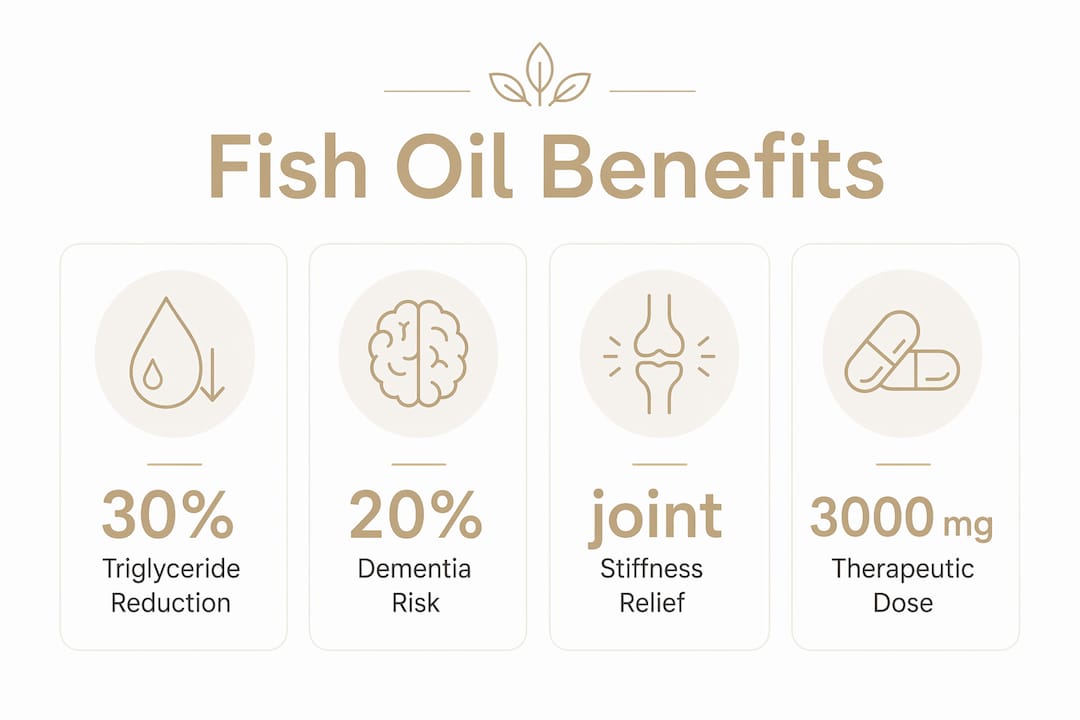
DHA is the dominant structural fat in the human brain, making omega-3 intake directly relevant to cognitive health. Long-term omega-3 intake may lower all-cause dementia risk by about 20%, based on a meta-analysis of over 2,400 participants showing significant cognitive improvements and reduced dementia risk. That figure represents a meaningful protective effect for a condition with limited pharmaceutical options.

The benefits are most pronounced in people with mild cognitive impairment rather than advanced dementia. Omega-3 supplementation improves processing speed, memory recall, and attention in this group. Duration matters: short-term supplementation of a few weeks shows minimal effect, while consistent intake over months produces measurable improvements.
Research also points to gene-environment interactions. Peripheral omega-3 biomarkers may predict cognitive decline, and people carrying the APOE4 genotype, which raises Alzheimer’s risk, may respond differently to supplementation than the general population. This makes personalized guidance from a healthcare provider especially valuable for cognitive health goals.
| Cognitive benefit | Evidence level | Notes |
|---|---|---|
| Dementia risk reduction (~20%) | Meta-analysis, 2,400+ participants | Long-term intake required |
| Mild cognitive impairment improvement | Multiple clinical trials | Most benefit in early-stage decline |
| Processing speed and memory | Dose-dependent | Consistent supplementation over months |
| Alzheimer’s prevention potential | Emerging research | APOE genotype may influence response |
For readers interested in the science of omega-3 fatty acids and how they support brain function, the research base is growing rapidly and the findings are worth understanding before choosing a supplement.
How does fish oil help with inflammation and joint health?
Fish oil reduces inflammation at the cellular level by shifting the body’s production of eicosanoids toward less inflammatory compounds. This mechanism explains why omega-3 supplementation consistently shows up in research on inflammatory conditions, particularly rheumatoid arthritis.
EPA-rich omega-3 supplementation reduces joint tenderness and morning stiffness in inflammatory arthritis at doses of approximately 1 gram per day or higher. Clinical studies show these improvements occur when fish oil is used alongside standard medical treatment, not as a replacement for it. The relief is real but works best as part of a broader treatment plan.
Here is how to get the most from fish oil for joint health:
- Choose EPA-dominant formulations. EPA drives the anti-inflammatory response more directly than DHA for joint conditions. Look for supplements where EPA content exceeds DHA on the label.
- Commit to at least 12 weeks. Anti-inflammatory effects from omega-3 supplementation build gradually. Short trials of four to six weeks often show minimal results.
- Pair with your existing treatment. Fish oil works best alongside prescribed medications for rheumatoid arthritis, not instead of them. Discuss integration with your doctor.
- Track morning stiffness duration. This is the most reliable self-reported marker of improvement. Record it weekly to gauge whether your dose is working.
Pro Tip: If you experience joint discomfort after exercise, omega-3’s role in fitness recovery extends beyond arthritis. EPA and DHA reduce exercise-induced inflammation, which can shorten recovery time between training sessions.
What are practical considerations for taking fish oil pills safely?
Dosing is the most commonly misunderstood aspect of fish oil supplementation. Fish oil supplements up to 3 grams of combined EPA and DHA daily are generally safe for adults. Above that threshold, clinicians recommend medical supervision because higher doses can slightly increase LDL cholesterol in some people.
The gap between what a label says and what a capsule delivers trips up many people. A “1,000 mg fish oil” capsule typically contains only 300 mg of actual EPA+DHA. The remaining 700 mg is other fats. This means reaching a therapeutic dose for triglyceride reduction requires far more capsules than most people expect.
Practical guidance for effective and safe supplementation:
- Read the EPA+DHA content, not the total fish oil weight, when comparing products
- Split your daily dose across two meals to reduce burping and nausea
- Take capsules with food to slow digestion and minimize gastrointestinal discomfort
- Store capsules in the refrigerator to slow oxidation and preserve potency
- Do not exceed 3 grams of combined EPA+DHA daily without medical guidance
Taking fish oil with meals or splitting the dose across the day reduces gastrointestinal discomfort like burping and nausea, according to Johns Hopkins Medicine. This simple timing adjustment makes a meaningful difference in tolerability for most people.
Whole food sources of omega-3 also deserve a place in your routine. Eating fatty fish twice a week delivers cardioprotective nutrients not found in isolated fish oil pills, including selenium and arginine. Foods like mackerel, sardines, and salmon provide a nutrient matrix that supplements alone cannot replicate.
| Approach | EPA+DHA delivery | Additional nutrients |
|---|---|---|
| Standard fish oil capsule (1,000 mg) | ~300 mg EPA+DHA | None beyond omega-3s |
| High-potency fish oil capsule | 500–800 mg EPA+DHA | None beyond omega-3s |
| Fatty fish (salmon, sardines, mackerel) | Variable, diet-dependent | Selenium, arginine, protein |
Key Takeaways
Fish oil pills deliver their strongest, most research-backed benefits at therapeutic doses of EPA and DHA, not at the low amounts found in most standard capsules.
| Point | Details |
|---|---|
| Heart health requires therapeutic dosing | Over 2,000 mg EPA+DHA daily lowers triglycerides by 15% to 30%. |
| Cognitive protection builds over time | Long-term omega-3 intake may reduce dementia risk by about 20%. |
| Joint relief needs EPA-dominant formulas | EPA-rich supplements reduce joint tenderness at doses of ~1 gram per day or higher. |
| Label math matters | A 1,000 mg fish oil capsule typically contains only ~300 mg of actual EPA+DHA. |
| Whole fish adds what pills cannot | Fatty fish delivers selenium and arginine, nutrients absent from isolated supplements. |
Why I think most people are taking fish oil wrong
Most people buy a bottle of fish oil, take one capsule a day, and wonder why they see no results after a month. The problem is not the supplement. The problem is the dose and the expectation.
The research on fish oil is genuinely strong, particularly for triglycerides and cognitive support. But the benefits are dose-dependent and time-dependent. One standard capsule delivering 300 mg of EPA+DHA does almost nothing for cardiovascular risk. You need to read the label, do the math, and commit to a consistent routine for months, not weeks.
What I have found works is treating fish oil as one layer of a broader nutrition strategy, not a standalone fix. Fatty fish twice a week, a high-potency supplement on other days, and a healthcare provider who knows your lipid panel. That combination produces results. Supplements alone, taken casually, rarely do.
The mood benefit angle is also worth tempering. EPA-rich fish oil shows modest benefit for clinical depression when taken alongside antidepressants, but it is not a mood booster for everyone. If you are taking fish oil hoping to feel happier, the evidence does not support that expectation for the general population.
Quality matters more than most people realize. A rancid or underdosed product delivers none of the benefits and may cause unnecessary side effects. When I look for a supplement, I prioritize verified EPA+DHA content, third-party testing, and a brand that publishes its science. That is where products like those from #nutribliss stand out. Transparency about what is actually in the capsule is non-negotiable.
— GAURAV
Nutribliss omega-3 supplements for your health goals

Nutribliss formulates its omega-3 fish oil supplements with verified EPA and DHA content, so you know exactly what you are getting per capsule. The products align with the evidence covered in this guide: heart health support, cognitive function, and inflammation management, all backed by the science Nutribliss publishes openly. Explore the full range of Nutribliss supplements to find the right omega-3 option for your goals. For readers who want to understand the research behind the formulations, the science behind superfoods page walks through the evidence in plain language.
FAQ
What does fish oil do for your heart?
Fish oil lowers triglycerides by 15% to 30% at doses above 2,000 mg of combined EPA and DHA daily. It also reduces arterial inflammation, which contributes to long-term cardiovascular protection.
How many fish oil pills should I take per day?
The right number depends on the EPA+DHA content per capsule, not the total fish oil weight. Most standard capsules contain only ~300 mg of EPA+DHA, so reaching a therapeutic dose often requires multiple capsules daily.
Can fish oil improve memory and reduce dementia risk?
Long-term omega-3 intake is associated with roughly a 20% reduction in dementia risk and measurable improvements in cognitive function for people with mild impairment. Benefits require consistent supplementation over months.
Does fish oil help with joint pain?
EPA-rich omega-3 supplements reduce joint tenderness and morning stiffness in inflammatory arthritis at doses of approximately 1 gram per day or higher. Results are best when fish oil is used alongside standard medical treatment.
Are there side effects from taking fish oil pills?
The most common side effects are a fishy aftertaste, burping, and mild nausea. Splitting doses across meals significantly reduces these issues. Adults should stay at or below 3 grams of combined EPA+DHA daily without medical supervision.